
 100% FREE ACCESS
11th Standard Syllabus & Materials
11th Standard
TN 11th Tamil இயற்கை வேளாண்மை,சுற்றுச்சூழல் -செய்யுள் - மனோன்மணீயம் Important Questions And Answers Study Material - QB365 Set A
NEW11th Standard
TN 11th Tamil என்னுயிர் என்பேன் -துணைப்பாடம் - இசைத்தமிழர் இருவர் Important Questions And Answers Study Material - QB365 Set A
NEW11th Standard
TN 11th Tamil மொழி கலை -செய்யுள் - ஒவ்வொரு புல்லையும் Important Questions And Answers Study Material - QB365 Set A
NEW11th Standard
TN 11th Tamil பீடு பெற நில் - இலக்கணம் - பகுபத உறுப்புகள் Important Questions And Answers Study Material - QB365 Set A
NEW11th Standard
TN 11th Tamil பீடு பெற நில் - துணைப்பாடம் - வாடிவாசல் Important Questions And Answers Study Material - QB365 Set A
NEW11th Standard
TN 11th Tamil பீடு பெற நில் - செய்யுள் - குறுந்தொகை Important Questions And Answers Study Material - QB365 Set A

Published on: 30/09/2018
Important 5m questions
Download Tamil Nadu 11th Standard Maths question papers, model tests, one-mark questions, important questions, and public exam papers in PDF format. Free study materials and answer keys for TN State Board students.
Questions + Answers key
Take MCQ Maths Test1.
Find the points at which f is discontinuous. At which of these points f is continuous from the right, from the left, or neither? Sketch the graph of . \(f(x)= \begin{cases}(x-1)^{3}, & \text { if } x<0 \\ (x+1)^{3}, & \text { if } x \geq 0\end{cases}\)
2.
At the given point xo discover whether the given function is continuous or discontinuous citing the reasons for your answer :\(x_{0}=3, f(x)= \begin{cases}\frac{x^{2}-9}{x-3}, & \text { if } x \neq 3 \\ 5, & \text { if } x=3\end{cases}\)
3.
Evaluate : \(lim_{x \rightarrow {\pi\over 4}}{4\sqrt{2}-(cos \ x+sin \ x)^5\over 1-sin 2x}\)
4.
Evaluate the following limits :
\(lim_{x-1}{3\sqrt{7+x^3}-\sqrt{3+x^2}\over x-1}\)
5.
If \(\vec{a}=2 \hat{i}+3 \hat{j}-4 \hat{k}, \vec{b}=3 \hat{i}-4 \hat{j}-5 \hat{k} \text {, and } \vec{c}=-3 \hat{i}+2 \hat{j}+3 \hat{k} \text {, }\) find the magnitude and direction cosines of \((i)\ \vec{a}+\vec{b}+\vec{c}\ (ii)\ 3 \vec{a}-2 \vec{b}+5 \vec{c}.\)
6.
Show that the vectors 2\(\hat{i}\) − \(\hat{j}\) + \(\hat{k}\), 3 \(\hat{i}\) − 4\(\hat{j}\) - 4\(\hat{k}\), \(\hat{i}\) − 3\(\hat{j}\) - 5 \(\hat{k}\) form a right angled triangle.
7.
Let A, B and C be the vertices of a triangle. Let D, E, and F be the midpoints of the sides BC, CA, and AB respectively. Show that \(\overrightarrow{AD}\) + \(\overrightarrow{BE}\) +\(\overrightarrow{CF}\) = \(\overrightarrow{0}\).
8.
9.
Let \(\vec a\) and \(\vec b\) be the position vectors of the points A and B. Prove that the position vectors of the points which trisects the line segment AB are \(\frac{\vec{a}+2 \vec{b}}{3} \text { and } \frac{\vec{b}+2 \vec{a}}{3} \text {. }\)
10.
Evaluate the following limits :\(lim_{x\rightarrow 0}{2^x-3^x\over x}\)
11.
Calculate \(lim_{x\rightarrow0}{1\over (x^2+x^3)}\)
12.
Let \(f(x)= \begin{cases}x+1, & x>0 \\ x-1, & x<0\end{cases}\)
Verify the existence of limit as x\(\rightarrow\)0.
13.
Find the direction cosines and direction ratios for the following vectors.3\(\hat{i}\) - 3\(\hat{k}\) + 4\(\hat{j}\)
14.
State how continuity is destroyed at x= x o for each of the following graphs.
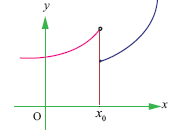
15.
State how continuity is destroyed at x = x o for each of the following graphs.
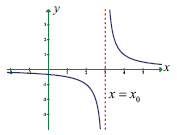
16.
Evaluate the following limits :
\(lim_{x\rightarrow1}{x^m-1\over x^n-1}\) ,m and n are integers.
17.
Use the graph to find the limits (if it exists). If the limit does not exist, explain why?
\(lim_{x\rightarrow{0}}sec \ x\)
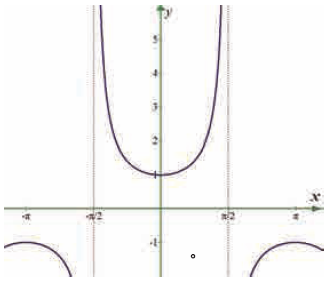
18.
Use the graph to find the limits (if it exists). If the limit does not exist, explain why?
\(lim_{x\rightarrow1}(x^2+2)\)
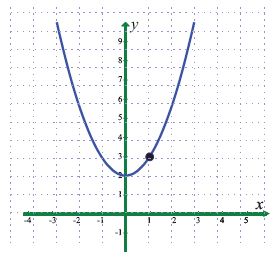
19.
Calculate \(\lim _{ x\rightarrow0}{|x| } \).
20.
Find \(\overrightarrow{a}\).\(\overrightarrow{b}\)when \(\overrightarrow{a}=\hat{i}-2\hat{j}+\hat{k}\) and \(\overrightarrow{b}=3\hat{i}-4\hat{j}-2\hat{k}\)
21.
The function \(f(x)= \begin{cases}\frac{x^{2}-1}{x^{3}+1} & x \neq-1 \\ P & x=-1\end{cases}\)is not defined for x = −1. The value of f(−1) so that the function extended by this value is continuous is
\({2\over3}\)
-\({2\over3}\)
1
0
22.
\(lim_{n \rightarrow \infty}({1\over n^2}+{2\over n^2}+{3\over n^2}+..+{n\over n^2})\) is
\(1\over 2\)
0
1
\(\infty\)
23.
\(lim_{x\rightarrow o}{8^x-4^x-2^x+1^x\over x^2}=\)
2 log 2
2( log2)2
log 2
3 log 2
24.
If \(\overrightarrow{a}=\hat{i}+2\hat{j}+2\hat{k},|\overrightarrow{b}|=5\) and the angle between \(\overrightarrow{a}\) and \(\overrightarrow{b}\) is \({\pi\over 6},\) then the area of the triangle formed by these two vectors as two sides, is
\(7\over4\)
\(15\over4\)
\(3\over4\)
\(17\over4\)
25.
If \(\lambda \hat{i}+2\lambda \hat{j}+2\lambda \hat{k}\) is a unit vector, then the value of \(\lambda\) is
\({1\over3}\)
\({1\over4}\)
\({1\over9}\)
\({1\over2}\)
1.
Given \(f(x)= \begin{cases}(x-1)^{3}, & \text { if } x<0 \\ (x+1)^{3}, & \text { if } x \geq 0\end{cases}\)
\(lim_{x\rightarrow 0^-}f(x)=lim_{x\rightarrow 0^-}(x-1)^3=(0-1)^3=-1\)
\(lim_{x\rightarrow 0^+}f(x)=lim_{x\rightarrow 0^+}(x+1)^3=(0+1)^3=1\)
Also, f(0)=(x+1)3=(0+1)3=1
\(\therefore lim_{x\rightarrow 0^-}f(x)\neq lim_{x\rightarrow 0^+}f(x)=f(0)\)
\(\therefore f(x)\) is not continuous at x=0
| x | -1 | -2 | 0 | 1 | 2 |
| f(x) | (x-1)3 -8 |
(x-1)3 -27 |
(x+1)3 1 |
(x+1)3 8 |
(x+1)3 27 |
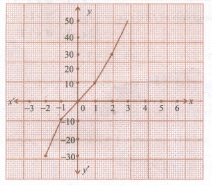
2.
Given \(x_{0}=3, f(x)= \begin{cases}\frac{x^{2}-9}{x-3}, & \text { if } x \neq 3 \\ 5, & \text { if } x=3\end{cases}\)
\(lim_{x\rightarrow 3^-}f(x)=lim_{x\rightarrow 3^-}{x^2-9\over x-3}=lim_{x\rightarrow 3^-}{(x+3)(x-3)\over x-3}=lim_{x\rightarrow 3^-}x+3=6\)
\(lim_{x\rightarrow 3^+}f(x)=lim_{x\rightarrow 3^+}{x^2-9\over x-3}=lim_{x\rightarrow 3^+}(x+3)=6\)
But f(3)=5
\(\therefore lim_{x\rightarrow 3^-}f(x)=lim_{x\rightarrow 3^+}f(x)\neq f(3)\)
\(\therefore f(x)\) continuous at xo=3
3.
\({4\sqrt{2}-(cos \ x+sin \ x)^5\over 1-sin 2x}={2^{5\over2}-[(cos x+sin x)^2]^{5\over2}\over 1-sin 2x}\)
\(={2^{5\over2}-(1+sin 2x)^{5\over2}\over 2-(1+sin 2x)}\)
\(={2^{5\over2}-(1+sin 2x)^{5\over2}\over 2-(1+sin 2x)}\)
Therefore, \(lim_{x \rightarrow {\pi\over 4}}{2^{5\over2}-[(cos x+sin x)^2]^{5/2}\over 2-[1+sin 2x]}\)=\(lim_{x \rightarrow {\pi\over 4}}{2^{5\over2}-[1+sin 2x]^{5\over2}\over 2-(1+sin 2x)}\)
Take y = 1 + sin2x. As \(x\rightarrow{\pi\over 4},y \rightarrow 2\)
\(=lim_{y\rightarrow 2}{2^{5\over2}-y^{5\over2}\over 2-y}\)
\(={5\over2}.2^{{5\over2}-1}={5\over2}\times 2^{3\over2}=5\sqrt{2}\).
4.
\(lim_{x-1}{3\sqrt{7+x^3}-\sqrt{3+x^2}\over x-1}\)\(=lim_{x-1}{({7+x^3})^{1\over3}-8^{1\over3}\over 7+x^3-8} \times{x^3-1\over x-1}-{(3+x^2)^{1\over2}-4^{1\over2}\over 3+x^2-4}\times {x^2-1\over x-1}\)|

[\(\because\) when x\(\rightarrow\) 1, x3 \(\rightarrow\) 1 and 7 + x3\(\rightarrow\) 7+ 1 = 8, also when x \(\rightarrow\) 1, x2 \(\rightarrow\) 1 and 3 + x2\(\rightarrow\) 4]\(=lim_{7+x^3\rightarrow8}{({7+x^3})^{1\over3}-8^{1\over3}\over 7+x^3-8} (x^2+x+1)-lim_{3+x^2\rightarrow4}{(3+x^2)^{1\over2}-4^{1\over2}\over 3+x^2-4}\times(x+1)\)
\({1\over3}(8)^{{1\over3}-1}(1^2+1+1)-{1\over2}(4^{{1\over2}-1})(1+1)\) \([\because lim_{x \rightarrow a}x^na^n=na^{n-1}]\)
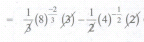
\(={1\over 8^{2\over3}}-{1\over 4^{1\over2}}={1\over (2^{3})^{2\over3}}-{1\over (2^{2})^{1\over2}}\)\(={1\over2^2}-{1\over2}={1\over4}-{1\over2}\)
\(={1-2\over4}={-1\over4}\)
\(\)
5.
(i) Given \(\overrightarrow { a } =2\hat { i } +3\hat { j } -4\hat { k } \)
\(\overrightarrow { b } =3\hat { i } -4\hat { j } -5\hat { k } \) and
\(\overrightarrow { c } =-3\hat { i } +2\hat { j } +3\hat { k }\)
\(\overrightarrow { a } +\overrightarrow { b } +\overrightarrow { c } =(2\hat { i } +3\hat { j } -4\hat { k } )+(3\hat { i } -4\hat { j } -5\hat { k } )+(-3\hat { i } +2\hat { j } +3\hat { k } )\)
\(=2\hat { i } +\hat { j } -6\hat { k } \)
\(|\overrightarrow { a } +\overrightarrow { b } +\overrightarrow { c } |=\sqrt { { 2 }^{ 2 }+{ 1 }^{ 2 }+{ (-6) }^{ 2 } } =\sqrt { 4+1+36 } =\sqrt { 41 } \)
Direction cosines of \(\left( \overrightarrow { a } +\overrightarrow { b } +\overrightarrow { c } \right) \) is \(\frac { 2 }{ \sqrt { 41 } } ,\frac { 1 }{ \sqrt { 41 } } ,\frac { -6 }{ \sqrt { 41 } } \)
\(\text {(ii) } 3 \vec{a}-2 \vec{b}+5 \vec{c}\)
\(3 \vec{a}-2 \vec{b}+5 \vec{c} =3(2 \hat{i}+3 \hat{j}-4 \hat{k})-2(3 \hat{i}-4 \hat{j}-5 \hat{k})+5(-3 \hat{i}+2 \hat{j}+3 \hat{k})\)
\(=6 \hat{i}+9 \hat{j}-12 \hat{k}-6 \hat{i}+8 \hat{j}+10 \hat{k}-15 \hat{i}+10 \hat{j}+15 \hat{k}\)
\(=-15 \hat{i}+27 \hat{j}+13 \hat{k}\)
\(|3 \vec{a}-2 \vec{b}+5 \vec{c}| =\sqrt{(-15)^2+(27)^2+(13)^2} \)
\(=\sqrt{225+729+169}=\sqrt{1123}\)
\(\text {Direction cosines are }\left(\frac{-15}{\sqrt{1123}}, \frac{27}{\sqrt{1123}}, \frac{13}{\sqrt{1123}}\right)\)
6.
Let the sides of the triangle be \(\hat{a}=\) 2\(\hat{i}\) − \(\hat{j}\) + \(\hat{k}\), \(\hat{b}=\) 3 \(\hat{i}\) − 4\(\hat{j}\) - 4\(\hat{k}\), \(\hat{c}=\) \(\hat{i}\) −3\(\hat{j}\) - 5 \(\hat{k}\)
\(|\hat{a}|=\sqrt{2^2+(-1)^2+1^2}=\sqrt{4+1+1}=\sqrt{6}\)
\(|\overrightarrow{b}|=\sqrt{3^2+(-4)^2+(-4)^2}=\sqrt{9+16+16}=\sqrt{41}\)
\(|\hat{c}|=\sqrt{1^2+(-3)^2+(-5)^2}=\sqrt{1+9+25}=\sqrt{35}\)
Now \(|\overrightarrow{b}|^2=(\sqrt{41})^2=41=35+6(\sqrt{35})^2+(\sqrt{6})^2=|\hat{a}|^2 +|\hat{c}|^2\)
By Pythagoras theorem, the given vectors from a right angled triangle.
7.
Let the position vector of the vertices of the \(\triangle\)ABC be \(\overrightarrow{a},\overrightarrow{b}\)and \(\overrightarrow{c}\) respectively.
Since D is the mid-point of BC.
\(\Rightarrow \overrightarrow{OD}={\overrightarrow{b}+\overrightarrow{c}\over 2}\)
E is the mid-point of AC,
\(\Rightarrow \overrightarrow{OE}={\overrightarrow{a}+\overrightarrow{c}\over 2}\)
and F is the mid-point of AB
\( \overrightarrow{OF}={\overrightarrow{a}+\overrightarrow{b}\over 2}\)
To prove that \(\overrightarrow{AD}+\overrightarrow{BE}+\overrightarrow{CF}=\overrightarrow{o}\)
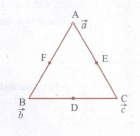
LHS=\(\overrightarrow{AD}+\overrightarrow{BE}+\overrightarrow{CF}=\overrightarrow{OD}-\overrightarrow{OA}+\overrightarrow{OE}-\overrightarrow{OB}+\overrightarrow{OF}+\overrightarrow{OC}\)
\(={\overrightarrow{b}+\overrightarrow{c}\over 2}=\overrightarrow{a}+{\overrightarrow{a}+\overrightarrow{c}\over 2}-\overrightarrow{b}\)+\({\overrightarrow{a}+\overrightarrow{b}\over 2}-\overrightarrow{c}\)
\(={\overrightarrow{b}+\overrightarrow{c}-2\overrightarrow{a}+\overrightarrow{a}+\overrightarrow{c}-2\overrightarrow{b}+\overrightarrow{a}+\overrightarrow{b}-2\overrightarrow{c}\over 2}\) \(={\overrightarrow{0}\over2}=\overrightarrow{0}=RHS\)
Hence proved.
8.
9.
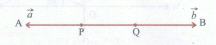
Let \(\overrightarrow{a}\) and \(\overrightarrow{b}\) be the position vectors of the points A and B.
\(\Rightarrow \overrightarrow{OA}=\overrightarrow{a}\) and \( \overrightarrow{OB}=\overrightarrow{b}\).
Let P divides the line segment AB in the ratio 1:2 and Q divides the line segment AB in the ratio 2 : 1
\(\therefore \overrightarrow{OP}={1.(\overrightarrow{OB})+2(\overrightarrow{OA})\over 1+2}={1(\overrightarrow{b})+2(\overrightarrow{a})\over 3}={\overrightarrow{b}+2\overrightarrow{a}\over 3}\)
and \( \overrightarrow{OQ}={2(\overrightarrow{OB})+1(\overrightarrow{OA})\over 2+1}={2\overrightarrow{b}+\overrightarrow{a}\over 3}={\overrightarrow{a}+2\overrightarrow{b}\over 3}\)
Hence, the required position vectors are \({\overrightarrow{b}+2\overrightarrow{a}\over 3}\)and \({\overrightarrow{a}+2\overrightarrow{b}\over 3}\).
10.
\(lim_{x\rightarrow 0}{2^x-3^x\over x}=lim_{x\rightarrow0}{2^x-1-3^x+1\over x}\) [Adding and subtracting 1 in the numerator]
\(lim_{x\rightarrow 0}{2^x-1\over x}-{(3^x+1)\over x}=lim_{x\rightarrow0}{2^x-1\over x}-lim_{x\rightarrow0}({3^x-1\over x})\)
\(=log2-log3\) \([\because lim_{x\rightarrow 0}{a^x-1\over x}=log \ a]\)
\(=log({2\over3})\)
\(\therefore lim_{x\rightarrow 0}{2^x-3^x\over x}=log({2\over3})\)
11.
One can tabulate values of x near 0 (from either side) and conclude \(f(x)={1\over x^2+x^3}\) grows without bound and hence \(f(x)\rightarrow \infty as \ x\rightarrow 0.\)
To calculate this limit without making a table, we first divide the numerator and denominator by x2. This division can be done, since in the calculation of the limit x ≠ 0 and hence x2 ≠ 0. We can have
\(lim_{x\rightarrow 0}{1\over x^2+x^3}=lim_{x\rightarrow 0}{{1\over x^2}\over{x^2+x^3\over x^2}}={lim_{x\rightarrow}({1\over x^2})\over lim_{x\rightarrow0}(1+x)}\)
Now \({1\over 8}\rightarrow \infty as \ x\rightarrow 0\) and \(lim_{x\rightarrow0}(1+x)=1\) .
Thus the numerator grows without bound while the denominator approaches 1, implying that \({1\over (x^2+x^3)}\) does tend to infinity.
12.
The function is graphed
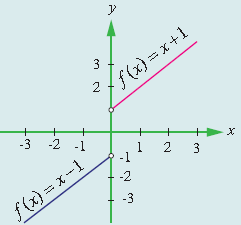
Clearly \(lim_{x\rightarrow 0^-}f(x)=-1\) and \(lim_{x\rightarrow 0^+}f(x)=1\) .
Since these limits are different, \(lim_{x\rightarrow 0}f(x)\) does not exist.
13.
The given vector is 3\(\hat{i}\) - 3\(\hat{k}\) + 4\(\hat{j} \Rightarrow\) 3\(\hat{i}\) + 4\(\hat{j}\) - 3\(\hat{k}\)
The direction ratios are 3, 4, -3.
r = \(\sqrt{x^2+y^2+z^2}=\sqrt{3^2+4^2+(-3)^2}\)
\(=\sqrt{9+16+9}=\sqrt{34}\)
Hence, the direction cosines are \({3\over \sqrt{34}},{4\over \sqrt{34}},{-3\over \sqrt{34}}\)
14.
The left-hand limit and right-hand limit does not coincide at x=xo.
15.
The limit of f(x) does not exist at x = xo.
16.
\(lim_{x\rightarrow1}{x^m-1\over x^n-1}\)
Multiplying and dividing by (x - 1) we get,
\(lim_{x\rightarrow1}{x^m-1^m\over x-1} \times { x-1\over x^n-1^n}=\)\((lim_{x\rightarrow1}{x^m-1^m\over x-1}) \times lim_{x\rightarrow1} {1\over ({x^n-1^n\over x-1})}\)
\(=m.(1)^{m-1}\times {1\over n(1)^{n-1}}={m \over n}\) \([\because lim_{x\rightarrow a}{x^n-a^n\over x-a}=n.a^{n-1}]\)
17.
\(lim_{x\rightarrow{0}}sec \ x\)
At x = 0, the curve meets the y-axis at 1.
\(\therefore lim_{x\rightarrow{0}}sec \ x=1\)
18.
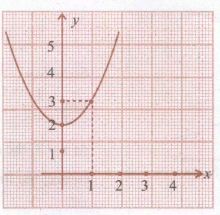
\(lim_{x\rightarrow1}(x^2+2)\)
Atx = 1, the value of the curve on y-axis is 3.
\(\therefore lim_{x\rightarrow1}(x^2+2)=3\)
19.
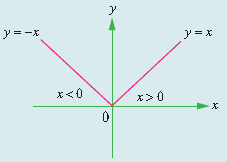
\(|x|= \begin{cases}-x & \text { if } x<0 \\ 0 & \text { if } x=0 \\ x & \text { if } x>0\end{cases}\)
If x > 0,then |x| = x, which tends to 0 as
\(x \rightarrow 0\) from the right of 0. That is, \(\lim _{ x\rightarrow0^+}{|x| } =0\)
If x < 0, then |x| = - x which again tends to 0 as x\(\rightarrow\)0. from the left of 0. That is, \(\lim _{ x\rightarrow0^-}{|x| } =0\).
Thus, \(\lim _{ x\rightarrow0^-}{|x| } =0=\lim _{ x\rightarrow0^+}{|x| }.\)
Hence \(\lim _{ x\rightarrow0}{|x| } =0\).
20.
Given \(\overrightarrow{a}=\hat{i}-2\hat{j}+\hat{k}\)
\(\overrightarrow{b}=3\hat{i}-4\hat{j}-2\hat{k}\)|
\(\overrightarrow{a} . \overrightarrow{b}=(\hat{i}-2\hat{j}+\hat{k}).(3\hat{i}-4\hat{j}-2\hat{k})\)
= 1(3) - 2(-4) + 1(-2)
= 3 + 8 - 2 = 9
\(\therefore \overrightarrow{a} . \overrightarrow{b}=9\)
21.
\(f(-1) =\lim _{x \rightarrow-1} f(x) \)
\(=\lim _{x \rightarrow-1} \frac{x^{2}-1}{x^{3}+1} \)
\(=\lim _{x \rightarrow-1} \frac{x^{2}-(-1)^{2}}{x^{3}-(-1)^{3}}=\frac{2(-1)^{2-1}}{3(-1)^{3-1}}=\frac{-2}{3}
\)
22.
\(\lim _{n \rightarrow \infty}[\left.\frac{1}{n^{2}}+\frac{2}{n^{2}}+\frac{3}{n^{2}}+\cdots+\frac{n}{n^{2}}\right] \)
\(=\lim _{n \rightarrow \infty}\left[\frac{(1+2+3+\cdots+\dot{n})}{n^{2}}\right] \)
\(=\lim _{n \rightarrow \infty}\left[\frac{n(n+1)}{2 n^{2}}\right] \)
\(=\frac{1}{2} \lim _{n \rightarrow \infty}\left(\frac{n+1}{n}\right) \)
\(=\frac{1}{2} \lim _{n \rightarrow \infty}\left(1+\frac{1}{n}\right)=1 / 2(1+0)=1 / 2
\)
23.
\(\lim _{x \rightarrow 0} \frac{8^{x}-4^{x}-2^{x}+1^{x}}{x^{2}}=\lim _{x \rightarrow 0} \frac{4^{x}\left(2^{x}-1\right)-1\left(2^{x}-1\right)}{x^{2}}\)
\(=\lim _{x \rightarrow 0} \frac{\left(2^{x}-1\right)\left(4^{x}-1\right)}{x^{2}}=\lim _{x \rightarrow 0}\left(\frac{2^{x}-1}{x}\right)\left(\frac{4^{x}-1}{x}\right) \)
\(=\log 2 \times \log 4=\log 2 \times 2 \log 2=2(\log 2)^{2}
\)
24.
(b)
\(15\over4\)
25.
\(\text { Unit vector }=\frac{\lambda \hat{i}+2 \lambda \hat{j}+2 \lambda \hat{k}}{\sqrt{\lambda^{2}+4 \lambda^{2}+4 \lambda^{2}}}\)
\(=\frac{\lambda \hat{k}+2 \lambda \hat{j}+2 \lambda \hat{k}}{\sqrt{9 \lambda^{2}}}=\frac{\lambda \hat{i}+2 \lambda \hat{j}+2 \lambda \hat{k}}{3 \lambda} \)
\(=\frac{\lambda(\hat{i}+2 \hat{j}+2 \hat{k})}{3 \lambda}=\frac{1}{3}(\hat{i}+2 \hat{j}+2 \hat{k}) \)
\(\lambda =\frac{1}{3} \)

11th Standard Syllabus & Materials
11th Standard
TN 11th Tamil பீடு பெற நில் - செய்யுள் - காவடிச்சிந்து Important Questions And Answers Study Material - QB365 Set A
NEW11th Standard
TN 11th Tamil பீடு பெற நில் - உரைநடை - மலை இடப்பெயர்கள் : ஓர் ஆய்வு Important Questions And Answers Study Material - QB365 Set A
NEW11th Standard
TN 11th Tamil மாமழை போற்றுதும் - துணைப்பாடம் - யானை டாக்டர் Important Questions And Answers Study Material - QB365 Set A
NEW11th Standard
TN 11th Tamil மாமழை போற்றுதும் - செய்யுள் - ஐங்குறுநூறு Important Questions And Answers Study Material - QB365 Set A



Tamilnadu Stateboard 11th Standard Subjects
Maths

Commerce

Economics

Biology

Business Maths and Statistics

Accountancy

Computer Science

Physics

Chemistry
Maths
Biology
Economics
Physics
Chemistry

History
Business Maths and Statistics

Computer Science
Accountancy

Computer Applications
History
Computer Technology
Commerce
Computer Applications
Computer Technology

Tamil

English

French
Tamilnadu Stateboard Standards

