
 100% FREE ACCESS
11th Standard Syllabus & Materials
11th Standard
TN 11th Tamil இயற்கை வேளாண்மை,சுற்றுச்சூழல் -செய்யுள் - மனோன்மணீயம் Important Questions And Answers Study Material - QB365 Set A
NEW11th Standard
TN 11th Tamil என்னுயிர் என்பேன் -துணைப்பாடம் - இசைத்தமிழர் இருவர் Important Questions And Answers Study Material - QB365 Set A
NEW11th Standard
TN 11th Tamil மொழி கலை -செய்யுள் - ஒவ்வொரு புல்லையும் Important Questions And Answers Study Material - QB365 Set A
NEW11th Standard
TN 11th Tamil பீடு பெற நில் - இலக்கணம் - பகுபத உறுப்புகள் Important Questions And Answers Study Material - QB365 Set A
NEW11th Standard
TN 11th Tamil பீடு பெற நில் - துணைப்பாடம் - வாடிவாசல் Important Questions And Answers Study Material - QB365 Set A
NEW11th Standard
TN 11th Tamil பீடு பெற நில் - செய்யுள் - குறுந்தொகை Important Questions And Answers Study Material - QB365 Set A

Published on: 29/09/2018
Model paper-Basic Algebra
Download Tamil Nadu 11th Standard Maths question papers, model tests, one-mark questions, important questions, and public exam papers in PDF format. Free study materials and answer keys for TN State Board students.
Questions + Answers key
Take MCQ Maths Test1.
If \(\alpha\) and \(\beta\) are the roots of the equation x2 - 2x + 3 = 0 from the equation where roots are
(a) \(\frac{1}{\alpha}\) and \(\frac{1}{\beta}\)
(b) \(\alpha^2\) and \(\beta^2\)
(c) \(\frac{1}{\alpha^2}\) and \(\frac{1}{\beta^2}\)
2.
Construct a quadratic equation with roots 7 and -3
3.
Let b > 0 and b ≠ 1. Express y = bx in logarithmic form. Also state the domain and range of the logarithmic function.
4.
Represent the following inequalities in the interval notation:
\(x\ge -1\) and \(x<4\)
5.
Solve for x \(\left| 3-x \right| <7\)
6.
Classify each element of \(\left\{ \sqrt { 7 } ,\frac { -1 }{ 4 } ,0,3.14,4,\frac { 22 }{ 7 } \right\} \) as a member of N, Q, R, -Q or Z.
7.
Simplify \(\left( 3^{ -6 } \right) ^{ \frac { 1 }{ 3 } }\)
8.
Simplify \(\left( 125 \right) ^{ \frac { 2 }{ 3 } }\)
9.
Prove that ap + q = 0 if f(x) = x3 - 3px + 2q is divisible by g(x) = x2 + 2ax + a2.
10.
Our monthly electricity bill contains a basic charge, that is independent of units consumed and a charge that depends on the units consumed. Let us say Electricity board charges Rs. 110 as basic charge and charges Rs. 4 for each unit we use. If a person wants to keep his electricity bill below Rs. 250, then what should be his electricity usage?
11.
Solve 3|x - 2| + 7 = 19 for x.
12.
Resolve the following rational expressions into partial fractions.
\({{1}\over{x^2-a^2}}\)
13.
If x2+ x + 1 is a factor of the polynomial 3x3+ 8x2+ 8x + a, then find the value of a.
14.
Simplify and hence find the value of n: \(3^{2 n} 9^{2} 3^{-n} / 3^{3 n}=27\)
15.
Determine the region in the plane determined by the inequalities.
\(2x+y\ge 8,\ \ x+2y\ge 8,\ \ x+y\le 6\)
16.
Determine the region in the plane determined by the inequalities.
\(2x+3y\le 6,\ x+4y\le 4,\ x\ge 0,\ y\ge 0.\)
17.
Resolve the following rational expressions into partial fractions.
\({{{(x-1)}^{2}}\over{x^3+x}}\)
18.
Determine the region in the Plane determined by the inequalities \(y\ge 2x,\ -2x+3y\le 6\)
19.
If the difference of the roots of the equation \(2{ x }^{ 2 }-\left( a+1 \right) x+a-1=0\) is equal to their product, then prove that a = 2.
20.
The condition that the equation ax2 + bx + c = 0 may have one root is the double the other is ___________
2b2 = 9ac
b2 = ac
b2 = 4ac
9b2 = 2ac
21.
Given \(|\frac{3}{x-4}|<1\) then ___________
x∈(∞,3)
x∈(4, ∞)
x∈(1, 7)
x∈(1, 4)U(4, 7)
22.
The value of log3 11.log11 13.log13 15.log15 27.log27 81 is
1
2
3
4
23.
If 8 and 2 are the roots of x2+ ax + c = 0 and 3, 3 are the roots of x2 + dx + b = 0; then the roots of the equation x2+ ax + b = 0 are
1, 2
-1, 1
9, 1
-1, 2
24.
The equation whose roots are numerically equal but opposite in sign to the roots 3x2- 5x -7 = 0 is
3x2- 5x - 7 = 0
3x2+ 5x - 7 = 0
3x2- 5x + 7 = 0
3x2 + x - 7
25.
If \({ log }_{ \sqrt { x } }\) 0.25 = 4, then the value of x is
0.5
2.5
1.5
1.25
26.
The value of \({ log }_{ 3 }\frac { 1 }{ 81 } \) is
-2
-8
-4
-9
27.
The value of \({ log }_{ \sqrt { 2 } }512\) is
16
18
9
12
28.
29.
The solution 5x-1<24 and 5x+1 > -24 is
(4,5)
(-5,-4)
(-5,5)
(-5,4)
1.
(a) 6x2 - 9x + 2 = 0
(b) x2 + 2x + 9 = 0
(c) 9x2 + 2x + 1 = 0
2.
Given roots are 7 and -3
Sum of the roots = 7+(-3) = 4
Product of the roots = 7(-3) = -21
The quadratic equation is x2- x (Sum of the roots) + Product of the roots = 0
Hence, the required quadratic equation is x2- 4x - 21 = 0
3.
Given y = bx
Converting this into logarithmic form, we get
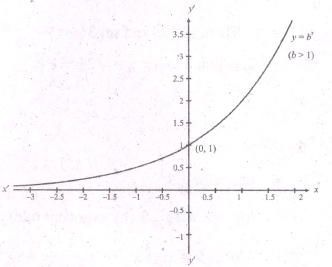
\({ log }_{ b }^{ y }\) = x
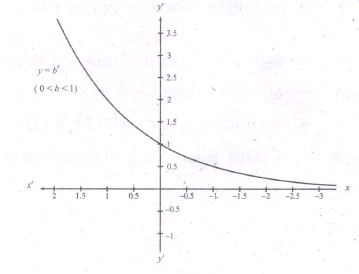
The domain logarithmic function is the set of positive real numbers and the range is the set of real numbers.
Domain (0,\(\infty\)), and Range (0,\(\infty\))
4.
x > - 1 and x < 4.
⇒ x ∈ (-1, 4)
.png)
5.
.png)
[a < b ⇒ ay > by for all y< 0]
Here y = -1
Given |3-x| < 7
This means -7 < 3 -x < 7
⇒-7-3 < -x < 7-3
⇒-10 < -x < 4
⇒10 > x > -4
\(\therefore\) The Solution set is \(x\in \left( -\infty ,-4 \right) \cup \left( -4,10 \right) \)
6.
Since \(\sqrt { 7 } \) is an irrational number, \(\sqrt { 7 } \) \(\in\) R.
Since \(\frac { -1 }{ 4 } \) is a negative rational number \(\frac { -1 }{ 4 } \) \(\in\) Q
0 is an integer and 0 \(\in\)Z.
3.14 = \(\pi \) is a non-recurring and non-terminating decimal.
\(\therefore\) 3.14 is an irrational number \(\Rightarrow\) 3.14 \(\in\) R-Q
4 is a positive integer \(\Rightarrow\) 4 \(\in\)R-Q.
\(\frac { 22 }{ 7 } \) = 3.14 \(\in\) R. Which is an irrational number.
7.
= \({ 3 }^{ -6\times \frac { 1 }{ 3 } }={ 3 }^{ 2 }=\frac { 1 }{ { 3 }^{ 2 } } =\frac { 1 }{ 9 } \)
8.
\(\left( 5^{ 3 } \right) ^{ \frac { 2 }{ 3 } }={ 5 }^{ 3\times \frac { 2 }{ 3 } }\)
= 52 = 25 \(\left[ \because ({ a }^{ m })^{ n }={ a }^{ mn } \right] \)
9.
Note that the degree of f(x) is 3 and the leading coefficient is 1. Since g(x) divides f(x), we have f(x) = (x + b) g(x), for some b ∈ R. Thus, x3 - 3px + 2q = (x + b) (x2 + 2ax + a2 ).
Equating like coefficients on both sides, we have 2a + b = 0, a2 + 2ab = -3p and 2q = ba2, Thus b = -2a, p = a2 and q = -a3
Now, q = -a3 = -a(a2) = -ap, which gives ap + q = 0.
10.
Let x denote the number of units used. Note that x ≥ 0. Then, his electricity bill will be Rs. 110 + 4x.
The person wants his bill to be below Rs. 250. Let us solve the inequality 110 + 4x < 250. Thus, 4x < 140; which gives 0 ≤ x < 35.
The person should keep his usage below 35 units in order to keep his bill below Rs. 250.
11.
3|x - 2| + 7 = 19, So that we have, |x - 2| = \(\frac { 19-7 }{ 3 } =4\). Thus, we have either, x - 2 = 4 (or) x - 2 = -4
Therefore the solutions are x = -2 (or) x = 6
12.
\({{1}\over{x^2-a^2}}={{1}\over{(x+a)(x-a)}}-={{A}\over{x+a}}+{{B}\over{x+a}}\)
\({{1}\over{x^2-a^2}}={{A(x-a)B(x+a)}\over{(x+a)(x-a)}}\)
\(\Rightarrow\) 1 = A(x - a) + B(x + a)
Putting x = a in (1) we get,
\(1=B(2a)\Rightarrow A=-{{1}\over{2a}}\)
Putting x = -a in (1) we get,
\(1=A(-2a)\Rightarrow A=-{{1}\over{2a}}\)
\(\therefore{{1}\over{x^2-a^2}}={{-{{1}\over{2}}a}\over{x+a}}+{{{{1}\over{2}}a}\over{x-a}}={{-1}\over{2a(x+a)}}+{{1}\over{2a(x-a)}}\)
13.
Let f(x) = 3x3 + 8x2 + 8x + a
Since (x2 + x + 1) is a factor of f(x), f(x) is divisible by x2 + x + 1
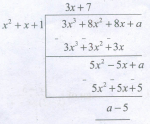
Since f(x) is divisible by x2 + x + 1, the remainder is zero.
∴ a - 5 = 0
⇒ a = 5
14.
Given \(\frac { { 3 }^{ 2n }{ 9 }^{ 2 }{ 3 }^{ -n } }{ { 3 }^{ 3n } } \) = 27
⇒ \(\frac { { 3 }^{ 2n-n }.{ 9 }^{ 2 } }{ { 3 }^{ 3n } }\) = 27 [∵ am.an = am+n]
⇒ \(\frac { { 3 }^{ n }.({ 3 }^{ 2 })^{ 2 } }{ { 3 }^{ 3n } } \) = 27
⇒ 3n-3n (34) = 27 \(\left[ \because \frac { a^{ m } }{ a^{ n } } ={ a }^{ m-n }\& ({ a }^{ m })^{ n }={ a }^{ mn } \right] \)
⇒ 3-2n.34 = 27
⇒ 3-2n+4 = 33
Equating the powers both sides we get
-2n+4 = 3
⇒ -2n = 3-4 = -1
⇒ 2n = 1
⇒ n = \(\frac { 1 }{ 2 } \)
15.
2x + y = 8
| x | 0 | 4 |
| y | 8 | 0 |
x + 2y + 8
| x | 0 | 8 |
| y | 4 | 0 |
x + y = 6
| x | 0 | 6 |
| y | 6 | 0 |
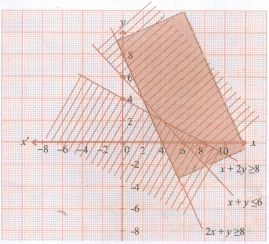
All points bounded between 2x + y = 8, x + 2y 8 and x + y = 6 is required region. Darkly shaded area will represent the solution set of the given linear inequalities.
16.
If 2x + 3y = 6
| x | 0 | 3 |
| y | 2 | 0 |
x + 4y = 4
| x | 0 | 4 |
| y | 1 | 0 |
x > y > 0 represents the area in the 1st quadrant.
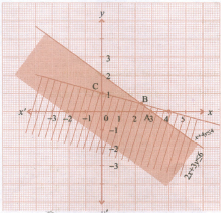
All points bounded between x = 0, y = 0, x + 4y = 4 and 2x + 3y = 6 is required region. Darkly shaded area will represent the solution set of the given linear inequalities.
17.
\({{{(x-1)}^{2}}\over{x^3+x}}={{{(x-1)}^{2}}\over{x(x^2+1)}}={{A}\over{x}}+{{Bx+C}\over{x^2+1}}\)
\(\Rightarrow\) (x-1)2 = A(x2+ 1) + (Bx + C)(x)
Putting x = 0 in (1) we get,
\(\boxed{1=A}\)
Putting x = 1 in (1) we get.
0 = A(2) + (B + C)(1)
\(\Rightarrow\) 0 = 2A + B + C
Equating the Coefficient of x2 in (1) we get,
1 = A + B \(\Rightarrow\) 1 = 1 B \(\Rightarrow\) \(\boxed{B=0}\)
Substituting A = 1, B = 0 in (2) we get,
0 = 2 + 0 + C \(\Rightarrow\) \(\boxed{C=-2}\)
\(\therefore\) \({{{(x-1)}^{2}}\over{x^3+x}}={{1}\over{x}}+{{0x-2}\over{x^2+1}}\)
\(\Rightarrow\) \({{{(x-1)}^{2}}\over{x^3+x}}={{1}\over{x}}-{{2}\over{x^3+1}}\)
18.
Suppose y = 2x
| x | 1 | -1 | 2 | -2 |
| y | 2 | -2 | 4 | -4 |
-2x + 3y = 6
-2x = 6 - 3y
\(x={6-3y\over -2}\)
| x | 0 | -3 |
| y | 2 | 0 |
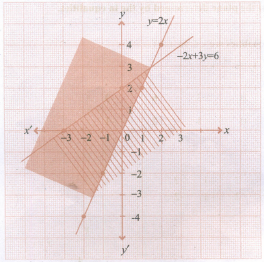
All the points above the y ≥ 2x and all the points below -2x + 3y ≤ 6 is required region. Darkly shaded area will represents the solution set of the given linear inequalities.
19.
Given equation is 2x2-(a+1)x + a - 1 = 0
Let α and β be the roots of the equation
Given α - β = αβ
\(α - β={a-1\over 2}[a=2, b=-(a+1),c=a-1]\ \ \ [∵\ αβ={c\over a}={a-1\over 2}]\)....(1)
and \(α + β={-b\over a}={a+1\over 2}\) ....(2)
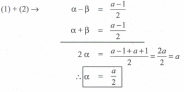
Substituting \(α={a\over 2}\)in (2) we get
\({a\over 2}+\beta={a+1\over 2}\)
\(⇒\ β={a+1\over 2}-{a\over2}={1\over 2}\)
\(∴\ β={a\over 2}\)
Substituting the value of α and β in α - β = αβ
we get \({a\over 2}-{1\over 2}=\left(a\over 2\right)\left(1\over 2\right)\)
\(⇒\ {a-1\over 2}={a\over 4}\)
⇒ a-1 = \(a\over 2\)
⇒ 2a - 2 = a
⇒ 2a - a = 2
⇒ a = 2
Hence proved
20.
(a)
2b2 = 9ac
21.
(d)
x∈(1, 4)U(4, 7)
22.
The value of
\(\log _{3} 11 \log _{11} 13 \log _{13} 15 \log _{15} 27 \log _{27} 81=\log _{3} 81 \)
\(=\log _{3} 3^{4}=4 \log _{3} 3=4 \)
23.
\(x^{2}+a x+c=0 \)
\(x^{2}+d x+b=0 \)
\(8 \& 2 \text { are the roots }\)\(\text { 3. } 3 \text { are the roots }\)
\(\therefore a=-10 ; c=16 \quad d=-6, \quad b=9\)
\(x^{2}+a x+b =0 \)
\(x^{2}-10 x+9 =0 \)
\(\Rightarrow(x-1)(x-9) =0 \)
\(\therefore x =1 \text { (or) } 9 \)
24.
\(3 x^{2}-5 x-7=0\)
\(\text { Let the roots be } \alpha, \beta\)
\(\Rightarrow \operatorname{Sum}: \alpha+\beta=\frac{5}{3}\)
\(\text { Product : } \alpha \beta=\frac{-7}{3}\)
\(\text { Now take the roots are }-\alpha,-\beta\)
\(\Rightarrow \text { Sum : }-\alpha-\beta \quad-(\alpha+\beta)=-\frac{5}{3}\)
\(\text { Product : }(-\alpha)(-\beta)=\alpha \beta=\frac{-7}{3}\)
\(\text { The reouired equation }\)
\(x^{2}+\frac{5}{3} x-\frac{7}{3}=0 \)
\(3 x^{2}+5 x-7=0 \)
25.
\(\log _{\sqrt{x}} 0.25 =4 \)
\((\sqrt{x})^{4} =0.25 \)
\((\sqrt{x})^{4} =\frac{1}{4} \)
\(x^{2} =\frac{1}{4} \)
\(\Rightarrow x=\frac{1}{2}=0.5\)
26.
\(\text { Let } \log _{3} \frac{1}{81}=x \Rightarrow 3^{x}=\frac{1}{81}\)
\(\Rightarrow 3^{x}=3^{-4}\)
\(\Rightarrow x=-4 \)
27.
\(\text { Let } \log _{\sqrt{2}} 512=x\)
\(\text { Then }(\sqrt{2})^{x}=2^{9}\)
\(\Rightarrow 2^{\frac{x}{2}}=2^{9} \Rightarrow x / 2=9 \Rightarrow x=18\)
28.
(b)
29.
\(5 x-1 <24 \ \ \ 5 x+1 >-24 \)
\(5 x <25 \ \ 5 x >-25\)
\(x <5 \ x >-5 \)
\(x \in(-5,5)\)

11th Standard Syllabus & Materials
11th Standard
TN 11th Tamil பீடு பெற நில் - செய்யுள் - காவடிச்சிந்து Important Questions And Answers Study Material - QB365 Set A
NEW11th Standard
TN 11th Tamil பீடு பெற நில் - உரைநடை - மலை இடப்பெயர்கள் : ஓர் ஆய்வு Important Questions And Answers Study Material - QB365 Set A
NEW11th Standard
TN 11th Tamil மாமழை போற்றுதும் - துணைப்பாடம் - யானை டாக்டர் Important Questions And Answers Study Material - QB365 Set A
NEW11th Standard
TN 11th Tamil மாமழை போற்றுதும் - செய்யுள் - ஐங்குறுநூறு Important Questions And Answers Study Material - QB365 Set A



Tamilnadu Stateboard 11th Standard Subjects
Maths

Commerce

Economics

Biology

Business Maths and Statistics

Accountancy

Computer Science

Physics

Chemistry
Maths
Biology
Economics
Physics
Chemistry

History
Business Maths and Statistics

Computer Science
Accountancy

Computer Applications
History
Computer Technology
Commerce
Computer Applications
Computer Technology

Tamil

English

French
Tamilnadu Stateboard Standards

