
 100% FREE ACCESS
11th Standard Syllabus & Materials
11th Standard
TN 11th Tamil இயற்கை வேளாண்மை,சுற்றுச்சூழல் -செய்யுள் - மனோன்மணீயம் Important Questions And Answers Study Material - QB365 Set A
NEW11th Standard
TN 11th Tamil என்னுயிர் என்பேன் -துணைப்பாடம் - இசைத்தமிழர் இருவர் Important Questions And Answers Study Material - QB365 Set A
NEW11th Standard
TN 11th Tamil மொழி கலை -செய்யுள் - ஒவ்வொரு புல்லையும் Important Questions And Answers Study Material - QB365 Set A
NEW11th Standard
TN 11th Tamil பீடு பெற நில் - இலக்கணம் - பகுபத உறுப்புகள் Important Questions And Answers Study Material - QB365 Set A
NEW11th Standard
TN 11th Tamil பீடு பெற நில் - துணைப்பாடம் - வாடிவாசல் Important Questions And Answers Study Material - QB365 Set A
NEW11th Standard
TN 11th Tamil பீடு பெற நில் - செய்யுள் - குறுந்தொகை Important Questions And Answers Study Material - QB365 Set A

Published on: 29/09/2018
Model question paper1
Download Tamil Nadu 11th Standard Maths question papers, model tests, one-mark questions, important questions, and public exam papers in PDF format. Free study materials and answer keys for TN State Board students.
Questions + Answers key
Take MCQ Maths Test1.
If an experiment has exactly the three possible mutually exclusive outcomes A, B, and C, check in each case whether the assignment of probability is permissible.
\(P(A)=\frac { 1 }{ \sqrt { 3 } } ,\quad P(B)-1-\frac { 1 }{ \sqrt { 3 } } ,\quad P(C)-0\)
2.
If 5Pr = 7Pr-1 find r.
3.
How many two-digit numbers can be formed using 1, 2, 3, 4, 5 without repetition of digits?
4.
Prove that the sum of first n positive odd numbers is n2.
5.
How many paths are there from start to end on a 6\(\times\) 4 grid as shown in the picture?
6.
How many strings can be formed from the letters of the word ARTICLE, so that vowels occupy the even places?
7.
A student appears in an objective test which contain 5 multiple choice questions. Each question has four choices out of which one correct answer.
(i) What is the maximum number of different answers can the students give?
(ii) How will the answer change if each question may have more than one correct answers?
8.
Count the number of three-digit numbers which can be formed from the digits 2, 4, 6, 8 if
(i) repetitions of digits is allowed.
(ii) repetitions of digits is not allowed
9.
Three letters are written to three different persons and addresses on three envelopes are also written. Without looking at the addresses, what is the probability that (i) exactly one letter goes to the right envelopes (ii) none of the letters go into the right envelopes?

10.
The chances of A, B, and C becoming manager of a certain company are 5 : 3: 2. The probabilities that the office canteen will be improved if A, B, and C become managers are 0.4, 0.5 and 0.3 respectively. If the office canteen has been improved, what is the probability that B was appointed as the manager?
11.
12.
(i) Find the number of strings of length 4, which can be formed using the letters of the word BIRD, without repetition of the letters.
(ii) How many strings of length 5 can be formed out of the letters of the word PRIME taking all the letters at a time without repetition.
13.
Find the number of strings that can be made using all letters of the word THING. If these words are written as in a dictionary, what will be the 85th string?
14.
Use induction to prove that 10n + 3 \(\times\) 4n+2 + 5 is divisible by 9 for all natural numbers n
15.
Using the mathematical induction, show that for any natural number n > 2,
\(\left(1-{1\over 2^2} \right)\left(1-{1\over 3^2} \right)\left(1-{1\over 4^2} \right)...\left(1-{1\over n^2} \right)={n+1\over 2n}\)
16.
17.
How many three-digit odd numbers can be formed using the digits 0, 1, 2, 3, 4, 5? if
The repetition of digits is allowed
18.
In a certain college 4% of the boys and 1% of the girls are taller than 1.8 meter. Further 60% of the students are girls. If a student is selected at random and is taller than 1.8 meters, then the probability that the student is a girl is
\({2\over 11}\)
\({3\over 11}\)
\({5\over 11}\)
\({7\over 11}\)
19.
If a and b are chosen randomly from the set {1,2,3,4} with replacement, then the probability of the real roots of the equation \(x^2+ax+b=0\) is
\({3\over 16}\)
\({5\over 16}\)
\({7\over 16}\)
\({11\over 16}\)
20.
The number of diagonals of a decagon _________
10
20
35
40
21.
5c1 + 5c2 + 5c3 + 5c4 + 5c5 is equal to _________
30
31
32
33
22.
The number of ways to arrange the letters of the word CHEESE are _________
120
240
720
6
23.
The number of 10 digit number that can be written by using the digits 2 and 3 is
10C2+9C2
210
210-2
10!
24.
The number of rectangles that a chessboard has
81
99
1296
6561
25.
The number of ways in which a host lady invite 8 people for a party of 8 out of 12 people of whom two do not want to attend the party together is
2 \(\times\) 11 C7+10C8
11C7+10C8
12C8-10C6
10C6+2!
26.
There are 10 points in a plane and 4 of them are collinear. The number of straight lines joining any two points is
45
40
39
38
27.
If a2-a \(C_2 = ^{a^2-a}\) C4 then the value of 'a' is
2
3
4
5
1.
since the experiment has exactly the three possible mutually exclusive outcomes A, B and C, they must be exhaustive events.
\(\Rightarrow S=A\cup B\cup C\)
Therefore, by axioms of probability
\(P(A)\ge 0,P(B)\ge P(C)\ge 0\) and
\(P(A\cup B\cup C)=P(A)+P(B)+P(C)=P(S)=1\)
The assignment is permissible because
\(P(A)=\frac { 1 }{ \sqrt { 3 } } \ge 0,\quad P(B)-1-\frac { 1 }{ \sqrt { 3 } } \ge 0,\quad P(C)-0\ge 0\)
\(P(S)=P(A)+P(B)+P(C)=\frac { 1 }{ \sqrt { 3 } } +1-\frac { 1 }{ \sqrt { 3 } } +0-1\)

2.
9
3.
| tens | one's |
| 4 | 5 |
The one's place can be filled up in 5 ways using 1,2,3,4,5 and tens place can be filled up in 4 ways.
∴ Number of two digit numbers using the digits 1,2,3,4,5 is 4 x 5 = 20.
4.
Let p(n) = 1 + 3 + 5 + ... + (2n- 1). Therefore P(1) = 1 = 12 is true.
We assume that P(k) = 1 + 3 + 5 +: .. (2k-1) is true for n = k.That is P(k) = k2
We need to prove P(k + 1) = (k+ 1)2
P(k+1) = 1+3+5+...(2(k+1)-1)
\(=\underbrace{1+3+5+7+.....+(2k+1)}+2k+1\)
= P(k) + 2k+1
= k2+2k+1 = (k+1)2
This implies, P(k + 1) is true. Hence, by the principle of a mathematical induction, P(n) is true for all natural numbers.
5.
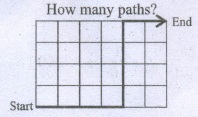
Note that any such path comprises 6 horizontal unit lengths and 4 vertical unit lengths. This each path consists of 10 unit lengths where 6 are of one kind (horizontal) and 4 are of another kind (vertical).
Thus the total number of paths is \(\frac { 10! }{ 4!\times 6! } \) = 210.
6.
In the letters of the word, ARTICLE, there are three vowels namely A, I, E.
There are 3 even places.
3 vowels can occupy the even places in 3P3 = 3! ways.
Remaining 4 letters can occupy 4 places in 4! ways.
Hence, total number of ways of arrangement = 4! \(\times\) 3!
= \(4\times 3\times 2\times 3\times 2\)
=144
7.
(i) Since each question can be answered in 4 ways, the maximum number of different answers
= \(4\times 4\times 4\times 4\times 4={ 4 }^{ 5 }\)
(ii) When each question has more than one correct answer the maximum number of different answers \(=(5 \times 3)^{5}=15^{5}\)
8.
(i)Repetition of digits is allowed
| hundreds | tens | unit |
| 4 | 4 | 4 |
The unit place can be filled in 4 ways.
Since repetition is allowed, the tens place and hundreds place can also be filled in 4 ways each.
∴ Total number one-digit numbers = 4 x 4 x 4 = 64
(ii) Repetition of digits is not allowed
| hundreds | tens | unit |
| 2 | 3 | 4 |
The unit place can be filled in 4 ways.
Since repetition of digits is not allowed, the tens place can be filled in 3 ways.
Hundreds place can be filled in 2 ways .
∴ Total number of 3-digit numbers without repetition = 4 \(\times\) 3 \(\times\) 2 = 24
9.
Let A, B, and C denote the envelopes and 1, 2, and 3 denote the corresponding letters
The different combination of letters put into the envelopes are shown in the table Let ci denote the outcomes of the events. Let X be the event of putting the letters into the exactly only one right envelopes Let Y be the event of putting none of the letters into the right envelope
S = {C1, C2, C3, C4, C5, C6}, n(S) = 6
X = {C2, C3, C6}, n(X) = 3
Y = {C4, C5} n(Y) = 2
P(X) = \(\frac { 3 }{ 6 } =\frac { 1 }{ 2 } \) P(Y) = \(\frac { 2 }{ 6 } =\frac { 1 }{ 3 } \)

10.
Let A1, A2 and A3 be the event of A, B, C becoming managers of the company respectively. Let X be the event that the office canteen will be improved.
Then, \(P\left(A_1\right)=\frac{5}{10}=0.5 \)
\(P\left(A_2\right)=\frac{3}{10}=0.3 \)
\(P\left(A_3\right)=\frac{2}{10}=0.2 \)
\(P\left(X / A_1\right)=0.4 \)
\(P\left(X / A_2\right)=0.5\)
\(P\left(X / A_3\right)=0.3\)
\(P\left(A_2 / X\right)=\frac{P\left(A_2\right) P\left(X / A_2\right)}{P\left(A_1\right) P\left(X / A_1\right)+P\left(A_2\right) P\left(X / A_2\right)}+P\left(A_3\right) P\left(X / A_3\right)\)
\(=\frac{0.3(0.5)}{0.5(0.4)+0.3(0.5)+0.2(0.3)} \)
\(=\frac{0.15}{0.2+0.15+0.06} \)
\(=\frac{0.15}{0.41}=\frac{15}{41}\)
11.
12.
(i) There are as many strings as filling the 4 vacant places by the 4 letters, keeping in mind that repetition is not allowed. The first place can be filled in 4 different ways by any one of the letters B, I, R, D. Following which, the second place can be filled in by any one of the remaining 3 letters in 3 different ways, following which the third place can be filled in 2 different ways, following which fourth place can be filled in 1 way. Thus the number of ways in which the 4 places can be filled, by the rule of product is 4 \(\times\) 3 \(\times\) 2 \(\times\) 1 = 24. Hence, the required number of strings is 24.
(ii) There are 5 different letters with which 5 places are to be filled. The first place can be filled in 5 ways as any one of the five letters P, R, I, M, E can be placed there. Having filled the first place with any of the 5 letters, 4 letters are left to be placed in the second place, three letters are left for the third place and 2 letters are left to be put in the fourth place. The remaining 1 letter has to be placed in the fifth place. Hence, the total number of ways filling up five places is 5 \(\times\) 4 \(\times\) 3 \(\times\) 2 \(\times\) 1 = 120.
13.
In the word THING, there are 5 letters
The lexicographic order of the word is G, H, I, N, T
Number of words starting with G = 4! = 24
Number of words starting with H = 4! = 24
Number of words starting with I 4! = 24
Number of words starting with NG 3! = 6
Number of words starting with NGH 2! = 2
Number of words starting with NGHI = 1!
Number of words starting with NIGHT = 1!
85th string NIGHT
14.
Let p(n) be the statement 10n + 3 \(\times\) 4n+2 + 5 is divisible by 9.
Step 1: Putting n = 1, we get,
101 + 3 \(\times\) 41 +2 + 5 = 10 + 3(43) + 5 = 15 + 3 (64)
= 207 is divisible by 9.
∴ p(1) is true
Step 2: Let us assume that p(k) is true.
∴ 10k + 3 x 4k+ 2 + 5 is divisible by 9
⇒ 10k + 3 x 4k + 2 + 5 = 9 m
⇒ 10k = 9 m - 5 - 3 x 4k+2 for some scalar m.
Step 3: To prove that p(k+ 1) is true
ie to p. T. 10k+1+ 3 x 4k+3 + 5 is divisible by 9
Consider 10k+1+ 3 x 4k+3 + 5
⇒ 10k·10+3.4k+2·41+5
= 10 [9m - 5 - 3 x 4k+2] + 124k+2 + 5 [using (1)]
= 90m - 50 - 30 x 4k+2 + 12 4k+2 + 5
= 90m - 45 - 18 (4k+2)
= 9 [10m - 5 - 2 (4k+2)] which is divisible by 9
∴ p(k+ 1) is true.
Hence, by the principle of mathematical induction, p(n) is true for all values of n.
15.
Let P(n) be the statement \(\left(1-{1\over 2^2} \right)\left(1-{1\over 3^2} \right)\left(1-{1\over 4^2} \right)...\left(1-{1\over n^2} \right)={n+1\over 2n}\)
Step 1:
Putting n = 2, we get
\(\left(1-{1\over2^2}\right)\left(1-{1\over3^2}\right)={2+2\over 2(2)+2}\)
\(⇒\ \left(1-{1\over4}\right)\left(1-{1\over9}\right)={4\over 6}\)
\(⇒\ \left(3\over4\right)\left(8\over9\right)={2\over3}⇒{2\over3}={2\over3}\)
∵ p(2) is true
Step 2:
Let us assume that p(k) is true
\(∵\ \left(1-{1\over 2^2}\right)\left(1-{1\over 2^2}\right)...\left(1-{1\over (K+1^2)}\right)={K+2\over 2K+2}\)
Step 3:
To prove that p(K+1) is true
i.e. to P.T \(\left(1-{1\over2^2}\right)\left(1-{1\over 3^2}\right)...\left(1-{1\over (K+1)^2}\right)\left(1-{1\over (K+2)^2}\right)={K+3\over 2(K+1)+2}={k+3\over 2K+4}\)
\(LHS=\left(1-{1\over 2^2}\right)\left(1-{1\over 3^2}\right)...\left(1-{}1\over (K+1)^2\right)\left(1-{1\over (K+2)^2}\right)\)
\(={K+2\over 2K+2}\left(1-{1\over (K+2)^2}\right)\)
\({K+2\over 2K+2}\left({(K+2)^2-1\over (KK+2)^2}\right)\) [Using (1)]
\(={K+2\over 2K+2}\left(K^2+4+4K-1\over (K+2)^2\right)\)
\(={K+2\over 2K+2}\left(K^2+4K+3\over (K+2)^2\right)={K+2\over 2(K+1)}{{(K+1)(K+3)\over (K+2)^2}}\)
\(={K+3\over 2(K+2)}={K+3\over 2K+4}=RHS\)
∵ p(K+1) is true
Hence by mathematical induction, p(n) is true for all values of n.
16.
17.
The repetition of digits is allowed
| Hundreds | tens | unit |
| 5 | 6 | 3 |
The unit place can be filled in 3 ways using the digits 1, 3, or 5 since we need 3 digit odd numeric Hundreds place can be filled in 5 ways excluding 0 and repetition of digits is allowed.
Tens place can be filled in 6 ways .
∴ By fundamental principle of multiplication, required number of 3 = digit odd numbers
= 5 \(\times\) 6 \(\times\) 3 = 30 \(\times\) 3 = 90.
18.
\(P\left(A_{1}\right)=0.6, \quad P\left(A_{2}\right)=0.4\)
\(A_{1}=\text { Event of selecting a girl }\)
\(\mathrm{B}=\text { Event of student taller than } 1.8 \mathrm{~m}\)
\(A_{2}=\text { Event of selecting a boy }\)
\(P\left(B / A_{1}\right)=\frac{1}{100}, P\left(B / A_{2}\right)=\frac{4}{100}\)
To find \(=\frac{P\left(A_{1}\right) \cdot P\left(B / A_{1}\right)}{P\left(A_{1}\right) \cdot P\left(B / A_{1}\right)+P\left(A_{2}\right) \cdot P\left(B / A_{2}\right)} \)
\(=\frac{0.6 \times \frac{1}{100}}{0.6 \times \frac{1}{100}+0.4 \times \frac{4}{100}} \)
\(=\frac{6}{\frac{6}{1000}+\frac{16}{1000}} \)
\(=\frac{6}{22}=\frac{3}{11} \)
19.
\(n(S)=n(A \times A) \quad=16\)
\(\text {To find } n(A)\)
\(\text {Let } a=4, b=1 \text { then } a^{2}-4 b \text { is }\)
A = 1,b = 1 then 16 - 4 > 0
b = 2. then 16 - 8 > 0
b=3 then 16-L2>0
b = 4 then 16 - 16 = 0
Let Q = 3,b = 1 thg,l, 9-4 > 0
b = 2 then 9 - 8 > 0
Let a = 2,b = l then 4 - 4 > 0
n(A).= 7,
\(P(A)=\frac{n(A)}{n(S)}=\frac{7}{16}\)
20.
(c)
35
21.
(b)
31
22.
(a)
120
23.
Number of 10 digit number that can be written by using the digits 2 and 3 is 210
24.
Number of rectangles in the chessboard is
\({ }^{9} C_{2} \times{ }^{9} C_{2} =\frac{9 \times 8}{1 \times 2} \times \frac{9 \times 8}{1 \times 2} \)
\(=36 \times 36=1296 \)
25.
Number of ways of selecting 8 people from 12 in 12C8 ways.
Let A and B both attend the party
Out of 10 remaining people 8 can attend in 10C6 ways.
.'. Number of ways in which two of them do not attend together = 12C8 - 10C6
26.
\(\text { No. of lines }{ }^{10} \mathrm{C}_{2}-{ }^{4} \mathrm{C}_{2}+1=45-6+1=40\)
27.
\(a^{2}-a^{a} C_{2} =a^{2}-a^{a} C_{4} \)
\(a^{2}-a^{a} C_{2} =a^{2}-a^{a} C_{a-a-4}\left(\because^{n} C_{r}={ }^{n} C_{n-r}\right) \)
\(a^{2}-a-4 =2 \)
\(a^{2}-a-6 =0 \)
\((a-3)(a+2) =0 \)
\(a=3 \text { or } a=-2 \text { which is impossible }\)

11th Standard Syllabus & Materials
11th Standard
TN 11th Tamil பீடு பெற நில் - செய்யுள் - காவடிச்சிந்து Important Questions And Answers Study Material - QB365 Set A
NEW11th Standard
TN 11th Tamil பீடு பெற நில் - உரைநடை - மலை இடப்பெயர்கள் : ஓர் ஆய்வு Important Questions And Answers Study Material - QB365 Set A
NEW11th Standard
TN 11th Tamil மாமழை போற்றுதும் - துணைப்பாடம் - யானை டாக்டர் Important Questions And Answers Study Material - QB365 Set A
NEW11th Standard
TN 11th Tamil மாமழை போற்றுதும் - செய்யுள் - ஐங்குறுநூறு Important Questions And Answers Study Material - QB365 Set A



Tamilnadu Stateboard 11th Standard Subjects
Maths

Commerce

Economics

Biology

Business Maths and Statistics

Accountancy

Computer Science

Physics

Chemistry
Maths
Biology
Economics
Physics
Chemistry

History
Business Maths and Statistics

Computer Science
Accountancy

Computer Applications
History
Computer Technology
Commerce
Computer Applications
Computer Technology

Tamil

English

French
Tamilnadu Stateboard Standards

