
 100% FREE ACCESS
11th Standard Syllabus & Materials
11th Standard
TN 11th Tamil இயற்கை வேளாண்மை,சுற்றுச்சூழல் -செய்யுள் - மனோன்மணீயம் Important Questions And Answers Study Material - QB365 Set A
NEW11th Standard
TN 11th Tamil என்னுயிர் என்பேன் -துணைப்பாடம் - இசைத்தமிழர் இருவர் Important Questions And Answers Study Material - QB365 Set A
NEW11th Standard
TN 11th Tamil மொழி கலை -செய்யுள் - ஒவ்வொரு புல்லையும் Important Questions And Answers Study Material - QB365 Set A
NEW11th Standard
TN 11th Tamil பீடு பெற நில் - இலக்கணம் - பகுபத உறுப்புகள் Important Questions And Answers Study Material - QB365 Set A
NEW11th Standard
TN 11th Tamil பீடு பெற நில் - துணைப்பாடம் - வாடிவாசல் Important Questions And Answers Study Material - QB365 Set A
NEW11th Standard
TN 11th Tamil பீடு பெற நில் - செய்யுள் - குறுந்தொகை Important Questions And Answers Study Material - QB365 Set A

Published on: 02/08/2018
From this syllabus, model question paper is prepared.it covers the important one mark, two, three marks and five marks. Chapters are covered in this question paper
1. Sets, Relations and Functions
2. Basic Algebra
3. Trigonometry
4. Combinations and Mathematical Induction
5. Binomial Theorem, Sequences and Series
6. Two Dimensional Analytical Geometry
Download Tamil Nadu 11th Standard Maths question papers, model tests, one-mark questions, important questions, and public exam papers in PDF format. Free study materials and answer keys for TN State Board students.
Questions + Answers key
Take MCQ Maths Test1.
A man repays an amount of Rs. 3250 by paying Rs. 20 in the first month and then increases the payment by Rs.15 per month. How long will it take him to clear the amount?
2.
Let A = {a, b, c, d}, B = {a, c, e}, C = {a, e}.
Show that A ∩ (B ∩ C) = (A ∩ B) ∩ C
3.
If \(\cos { \left( \alpha -\beta \right) } +\cos { \left( \beta -\gamma \right) } +\cos { \left( \gamma -\alpha \right) } =\frac { -3 }{ 2 } \) then prove that \(\cos { \alpha } +\cos { \beta } +\cos { \gamma } =\sin { \alpha } +\sin { \beta } +\sin { \gamma } =0\)
4.
Show that cos2 A + cos2 B - 2 cos A cos B cos (A + B) = sin2 (A + B)
5.
A plane is 1 km from one landmark and 2 km from another. From the planes point of view the land between them subtends an angle of 450. How far apart are the landmarks?
6.
A fighter jet has to hit a small target by flying a horizontal distance. When the target is sighted, the pilot measures the angle of depression to be 300. If after 100 km, the target has an angle of depression of 600, how far is the target from the fighter jet at that instant?
7.
If \(\frac{1}{\sqrt{3}\times\sqrt{2}}=\sqrt{3}+a\) then a is ___________
\(\sqrt{2}\)
-\(\sqrt{2}\)
\(\sqrt{\frac{3}{2}}\)
\(\sqrt{\frac{2}{3}}\)
8.
Solve 3x2 + 5x - 2≤0
(2,\(\frac{1}{3}\))
[2,\(\frac{1}{3}\)]
(-2,\(\frac{1}{3}\))
(-2,\(\frac{-1}{3}\))
9.
If \(\alpha\) and \(\beta\) are the roots of 2x2 + 4x + 5 = 0 the equation where roots are 2\(\alpha\) and 2\(\beta\) is ___________
4x2+ 4x + 5 = 0
2x2 + 4x + 50 = 0
x2 + 4x + 5 = 0
x2+ 4x + 10 = 0
10.
If \(\alpha\) and \(\beta\) are the roots of 2x2 - 3x - 4 = 0 find the value of \(\alpha^2+\beta^2\)
\(\frac{41}{4}\)
\(\frac{\sqrt{14}}{2}\)
0
none of these
11.
If \(\frac { kx }{ (x+2)(x-1) } =\frac { 2 }{ x+2 } +\frac { 1 }{ x-1 } \), then the value of k is
1
2
3
4
12.
If a and b are the real roots of the equation x2- kx + c = 0, then the distance between the points (a, 0) and (b, 0) is
\(\sqrt { { k }^{ 2 }-4c } \)
\(\sqrt { { 4k }^{ 2 }-c } \)
\(\sqrt { 4c-{ k }^{ 2 } } \)
\(\sqrt { k-8c } \)
13.
If 8 and 2 are the roots of x2+ ax + c = 0 and 3, 3 are the roots of x2 + dx + b = 0; then the roots of the equation x2+ ax + b = 0 are
1, 2
-1, 1
9, 1
-1, 2
14.
The value of loga b logb c logc a is
2
1
3
4
15.
Which of the following is not true?
sin ፀ = \(-\frac { 3 }{ 4 } \)
cosፀ = -1
tan ፀ = 25
sec ፀ = \(\frac { 1 }{ 4 } \)
16.
If \(\pi <2\theta <\frac { 3\pi }{ 2 } \), then \(\sqrt { 2+\sqrt { 2+2cos4\theta } } \) equals to
-2 cosፀ
-2 sinፀ
2 cosፀ
2 sinፀ
17.
Let R be the universal relation on a set X with more than one element. Then R is
not reflexive
not symmetric
transitive
none of the above
18.
19.
For non-empty sets A and B, if A ⊂ B then (A \(\times\)B) ⋂ (B \(\times\)A) is equal to
A ⋂ B
A \(\times\)A
B \(\times\)B
none of these.
20.
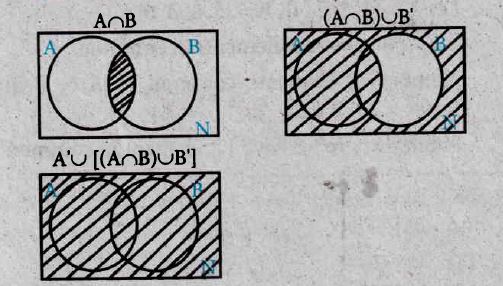
Let A and B be subsets of the universal set N, the set of natural numbers. Then A'∪[(A⋂B)∪B'] is
A
A'
B
N
21.
Let R be the set of all real numbers. Consider the following subsets of the plane R x R: S = {(x, y) : y =x + 1 and 0 < x < 2} and T = {(x,y) : x - y is an integer} Then which of the following is true?
T is an equivalence relation but S is not an equivalence relation
Neither S nor T is an equivalence relation
Both S and T are equivalence relation
S is an equivalence relation but T is not an equivalence relation.
22.
If A = {(x,y) : y = sin x, x ∈ R} and B = {(x,y) : y = cos x, x ∈ R} then A∩B contains
no element
infinitely many elements
only one element
cannot be determined
23.
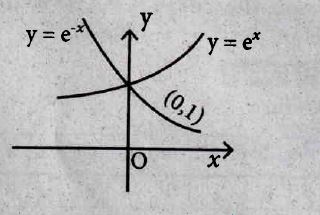
If A = {(x,y) : y = ex, x∈R} and B = {(x,y) : y = e-x, x ∈ R} then n(A∩B) is
Infinity
0
1
2
24.
Let X = {1, 2, 3, 4}, Y = {a, b, c, d} and f = {(1, a), (4, b), (2, c), (3, d), (2, d)}. Then f is
an one-to-one function
an onto function
a function which is not one-to-one
not a function
25.
If the function f:[-3,3]➝S defined by f(x) = x2 is onto, then S is
[-9,9]
R
[-3,3]
[0,9]
26.
The function f:[0,2π]➝[-1,1] defined by f(x) = sin x is
one-to-one
onto
bijection
cannot be defined
27.
If one root of the equation 2x2- ax + 64 = 0 is twice that of the other then find the value of a
28.
If one root of the equation 3x2+ kx - 81= 0 is the square of the other then find k
29.
Prove that: cos 24° + cos 55° + cos 125° + cos 204° + cos 300°\(=\frac{1}{2}\)
30.
Prove that sin (270° - \(\theta\)) sin (90° - \(\theta\)) - cos (270° - \(\theta\)) cos (90° + \(\theta\)) + 1 = 0.
31.
Show that the sequence where log a,\(log\frac { { a }^{ 2 } }{ b^{ 1 } } log\frac { { a }^{ 2 } }{ { b }^{ 2 } } \) ..is an A.P
32.
Prove that in the expansion of (1+x)n, the Co-efficient of terms equidistant from the beginning and from the end are equal
33.
There are 5 teachers and 20 students. Out of them a committee of 2 teachers and 3 students is to be formed. Find the number of ways in which this can be done. Further find in how many of these committees
(i) a particular teacher is included?
(ii) a particular student is excluded?
34.
A polygon has 90 diagonals. Find the number of its sides?
35.
If (n+2)! = 60(n-1)! find n.
36.
Prove that n!(n + 2) = n! + (n + 1)!
37.
Find the equation of a straight line parallel to 2x + 3y = 10 and which is such that the sum of its intercepts on the axes is 15.
38.
Which of the following sets are finite and which are infinite?
Set of concentric circles in a plane.
39.
Find the pairs of equal sets from the following sets. A = {0}, B = {x : x > 15 and x < 5}, C = {x : x - 5 = 0}, D = {x : x2 = 25}, E = {x : x is an integral positive root of the equation x2 - 2x - 15 = 0}.
40.
Find a positive number smaller than \(\frac { 1 }{ { 2 }^{ 1000 } } \). Justify.
41.
Find two irrational numbers such that their sum is a rational number. Can you find two irrational numbers whose product is a rational number
42.
Try to write the following intervals in symbolic form:
(i) \(\{x:x\in R,-2\le x \le 0 \},\)
(ii) \(\{ x:x\in R, 0\)
(iii) \(\{ x:x \in R, -8\le -2 \}\)
(iv) \(\{x:x\in R, -5\le x \le 9 \}\)
43.
If A = { 0, 1, 2, 3, 4, 5, 6, 7 } is a set. Then,
44.
Show that the sum of (m + n)th and (m - n)th term of an A.P. is equal to twice the mth term.
1.
Suppose the loan is cleared in n months. Clearly the amount forms an A.P. with a = 20 and d = 15
∴ Sum of the amounts = 3250
Sn = 3250
\(⇒\ {n\over2}[2a + (n -1)d]=3250\)
\(⇒\ {n\over2}[40+(n-1)15]=3250\)
⇒ n(40 + 15n - 15) = 6500
⇒ n (15n + 25) = 6500
⇒ 15n2 + 25n = 6500
⇒ 15n2 + 25n = 6500
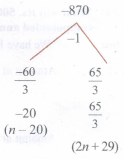
⇒ 3n2 + 5n - 1300 = 0
⇒ (n - 20) (3n + 65) = 0
⇒ n = 20 or \(n={-65\over 3}\) which is not possible
∴ n = 20
Thus, the amount is cleared in 20 months.
2.
Given A = {a, b, c, d}, B = {a, c, e}, C = {a, e}
B∩C = {a, c}
A∩(B∩C) = {a}
A ∩ B = {a, e}
(A ∩ B) ∩ C = {a}
From (1) and (2), it is clear that A ∩ (B ∩ C) = (A ∩ B) ∩ C.
3.
Given cos(\(\alpha \) - β)+cos(β - \(\gamma \))+cos(\(\gamma \) - \(\alpha \)) = - \(\frac{3}{2}\)
\(cos\alpha cos\beta +sin\alpha sin\beta +cos\beta cos\gamma +sin\beta sin\gamma +cos\gamma cos\alpha +sin\alpha sin\gamma =-\frac { 3 }{ 2 } \)
\(2\left[ cos\alpha cos\beta +cos\beta cos\gamma +cos\gamma cos\alpha +sin\alpha sin\beta +sin\beta sin\gamma +sin\alpha sin\gamma \right] =-3\)
\(\left( 2cos\alpha cos\beta +2cos\beta cos\gamma +2cos\gamma cos\alpha \right) +\left( 2sin\alpha sin\beta +2sin\beta sin\gamma +2sin\alpha sin\gamma \right) +3=0\)
\(\left( 2cos\alpha cos\beta +2cos\beta cos\gamma +2cos\gamma cos\alpha \right) +\left( 2sin\alpha sin\beta +2sin\beta sin\gamma +2sin\alpha sin\gamma \right) +\left( { cos }^{ 2 }\alpha +{ sin }^{ 2 }\alpha \right) +\left( { cos }^{ 2 }\beta +{ sin }^{ 2 }\beta \right) +\left( { cos }^{ 2 }\gamma +{ sin }^{ 2 }\gamma \right) =0\)
\({ \left( cos\alpha +cos\beta +cos\gamma \right) }^{ 2 }+{ \left( sin\alpha +sin\beta +sin\gamma \right) }^{ 2 }=0\)
\(cos\alpha +cos\beta +cos\gamma =0\) and \(sin\alpha +sin\beta +sin\gamma =0\)
4.
LHS = cos2A + (1-sin2B) - 2cos A cos B.cos(A+B)
= cos2A - sin2B+1 - 2cos A cos B.cos(A+B)
=cos(A+B)cos(A-B) + 1 - 2 cos A cos B.cos(A+B)
= cos(A + B)cos(A - B) + 1 - 2cos A cos B.cos(A+B)
= cos(A+B)[cos(A-B) - 2cos A cos B]+1
= cos(A+B)[cos A cos B + sin A sin B - 2 cos A cos B]+1
= -cos(A+B)[cos A cos B - sin A sin B]+1
= -cos(A+B) cos(A+B)+1
= -cos2(A+B)+1 = 1-cos2(A+B)
= sin2(A+B) = RHS
Hence proved.
5.
Let A, B be the land marks and C be the position of the plane,
Given ㄥACB 45°
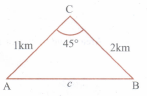
Using cosine formula,
c2 = a2 + b2 - 2ab cos C
c2 = 22 + 12 - 2(2)(1) cos 450
\(=4+1-4\left(1\over \sqrt3\right)\)

c2 = 5 - 2√2
\(c^2=\sqrt{5-2\sqrt2}km\)
6.
Let C be the position of the target and A and B be the positions of the fighter jet
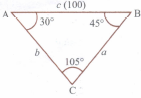
Given ㄥBAC = 30, ㄥABC = 45
ஃ ㄥC = 180 - (30 - 45) = 180 - 75 = 105
Given AB = 100 km
Using sine formula,
\(\frac { a }{ sinA } =\frac { c }{ sinC } \)
\(\Rightarrow \frac { a }{ sin30° } =\frac { 100 }{ sin105° } \)
\(\Rightarrow \frac { a }{ \frac { 1 }{ 2 } } =\frac { 100 }{ sin105° } \Rightarrow 2a=\frac { 100 }{ sin105° } \Rightarrow a=\frac { 50 }{ sin105° } \)
Now, sin 105° = sin (60 + 45) = sin 60 cos 45 + cos 60 sin 45
= \(\frac { \sqrt { 3 } }{ 2 } .\frac { 1 }{ \sqrt { 2 } } +\frac { 1 }{ 2 } .\frac { 1 }{ \sqrt { 2 } } =\frac { \sqrt { 3 } +1 }{ 2\sqrt { 2 } } \)
Substituting (2) in (1) we get,
a = \(\frac { 50 }{ \frac { \sqrt { 3 } +1 }{ 2\sqrt { 2 } } } \Rightarrow a=\frac { 50\left( 2\sqrt { 2 } \right) }{ \sqrt { 3 } +1 } =\frac { 100\sqrt { 2 } }{ \sqrt { 3 } +1 } \times \frac { \sqrt { 3 } -1 }{ \sqrt { 3 } -1 } \)
a = \(\frac { 100\left( \sqrt { 6 } -\sqrt { 2 } \right) }{ 3-1 } =50\left( \sqrt { 6 } -\sqrt { 2 } \right) km\)
7.
(b)
-\(\sqrt{2}\)
8.
(d)
(-2,\(\frac{-1}{3}\))
9.
(d)
x2+ 4x + 10 = 0
10.
(b)
\(\frac{\sqrt{14}}{2}\)
11.
\(\frac{2}{x+2}+\frac{1}{x-1}=\frac{2 x-2+x+2}{(x+2)(x-1)}=\frac{3 x}{(x+2)(x-1)}= k = 3\)
12.
\(x^{2}-\mathrm{k} x+\mathrm{c}=0\)
a and b are the roots
\(\therefore a+b=k, a b=c\)
To find
\(\sqrt{(a-b)^{2}+0^{2}}=a-b=\sqrt{(a+b)^{2}-4 a b}=\sqrt{k^{2}-4 c}\)
13.
\(x^{2}+a x+c=0 \)
\(x^{2}+d x+b=0 \)
\(8 \& 2 \text { are the roots }\)\(\text { 3. } 3 \text { are the roots }\)
\(\therefore a=-10 ; c=16 \quad d=-6, \quad b=9\)
\(x^{2}+a x+b =0 \)
\(x^{2}-10 x+9 =0 \)
\(\Rightarrow(x-1)(x-9) =0 \)
\(\therefore x =1 \text { (or) } 9 \)
14.
\(\log _{a} b \log _{b} c \log _{c} a=\log _{a} c \log _{c} a=\log _{a} a=1\)
15.
\(\text { Since }|\cos x|<1\)
\(\text { From option (4), }\)
\(\sec \theta=\frac{1}{4}\)
\(\Rightarrow \cos \theta=4 \text { is not possible. }\)
16.
\(\sqrt{2+2 \cos 4 \theta} =\sqrt{2+2\left(2 \cos ^{2} 2 \theta-1\right)} \)
\(=\sqrt{4 \cos ^{2} 2 \theta} \)
\(=2 \cos 2 \theta \)
\(\sqrt{2+\sqrt{2+2 \cos 4 \theta}} =\sqrt{2+2 \cos 2 \theta} \)
\(=\sqrt{2+2\left(2 \cos ^{2} \theta-1\right)} \)
\(=\sqrt{4 \cos ^{2} \theta} \)
\(=\pm 2 \cos \theta \)
\(\Rightarrow \pi<2 \theta<\frac{3 \pi}{2} \)
\(\Rightarrow \frac{\pi}{2}<\theta<\frac{3 \pi}{4} \text { in II quadrant. } \)
\(\therefore \sqrt{2+\sqrt{2+2 \cos 4 \theta}}=-2 \cos \theta\)
17.
Let X = (a, b, c)
Then R = Universal relation
= {(a, a), (a, b), (a, c), (b, a), (b, b), (b, c), (c, a), (c, b), (c, c)}.
It is transitive
18.
(c)
19.
Let A = (a, b),B = (a,b,c)
A \(\times\)B = {(a, a), (a, b), (a, c), (b, a), (b, b), (b, c)}
B \(\times\)A = {(a, a),(a, b), (b, a), (b, b), (c, a),(c, b)}
(A \(\times\)B) ⋂ (B \(\times\)A) = {(a, a), (a,b), (b, a): (b, b)}
= A \(\times\)A
20.
21.
\(\mathrm{T}: x-y \text { is an integer } \Rightarrow x \mathrm{R} y\)
\(\text { i) } x-x=0 \text { is an integer }\)
\(\therefore \text { T is reflexive. }\)
\(\text { ii) }(x-y) \text { is an integer } \Rightarrow y-x \text { is also an integer }\)
\(\therefore \mathrm{T} \text { is symmetry }\)
iii) If (x - y) is an integer and y- z is also an integer, by adding
x - z is also an integer.
\(\therefore \mathrm{T} \text { is transitive }\)
Thus, T is an equivalence relation.
\(\mathrm{S}: \mathrm{y}=x+1 \Rightarrow x \mathrm{~S} y\)
\(\text { i) } x=x+1 \Rightarrow x S x \text { is not true. }\)
\(\therefore S \text { is not reflexive. }\)
Hence T is an equivalence relation but S is not an equivalence relation
22.
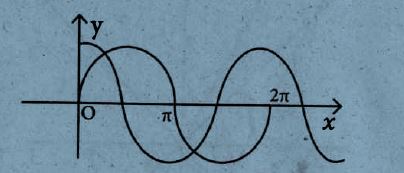
23.
\(n(A \cap B)=1\)
24.
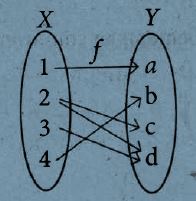
It is not a function since it has two images
25.
f(0) = 0, f(-3) = 9 and f(3) = 9
.'. S is [0,9]
26.
It is onto not one-one
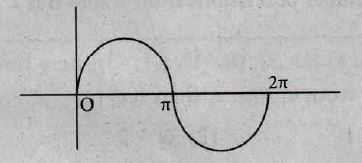
\(\text { Since } \sin 30^{\circ}=\frac{1}{2}\)
\(\sin 150^{\circ}=\frac{1}{2}\)
27.
Let the roots be α, 2α
sum of the roots α+2α = 3α =\(\frac { -(-a) }{ 2 } \) = \(\frac { a }{ 2 } \)
⇒ \(\alpha =\frac { a }{ 6 } \) ...(1)
Product of the roots α(2α)= 2α2 = \(\frac { 64 }{ 2 } \) = 32
⇒ a2 = \(\frac { 32 }{ 2 } \) = 16 ⇒ α =\(\sqrt { 16 } =\pm 4\)
Substituting a value in (1) we get
± 4 = \(\frac { a }{ 6 } \) ⇒ a = ± 6\(\times\)4 = ± 24
28.
Let the roots be α and α2
sum of the roots α + α2 = \(\frac { -k }{ 3 } \) ...(1)
product of the roots α(α2) = (α3) = \(\frac { -81 }{ 3 } \) = -27
α3 = -27=(-3)3 ⇒ α = -3
substituting α value in (1) we get
-3 + (-3)2 = \(\frac { -k }{ 3 } \)
(i.e) -3 + 9 = \(\frac { -k }{ 3 } \)
(i.e) \(\frac { -k }{ 3 } \) = 6 ⇒ k = -18
29.
cos 204= cos (180° + 24°) = - cos 24°
cos 125°= cos (180° - 55°) = - cos 55°
\(\therefore\) LHS cos 24° + cos 55° + (- cos 55°) + (- cos 24°) + cos 300°
= cos 24° + cos 55° - cos 55° - cos 24° + cos 300°
\(=cos300°=cos(360°-60°)=cos60°=\frac{1}{2}=RHS\)
30.
LHS sin (270° - \(\theta\)) sin (90° - \(\theta\)) - cos (270° - \(\theta\)) cos (90° + \(\theta\)) + 1
Now, sin (270° - \(\theta\)) = sin {180° + (90° - \(\theta\))}
= - cos (90° - \(\theta\)) = - sin \(\theta\)
LHS = - cos \(\theta\) . cos \(\theta\) - (- sin \(\theta\)) (- sin \(\theta\)) + 1
= - cos2 \(\theta\) - sin2\(\theta\) + 1
= - (cos2\(\theta\) + sin2 \(\theta\)) + 1 = -1 + 1 = 0 = RHS
31.
Here T2-T1 = \(log\frac { { a }^{ 2 } }{ b } -log\quad a=log\frac { { a }^{ 2 }/b }{ a } \)
= \(log\frac { a }{ b } \)
T3-T2 = \(log\frac { a^{ 3 } }{ b^{ 2 } } -log\frac { a^{ 2 } }{ b^{ 2 } } =log\frac { a^{ 3 } }{ b^{ 2 } } +log\frac { a^{ 2 } }{ b^{ 2 } } \)
= \(log\frac { a^{ 3 } }{ b^{ 2 } } \times \frac { b }{ { a }^{ 2 } } =log\frac { a }{ b } \)
∴ T2-T1 = T3-T2 = \(log\left( \frac { a }{ b } \right) \)
∴ The given sequences is an A.P
32.
In (1 + x)n, (r + 1)th term from the beginning.
Tr+1 = nCr 1n-r. xr = nCrxr ....(1)
Its co-efficient is nCr
In (1 + x)n, there are (n + 1) terms
So, the (r +1)th term from the end will have (n + 1) - (r + 1) = n - r terms
∴ Tn-r+1 = nCn-r 1n-(n-r).xn-r = nCn-rxn-r ...(2)
Its Co-efficient is nCn-r
From (1) and (2), the Co-efficient of (r + 1)th term from the beginning and from the end are equal
33.
(i) a particular teacher is included?
There are 5 teachers and 20 students 2 teachers out of 5 teachers can be selected in 5C2 ways.
3 students out of 20 students can be selected in 20C3 ways
Hence, total number of committees = 20C3 \(\times \) 5C2
= \(\frac { 20\times 19\times 18 }{ 3\times 2\times 1 } \times \frac { 5\times 4 }{ 2\times 1 } \)
= \(10\times 19\times 6\times 5\times 2\)
= 11400
Since a particular teacher is included, the committee will have 1 teacher and 3 students.
∴ 1 teacher can be selected from 4'teachers in 4C1 = 4 ways.
3 students out of 20 students can be selected in 20C3 ways.
Hence, required number of committees
= 4C1 \(\times \) 20C3
= \(4\times \frac { 20\times 19\times 18 }{ 3\times 2\times 1 } \)
= 4560
(ii) 2 teachers can be selected from 5 teachers in 5C2 ways
Since a particular student is excluded, 3 students can be selected from 19 students in 19C3 ways
Hence required number of committees = 19C3 \(\times \) 5C2
=\(\frac { 19\times 18\times 17 }{ 3\times 2\times 1 } \times \frac { 5\times 4 }{ 2\times 1 } \)
= 19 \(\times \)6\(\times \)17\(\times \)5
= 9690
34.
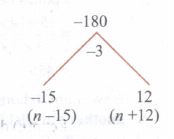
Let there be n sides of the polygon. We know that the number of diagonals of n sided polygon is \(\frac { n(n-3) }{ 2 } \)
⇒ Given \(\frac { n(n-3) }{ 2 } =90\)
⇒ n2-2n = 180
⇒ n2-3n-180 = 0
⇒ (n-15) (n+12) = 0
⇒ n = 15 or n = -12
⇒ There are 15 sides for the polygon which has 90 diagonals.
35.
Given (n+2)! = 60(n-1)!

\(\Rightarrow \) (n+2) (n+1)(n) = 60
\(\Rightarrow \) (n+2)(n+1)(n) = 5 \(\times\)4 \(\times\)3
Equating the terms both sides we get, n = 0
36.
LHS = n!(n + 2)
RHS = n! + (n+1)!
= n!+(n+1)(n)!....(1)
= n!(1+n+1)
= n!(n+20)...(2)
From (1) and (2), LHS = RHS
Hence Proved.
37.
Any line parallel to 2x + 3y = 10 is of the form 2x + 3y + k = 0 ....(1)
2x + 3y = -k
Dividing by - k we get,
\(\frac { 2x }{ -k } +\frac { 3y }{ -k } =1\)
\(\Rightarrow \frac { x }{ \left( -\frac { k }{ 2 } \right) } +\frac { y }{ \left( -\frac { k }{ 3 } \right) } =\pm \left( \frac { 5+k }{ 5 } \right) \)
Its intercepts are \(\frac { -k }{ 2 } \) and \(\frac { -k }{ 3 } \)
Also, it is given that sum of the intercepts on the axes is 15.
\(\therefore \ \frac { -k }{ 2 } +\left( \frac { -k }{ 3 } \right) =15\)
\(\Rightarrow \frac { -3k-2k }{ 6 } =15\)
\(\Rightarrow \frac { -5k }{ 6 } =15\)
\(\Rightarrow -5k=15\times 6\)
\(\Rightarrow k=\frac { -15\times 6 }{ 5 } =-18\)
\(\therefore\) Equation the required lines is 2x + 3y - 18 = 0 \(\Rightarrow\) 2x + 3y = 18.
38.
Set of concentric circles in a plane is an infinite set since number of concentric circles in a plane is infinite
39.
Given A = {0} ...(1)
B = {x : x > 15 and x < 5} ⇒ B = Ф ...(2)
C = {x : x-5 = 0} ⇒ B = {5} ...(3)
D = { x : x2 = 25} ⇒ D = {-5, 5} ...(4)
E = {x : x is an integral positive root of x2 - 2x - 15 = 0}
⇒ E = {5} ...(5)
From (3) and (5), clearly C = E.
Hence C and E are equal sets
40.
Given number is \(\frac { 1 }{ { 2 }^{ 1000 } } \)
we know 1000 < 1001
\(\Rightarrow\) 21000 < 21001
\(\Rightarrow\) \(\frac { 1 }{ { 2 }^{ 1000 } } <\frac { 1 }{ { 2 }^{ 1001 } } \)
\(\therefore\) A positive number smaller than \(\frac { 1 }{ { 2 }^{ 1000 } } is\frac { 1 }{ { 2 }^{ 1001 } } \)
41.
Let the two irrational numbers be \(5+\sqrt { 7 } \) and \(7-\sqrt { 7 } \)
Their sum = \(\left( 5+\sqrt { 7 } \right) +\left( 7-\sqrt { 7 } \right) \ = \ 5+\sqrt { 7 } +7-\sqrt { 7 } \)
= 5 + 7 = 12 which is a rational number.
Consider the two irrational numbers \(4+\sqrt { 6 } \) and \(4-\sqrt { 6 } \)
Their product = \(\left( 4+\sqrt { 6 } \right) +\left( 4-\sqrt { 6 } \right) ={ 4 }^{ 2 }-{ \left( \sqrt { 6 } \right) }^{ 2 }\)= 16 - 6 = 10 which is a rational number.
42.
(i) [-2, 0],
(ii) (0, 8),
(iii) (-8, -2],
(iv) [-5, -9]
43.
A = { x | x is a whole number less than or equal to 7 } is the set-bilder form of A.
44.
Tn = a + (n - 1)d
Tm+n = a + (m + n - 1)d
& Tm-n = a + (m - n - 1)d
Tm+n + Tm-n = a + (m + n - 1)d + a + (m - n - 1)d
= 2a + d(m + n - 1 + m - n - 1)
= 2a + d(2m - 2)
= 2[a + (m - 1)d]
Tm+n + Tm-n = 2. Tm

11th Standard Syllabus & Materials
11th Standard
TN 11th Tamil பீடு பெற நில் - செய்யுள் - காவடிச்சிந்து Important Questions And Answers Study Material - QB365 Set A
NEW11th Standard
TN 11th Tamil பீடு பெற நில் - உரைநடை - மலை இடப்பெயர்கள் : ஓர் ஆய்வு Important Questions And Answers Study Material - QB365 Set A
NEW11th Standard
TN 11th Tamil மாமழை போற்றுதும் - துணைப்பாடம் - யானை டாக்டர் Important Questions And Answers Study Material - QB365 Set A
NEW11th Standard
TN 11th Tamil மாமழை போற்றுதும் - செய்யுள் - ஐங்குறுநூறு Important Questions And Answers Study Material - QB365 Set A



Tamilnadu Stateboard 11th Standard Subjects
Maths

Commerce

Economics

Biology

Business Maths and Statistics

Accountancy

Computer Science

Physics

Chemistry
Maths
Biology
Economics
Physics
Chemistry

History
Business Maths and Statistics

Computer Science
Accountancy

Computer Applications
History
Computer Technology
Commerce
Computer Applications
Computer Technology

Tamil

English

French
Tamilnadu Stateboard Standards

