
6th Standard Syllabus & Materials
6th Standard
Tamilnadu 6th Standard Tamil இயல் 3 - எல்லாரும் இன்புற - பெயர்ச்சொல் Important Questions And Answers Study Material - QB365 Set B
NEW6th Standard
Tamilnadu 6th Standard Tamil இயல் 3 - எல்லாரும் இன்புற - பெயர்ச்சொல் Important Questions And Answers Study Material - QB365 Set A
NEW6th Standard
Tamilnadu 6th Standard Tamil இயல் 2 - கூடித் தொழில் செய் - சுட்டு எழுத்துகள், வினா எழுத்துகள் Important Questions And Answers Study Material - QB365 Set B
NEW6th Standard
Tamilnadu 6th Standard Tamil இயல் 2 - கூடித் தொழில் செய் - சுட்டு எழுத்துகள், வினா எழுத்துகள் Important Questions And Answers Study Material - QB365 Set A
NEW6th Standard
Tamilnadu 6th Standard Tamil பருவம் 1 - இயல் 1 - மொழி -தமிழ்த்தேன் - இன்பத்தமிழ் Important Questions And Answers Study Material - QB365
NEW6th Standard
Tamilnadu 6th Standard Social Science T3 - குடிமையியல் - உள்ளாட்சி அமைப்பு - ஊரகமும் நகர்ப்புறமும் Important Questions And Answers Study Material - QB365 Set B

Published on: 22/09/2018
Important Five Mark Question Paper
Download Tamil Nadu 6th Standard Maths question papers, model tests, one-mark questions, important questions, and public exam papers in PDF format. Free study materials and answer keys for TN State Board students.
Questions + Answers key
Take MCQ Maths TestPART - A
1.
Suppose that there are some eggs in a tray. If 6 eggs are taken out from it and still 10 eggs are remaining, how many eggs are there in the tray?

2.
Compare 59283746 and 59283748 using place value chart.
3.
In a family, the amount spent in a month for buying Provisions and Vegetables are in the ratio 3 : 2. If the allotted amount is Rs. 4000, then what will be the amount spent for (i) Provisions and (ii) Vegetables?
4.
A line segment 63 cm long is to be divided into two parts in the ratio 3 : 4. Find the length of each part.
5.
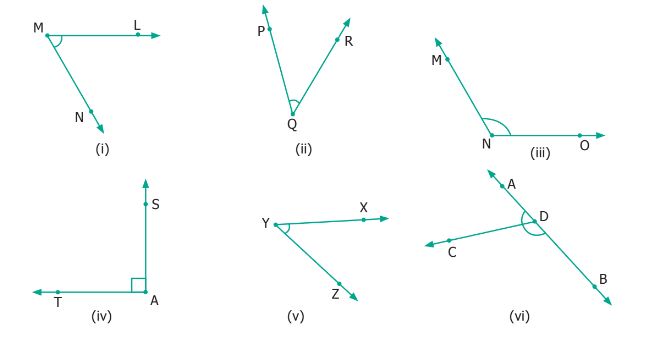
Pick out the Obtuse angles from the given figures.
6.
The table given below shows the results of the matches played by 8 teams in a Kabaddi championship tournament.
| Teams | A | B | C | D | E | F | G | H |
| Total Matches played | 8 | 7 | n | a | 9 | 10 | 8 | y |
| Matches won | 5 | 6 | 4 | 7 | b | 6 | x | 3 |
| Matches lost | k | m | 6 | 2 | 3 | c | 4 | 6 |
Find the value of all the variables in the table given above.
7.
You purchase 6 apples for Rs. 90 and your friend purchases 5 apples for Rs. 70. Whose purchase is better?
8.
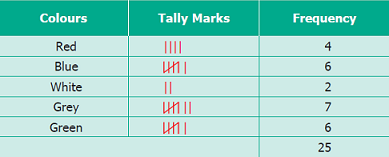
The following list tells colours liked by 25 students. Prepare a table using Tally Marks.
| Red | Blue | White | Grey | White |
| Green | Grey | Blue | Green | Grey |
| Blue | Grey | Red | Green | Red |
| Blue | Blue | Green | Blue | Green |
| Grey | Grey | Green | Grey | Red |
9.
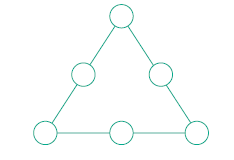
In the following magic triangle, arrange the numbers from 1 to 6, so that you get the same sum on all its sides.
10.
Read the given Bar Graph which shows the percentage of marks obtained by Brinda in different subjects in an assessment test.
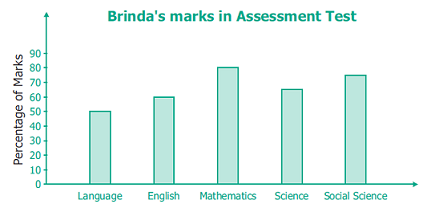
Observe the Bar Graph and answer the following questions.
(i) 1 Unit = __________ % of marks on vertical line.
(ii) Brinda has scored maximum marks in __________ subject.
(iii) Brinda has scored minimum marks in __________ subject.
(iv) The percentage of marks scored by Brinda in Science is __________.
(v) Brinda scored 60% marks in the subject __________.
(vi) Brinda scored 20% more in __________ subject than __________ subject.
11.
Count the number of squares in each of the following figures?

12.
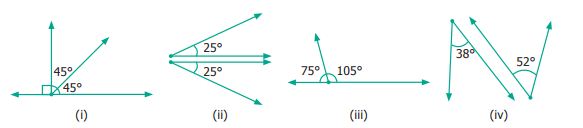
From the figures given below, classify the following pairs of angles into complementary and non complementary
13.
The bar graph illustrates the results of a survey conducted on vehicles crossing over a Toll Plaza in one hour.
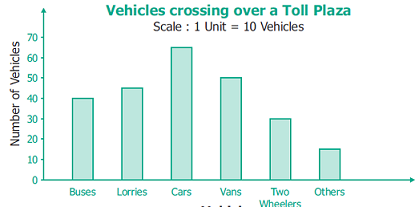
Observe the bar graph carefully and fill up the following table.
| Vehicles | Vans | Buses | Cars | Others | Total vehicles | ||
| Number of Vehicles | 30 | 45 |
14.
Gopal is 8 years younger to Karan. If the sum of their ages is 30, how old is Karnan?
15.
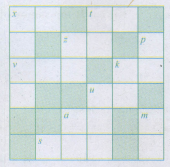
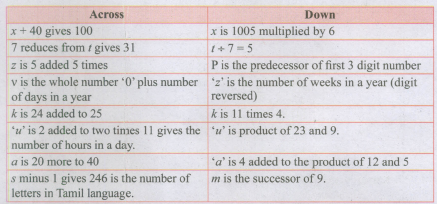
Find the variables from the clues given below and solve the cross-word puzzle.
16.
Mariana threw a die 40 times and noted the number appearing each time as shown below.
| 1 | 3 | 5 | 6 | 6 | 3 | 5 | 4 | 1 | 4 |
| 2 | 5 | 3 | 4 | 6 | 1 | 5 | 5 | 6 | 1 |
| 1 | 2 | 2 | 3 | 5 | 2 | 4 | 5 | 5 | 6 |
| 5 | 1 | 6 | 2 | 3 | 5 | 2 | 4 | 1 | 5 |
Make a table and enter the data using tally marks.
Find the number that appeared
(a) the minimum number of times
(b) the maximum number of times
(c) Find those numbers that appear an equal number of times.
17.
Total number of students of a school in different years is shown in the following table
| Years | Number of Students |
|---|---|
| 1996 | 800 |
| 1997 | 500 |
| 1998 | 450 |
| 1999 | 600 |
| 2000 | 950 |
A) Prepare a pictograph of students using one symbol to represent 100 students and answer the following questions
(a) How many symbols represent total number of students in the year 2000?
(b) How many symbols represent total number students in the year 1997?
18.
Ragavi's father is a mobile shop owner. She finds the following data of sale of mobiles in a week.
| Day | Number of Mobiles sold |
| Monday | 50 |
| Tuesday | 45 |
| Wednesday | 40 |
| Thursday | 20 |
| Friday | 35 |
| Saturday | 30 |
| Sunday | 55 |
Draw a vertical and horizontal bar graph
19.
In an exhibition, the number of tickets sold on the first, second, third and fourth days are 1,10,000, 75,060, 25,700 and 30,606 respectively. Find the total number of tickets sold on all the 4 days.
20.
Round off the seven digit number 29,75,842 to the nearest lakhs and ten lakhs. Are they the same?
PART - A
1.
According to the given statement,

This can be written as, x – 6 gives 10, where ‘x’ denotes the unknown number. Now, we will find out for what value of ‘x’, x − 6 gives 10.
| Value of ‘x’ Yes/No | x − 6 | Result | Is it 10? |
| 7 | 7-6 | 1 | No |
| 10 | 10-6 | 4 | No |
| 12 | 12-6 | 6 | No |
| 15 | 15-6 | 9 | No |
| 16 | 16-6 | 10 | Yes |
| 18 | 18-6 | 12 | No |
Hence, the unknown number (variable) ‘x’ takes the value 16.
2.
Step 1: Number of digits in the two given numbers are equal.
Step 2: Compare the place values using the place value chart.
| Place Value | C | T L | L | T Th | Th | H | T | 0 |
| First Number | 5 | 9 | 2 | 8 | 3 | 7 | 4 | 6 |
| Second Number | 5 | 9 | 2 | 8 | 3 | 7 | 4 | 8 |
Compare the digits of the two numbers from the highest place value as noted below.
| 5 = 5 | 9 = 9 | 2 = 2 | 8 = 8 | 3 = 3 | 7 = 7 | 4 = 4 | 6 < 8 |
Here only the digits in the ones place are not equal and 6 < 8.
Hence, 59283746 < 59283748.
3.
(i) For Provisions:
Dividing the total amount Rs. 4000 into 3 + 2 = 5 equal parts then
3 out of 5 parts are spent for provisions & 2 out of 5 parts for vegetables
\(\therefore 4000\times\frac{3}{5}=2400\) for provisions
(ii) For vegetables:
\(4000\times\frac{2}{5}=1600\) for Vegetables
\(\therefore\) Rs.2400 spend on provisions & Rs.1600 spend on Vegetables
4.
Total length 63 cm, on dividing 3 + 4 = 7 equal parts, we get the line segments with lengths
\(\frac{3}{7}\times63=27\ cm\)
\(\frac{4}{7}\times63=36\ cm\)
Length of each line segment is 27 cm & 36 cm
5.
i), iii) are obtuse angles
6.
i) 5k = 8
k = 8 - 5 =
k = 3
ii) 6 + m = 7
m = 7 - 6
m = 1
iii) 4 + 6 = n
n = 10
iv) 7 + 2 = a
a = 9
v) b + 3 = 9
= 9 - 3
b = 6
vi) 6 + c = 10
c = 10 - 6 = 4
c = 4
vii) x +4 = 8
x = 8 - 4
x = 4
viii) y = 3 + 6
y = 9
7.
In my purchase cost of 6 apples = Rs. 90
∴ cost of 1 apple = \(\frac { 90 }{ 6 } \) = Rs. 15
In my friend's purchase cost of 5 apples = Rs. 70
∴ Cost of apple =\(\frac { 70 }{ 5 } \) = Rs. 14
My friend buy for lower prize.
∴ My friend's purchase is a better buy.
8.
9.
Step 1: Complete the corners with smaller numbers 1, 2 and 3.
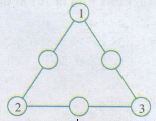
Step 2: The side having smallest numbers 1 & 2 are to be filled with the greatest number 6, the second smallest 1 & 3 side to be filled with the second largest 5 at the middle and so on.
a.JPG)
The magic sum is 1 + 6 + 2 = 2 + 4 + 3 = 3 + 5 + 1 = 9. Some other ways are given below
b.JPG)
The magic sum = 1 + 6 + 3 = 3 + 2 + 5 = 5 + 4 + 1 = 10
c.JPG)
The magic sum 6 + 1 + 4 = 4 + 5 + 2= 2 T 3 + 6 = 11.
d.JPG)
The magic sum 4 + 3 + 5 = 5 + 1 + 6= 6 + 2 + 4 = 12.
10.
i) 10%
ii) Mathematics
iii) Language
iv) 65%
v) English
vi) Mathematics; Science
11.
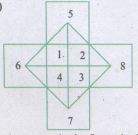
As we see in the figure in the middle 1, 2, 3 and 4 are 4 small squares.
Also we have 9 and 10 => 2 big squares. Outer squares 5, 6, 7, & 8 => 4.
Total = 4 + 4 + 1 + 1 = 10 squares.
12.
(i) and (iv) are complementary angles
(ii) and (iii) are non-complementary angles
13.
| Vehicles | Vans | Two Wheelers | Buses | Lorries | Cars | Others | Total vehicles |
| Number of Vehicles | 50 | 30 | 40 | 45 | 65 | 15 | 245 |
14.
Let karnan's age be x years
Gopals age is x-8 years
Given sum of their ages is 30.
i.e. x+(x-8) = 30
Now we will form the table to find thier sums =30
| Karnan's age(x) | Gopal's age x-8 | sum x+(x-8) | result | Is Sum=30 Yes/No |
| 10 | 10 - 8 = 2 | 10+2 | 12 | No |
| 11 | 11- 8= 3 | 11 + 3 | 14 | No |
| 12 | 12 - 8 = 4 | 12 + 4 | 16 | No |
| 13 | 13- 8= 5 | 13 + 5 | 18 | No |
| 14 | 14 - 8 = 6 | 14 + 6 | 20 | No |
| 15 | 15 - 8 = 7 | 15 + 7 | 22 | No |
| 16 | 16 - 8 = 8 | 16 + 8 | 24 | No |
| 17 | 17-8= 9 | 17 + 9 | 26 | No |
| 18 | 18-8=10 | 18 + 10 | 28 | No |
| 19 | 19-8=11 | 19 + 11 | 30 | Yes |
For x =19(Karnan's age) the sum = 30
\(\therefore \) Karnan's age = 19 years
15.
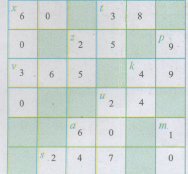
16.
Table using Tally Marks
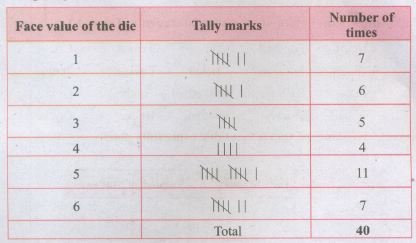
(a) The number '4' appeared minimum number of times
(b) The number '5' appeared maximum number of times
(c) Numbers '1' and '6' appeared equal number of times.
17.
The pictograph is given by
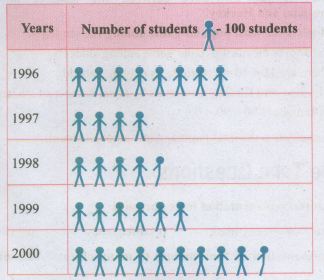
(a) 9 Full pictures and a half picture represent the number of students in the year2000
(b) 5 symbols
18.
(i) Vertical Bar Graph.
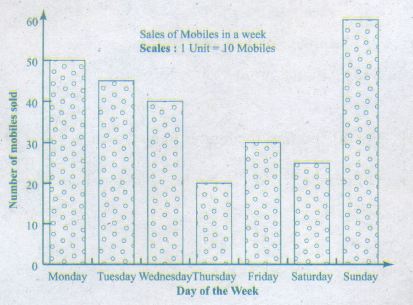
(ii) Horizontal Bar Graph.
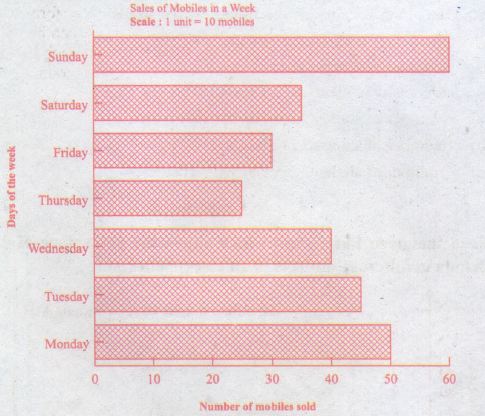
19.
| Number of tickets sold on the first day | = | 1,10,000 |
| Number of tickets sold on the second day | = | 75,060 |
| Number of tickets sold on the third day | = | 25,700 |
| Number of tickets sold on the fourth day | = | 30,606 |
| Adding all the above, the total number of tickets sold on all the 4 days |
= | 2,41,366 |
20.
| TL | L | TTH | TH | H | T | O |
| 2 | 9 | 7 | 5 | 8 | 4 | 2 |
To the nearest lakhs \(\Rightarrow\) 30,00,000
To the nearest ten lakhs \(\Rightarrow\) 30,00,000
Yes, they are the same.

6th Standard Syllabus & Materials
6th Standard
Tamilnadu 6th Standard Social Science T3 - குடிமையியல் - உள்ளாட்சி அமைப்பு - ஊரகமும் நகர்ப்புறமும் Important Questions And Answers Study Material - QB365 Set A
NEW6th Standard
Tamilnadu 6th Standard Social Science T3 - குடிமையியல் - மக்களாட்சி Important Questions And Answers Study Material - QB365 Set B
NEW6th Standard
Tamilnadu 6th Standard Social Science T3 - குடிமையியல் - மக்களாட்சி Important Questions And Answers Study Material - QB365 Set A
NEW6th Standard
Tamilnadu 6th Standard Social Science T3 - புவியியல் - பேரிடரைப் புரிந்து கொள்ளுதல் Important Questions And Answers Study Material - QB365 Set B



Tamilnadu Stateboard 6th Standard Subjects
Tamilnadu Stateboard Standards




