
 100% FREE ACCESS
11th Standard Syllabus & Materials
11th Standard
TN 11th Tamil இயற்கை வேளாண்மை,சுற்றுச்சூழல் -செய்யுள் - மனோன்மணீயம் Important Questions And Answers Study Material - QB365 Set A
NEW11th Standard
TN 11th Tamil என்னுயிர் என்பேன் -துணைப்பாடம் - இசைத்தமிழர் இருவர் Important Questions And Answers Study Material - QB365 Set A
NEW11th Standard
TN 11th Tamil மொழி கலை -செய்யுள் - ஒவ்வொரு புல்லையும் Important Questions And Answers Study Material - QB365 Set A
NEW11th Standard
TN 11th Tamil பீடு பெற நில் - இலக்கணம் - பகுபத உறுப்புகள் Important Questions And Answers Study Material - QB365 Set A
NEW11th Standard
TN 11th Tamil பீடு பெற நில் - துணைப்பாடம் - வாடிவாசல் Important Questions And Answers Study Material - QB365 Set A
NEW11th Standard
TN 11th Tamil பீடு பெற நில் - செய்யுள் - குறுந்தொகை Important Questions And Answers Study Material - QB365 Set A

Published on: 15/08/2018
UNIT V
Download Tamil Nadu 11th Standard Maths question papers, model tests, one-mark questions, important questions, and public exam papers in PDF format. Free study materials and answer keys for TN State Board students.
Questions + Answers key
Take MCQ Maths Test1.
If an A.P the sum of terms equidistant from the beginning and end is equal to ______________
first term
second term
sum of first and last term
last term
2.
If x, 2x + 2, 3x + 3 . . . are in G.P, then the 4th term is ______________
27
-27
13.5
-13.5
3.
21/4 41/8 81/16 161/32 . . . = ______________
1
2
\(\frac{3}{2}\)
\(\frac{5}{2}\)
4.
The sum of 40 terms of an A.P whose first term is 2 and common difference 4 will be ______________
3200
1600
200
2800
5.
If a,b, c are in A.P, as well as in G.P then ______________
a = b ≠ c
a ≠ b = c
a ≠b ≠ c
a = b = c
6.
\(\frac{1}{q+r},\frac{1}{r+p},\frac{1}{p+q}\) are in A.P., then ______________
p,q,r are inA.P
p2,q2,r2 are inA.P
\(\frac{1}{p},\frac{1}{q},\frac{1}{r}\)
p,q,r are in H.P.
7.
The value of n for which \(\frac{a^{n+1}+b^{n+1}}{a^n+b^n}\) is the arithmetic mean of a and b is ______________
1
2
4
0
8.
The value of nC0 - nC1 + nC2 - nC3 ... + (-1)nnCn is ______________
2n+1
n
2n
0
9.
The sum of the coefficients in the expansion of (1 - x)10 is ______________
0
1
102
1024
10.
The last term in the expansion of (2 +\(\sqrt { 3 } \))8 ______________
81
27
\(\sqrt { 3 } \)
3
11.
Sum of the binomial coefficients is ______________
2n
n2
2n
n+17
12.
The larget coefficients in the expansion of (1 + X)24 is ______________
24C24
24C13
24C12
24C11
13.
\(\frac{2}{1!}+\frac{4}{3!}+\frac{6}{5!}+. . .\infty =\) ______________
e
2e
\(\frac{1}{e}\)
e2
14.
\(\left(1+\frac{1}{\lfloor2}+\frac{1}{\lfloor4}+\frac{1}{\lfloor6}+...\right)^2-\left(1+\frac{1}{\lfloor3}+\frac{1}{\lfloor5}+\frac{1}{\lfloor7}+...\right)^2=\)______________
1
2
e
2e
15.
3 log 2 + \(\frac{1}{4}-\frac{1}{2}(\frac{1}{4})^2+\frac{1}{3}(\frac{1}{4})^2\)+ . . . = ______________
log 8
log 10
log 2
log 4
16.
The ratio of the coefficient of x 15 to the term independent of x in \([x^2+(\frac{2}{x})]^{15}\) is ______________
1:16
1:8
1:32
1:64
17.
The sum of the series C02- C12 + C22 .....+ (- 1)nC2n where n is an even integer is ______________
2nCn
(-1)n2nCn
(-1)n2nCn-1
(-1)n/2nCn/2
18.
The middle term in the expansion of is \((x- \frac{2}{x})^{12}\) is ______________
12C6
12C626
12C7
12C627
19.
The coefficient of x32 in the expansion of \((x^4-\frac{1}{x^3})^{15}\)______________
15C4
15C3
15C5
15C6
20.
The coefficient of a5 in the expansion of (3a + 5b)5 is ______________
1
243
6750
9375
21.
The value of \(1-\frac{1}{2}(\frac{3}{4})+\frac{1}{3}(\frac{3}{4})^2-\frac{1}{4}(\frac{3}{4})^3+...\)is ______________
\(\frac{3}{4}log(\frac{7}{4})\)
\(\frac{4}{3}log(\frac{7}{4})\)
\(\frac{1}{3}log(\frac{7}{4})\)
\(\frac{4}{3}log(\frac{4}{7})\)
22.
Expansion of \(log(\sqrt \frac{1+x}{1-x})\) is ______________
\(x+\frac{x^3}{3}+\frac{x^5}{5}+...\)
\(1.\frac{x^2}{2}+\frac{x^4}{4}+...\)
\(1-x+\frac{x^2}{2}+\frac{x^3}{5}+...\)
\(x-\frac{x^2}{3}+\frac{x^3}{3}+...\)
23.
\(\sqrt \frac{1-2x}{1+2x}\) is approximately equal to ______________
1- 2x-x2
1 + 2x+ x2
1+ 2x
1-2x+x2
24.
\(\frac{1}{1!}+\frac{1}{3!}+\frac{1}{5!}+...\) is ______________
\(\frac{e^{-1}}{2}\)
\(\frac{e+e^{-1}}{2}\)
\(\frac{e-e^{-1}}{2}\)
none of these
25.
1 - 2x + 3x2 - 4x3 + ..., Ixl< 1 is ______________
(1-x)-2
(1+x)-2
(1-x)2
(1+x)2
26.
In the series \(\frac{1}{1+\sqrt 2}+\frac{1}{\sqrt 2+\sqrt 3}+\frac{1}{\sqrt 3+\sqrt 4}+...\) some of first 24 number is ______________
4
\(\sqrt 24\)
\(\frac{1}{\sqrt 24}\)
\(\frac{1}{\sqrt 25-\sqrt 24}\)
27.
AM, GM, HM denote the Arithmetic mean, Geometric mean and Harmonic mean respectively the relationship between this is ______________
AM < GM < HM
AM ≤ GM ≤ HM
AM>GM>HM
AM≥GM≥HM
28.
In the expansion of (1 +x )22 which term is the middle term ______________
T11 and T12
T11
T12
T13
29.
In the expansion of (2x + 3)5 the coefficient of x2 is ______________
720
1080
810
5
30.
With usual notation C0 + C2 + C4 + ... is ______________
2n-1
2n
2n+1
2n+2
31.
If (1 + x2)2 (1 + x)n = a0+ a1x + a2x2 + ... + xn+4 and if a0, a1, a2 are in AP, then n is
1
5
2
4
32.
If a is the arithmetic mean and g is the geometric mean of two numbers, then
a \(\le \) g
a \(\ge\) g
a = g
a > g
33.
If nC10 > nCr for all possible r, then a value of n is
10
21
19
20
34.
The coefficient of x8y12 in the expansion of (2x + 3y)20 is
0
28312
28312 + 21238
20C8 28 312
35.
The coefficient of x6 in (2 + 2x)10 is
10C6
26
10C626
10C6210
36.
37.
The Co-efficient of x3 in \(\sqrt { \frac { 1-x }{ 1+x } } ,\left| x \right| <1\ is\ \)______________
\(\frac { 1 }{ 2 } \)
\(\frac { 3 }{ 8 } \)
\(\frac { -3 }{ 8 } \)
\(\frac {- 1 }{ 2 } \)
38.
The series for log \(\left( \frac { 1+x }{ 1-x } \right) is\) ______________
\(x+\frac { { x }^{ 3 } }{ 3 } +\frac { { x }^{ 5 } }{ 5 } +...+\infty \)
\(2\left[ x+\frac { { x }^{ 3 } }{ 3 } +\frac { { x }^{ 5 } }{ 5 } +...+\infty \right] \)
\(\frac { { x }^{ 2 } }{ 2 } +\frac { { x }^{ 4 } }{ 4 } +\frac { { x }^{ 6 } }{ 6 } +...+\infty \)
\(2\left[ \frac { { x }^{ 2 } }{ 2 } +\frac { { x }^{ 4 } }{ 4 } +\frac { { x }^{ 6 } }{ 6 } +...+\infty \right] \)
39.
The series 1+4x+8x2 + \(\frac { 32 }{ 3 } { x }^{ 3 }+.....+\infty \ is\) ______________
ex
e4x
e2x
e8x
40.
Sum of n terms of the series \(\sqrt { 2 } +\sqrt { 8 } +\sqrt { 18 } +\sqrt { 32 } ..is\) ______________
\(\frac { n(n+1) }{ 2 } \)
2n(n+1)
\(\frac { n(n+1) }{ \sqrt { 2 } } \)
1
41.
If \(\Sigma n=210\) then \(\Sigma { n }^{ 2 }\)= ______________
2870
2160
2970
none of these
42.
The sum of the series \(\frac { 1 }{ { log }_{ 2 }^{ 4 } } +\frac { 1 }{ { log }_{ 4 }^{ 4 } } +\frac { 1 }{ { log }_{ 8 }^{ 4 } } +.....+\frac { 1 }{ { log }_{ { 2 }^{ n } }^{ 4 } } is\)______________
\(\frac { n(n+1) }{ 2 } \)
\(\frac { n(n+1)(2n+1) }{ 2 } \)
\(\frac { n(n+1) }{ 4 } \)
none of these
43.
The value of \({ 9 }^{ \frac { 1 }{ 3 } }\) ,\({ 9 }^{ \frac { 1 }{ 9 } }\)\({ 9 }^{ \frac { 1 }{ 27}}\),\(\infty \) is ______________
1
3
9
none of these
44.
The nth term of a G.P is 128 and the sum of its n terms is 225. If its common ratio is 2, then its first term is ______________
1
3
8
none of these
45.
If in an infinite G. P. first term is equal to 10 times the sum of all successive terms, then its common ratio is ______________
\(\frac { 1 }{ 10 } \)
\(\frac { 1 }{ 11 } \)
\(\frac { 1 }{ 9 } \)
\(\frac { 1 }{ 20 } \)
46.
If the first, second and last term of an A.P. are a, b and 2a respectively, then its sum is ______________
\(\frac { ab }{ 2(b-a) } \)
\(\frac { ab }{ b-a } \)
\(\frac { 3ab }{ 2(b-a) } \)
none of these
47.
The first and last term of an A.P. are 1 and 11. If the sum of its terms is 36, then the number of terms will be ______________
5
6
7
8
48.
The term without x in \({ \left( 2x-\frac { 1 }{ 2{ x }^{ 2 } } \right) }^{ 12 }\) is ______________
495
-495
-7920
7920
49.
If the sum of n terms of an A. P. be 3n2 - n and its common difference is 6, then its first term is ______________
2
3
1
4
50.
The Co-efficient of x-17 in \({ \left( { x }^{ 4 }-\frac { 1 }{ { x }^{ 3 } } \right) }^{ 15 }\)is _____________
1365
-1365
3003
-3003
51.
If \(\frac { { T }_{ 2 } }{ { T }_{ 3 } } \)is the expansion of (a+b)n and \(\frac { { T }_{ 3 } }{ { T }_{ 4 } } \) is the expansion of (a+b)n+3 are equal, then n = ______________
3
4
5
6
52.
The value of \(1-\frac { 1 }{ 2 } \left( \frac { 2 }{ 3 } \right) +\frac { 1 }{ 3 } { \left( \frac { 2 }{ 3 } \right) }^{ 2 }-\frac { 1 }{ 4 } { \left( \frac { 2 }{ 3 } \right) }^{ 2 }+....is\)
\(log\left( \frac { 5 }{ 3 } \right) \)
\(\frac { 3 }{ 2 } log\left( \frac { 5 }{ 3 } \right) \)
\(\frac { 5 }{ 3 } log\left( \frac { 5 }{ 3 } \right) \)
\(\frac { 2 }{ 3 } log\left( \frac { 2 }{ 3 } \right) \)
53.
The value of \(\frac { 1 }{ 2! } +\frac { 1 }{ 4! } +\frac { 1 }{ 6! } +....is\)
\(\frac { { e }^{ 2 }+1 }{ 2e } \)
\(\frac { { (e+1) }^{ 2 } }{ 2e } \)
\(\frac { { (e-1) }^{ 2 } }{ 2e } \)
\(\frac { { e }^{ 2 }+1 }{ 2e } \)
54.
The coefficient of x5 in the series e-2x is
\(\frac { 2 }{ 3 } \)
\(\frac { 2 }{ 3 } \)
\(\frac { -4 }{ 15 } \)
\(\frac { 4 }{ 15 } \)
55.
The sum of an infinite GP is 18. If the first term is 6, the common ratio is
\(\frac { 1 }{ 3 } \)
\(\frac { 2 }{ 3 } \)
\(\frac { 1 }{ 6 } \)
\(\frac { 3 }{ 4 } \)
56.
The value of the series\(\frac { 1 }{ 2 } +\frac { 7 }{ 4 } +\frac { 13 }{ 8 } +\frac { 19 }{ 16 } +\).....is
14
7
4
6
57.
The sum up to n terms of the series \(\sqrt { 2 } +\sqrt { 8 } +\sqrt { 18 } +\sqrt { 32 } +\).....is
\(\frac { n(n+1) }{ 2 } \)
2n(n+1)
\(\frac { n(n+1) }{ \sqrt { 2 } } \)
1
58.
The nth term of the sequence \(\frac { 1 }{ 2 } ,\frac { 3 }{ 4 } ,\frac { 7 }{ 8 } ,\frac { 15 }{ 6 } \),......is
2n - n - 1
1 - 2-n
2-n + n - 1
2n-1
59.
The sum up to n terms of the series \(\frac { 1 }{ \sqrt { 1 } +\sqrt { 3 } } +\frac { 1 }{ \sqrt { 3 } +\sqrt { 5 } } +\frac { 1 }{ \sqrt { 5 } +\sqrt { 7 } } +\)....is
\(\sqrt { 2n+1 } \)
\(\frac { \sqrt { 2n+1 } }{ 2 } \)
\(\sqrt { 2n+1 } -1\)
\(\frac { \sqrt { 2n+1 } -1 }{ 2 } \)
60.
The nth term of the sequence 1, 2, 4, 7, 11,... is
n3 + 3n2 + 2n
n3 - 3n2 + 3n
\(\frac { n(n+1)(n+2) }{ 3 } \)
\(\frac { { n }^{ 2 }-n+2 }{ 2 } \)
61.
The remainder when 3815 is divided by 13 is
12
1
11
5
62.
If Sn denotes the sum of n terms of an AP whose common difference is d, the value of Sn - 2Sn-1 + Sn-2 is
d
2d
4d
d2
63.
The HM of two positive numbers whose AM and GM are 16, 8 respectively is
10
6
5
4
64.
The sequence \(\frac { 1 }{ \sqrt { 3 } } ,\frac { 1 }{ \sqrt { 3 } +\sqrt { 2 } }, \frac { 1 }{ \sqrt { 3 } +2\sqrt { 2 } },...... \)form an
AP
GP
HP
AGP
65.
If a, 8, b are in AP, a, 4, b are in GP, and if a, x, b are in HP then x is
2
1
4
16
66.
If sum of the n terms of a G.P be S, their product P and the sum of their reciprocals R, then prove that \(P^{2}=(\frac{S}{R})^{n}\)
67.
If S1, S2, S3 be respectively the sums of n, 2n, 3n, terms of a G.P. , then prove that S1 (S3 - S2) = (S2 - S1)2.
68.
If three consecutive coefficients in the expansion of (1+x)n are in the ratio 6:33:110,find n.
69.
Show that the coefficient of the middle term in the expansion of (1+x)2n is equal to the sum of the coefficients of the two middle terms in the expansion of (1+x)2n-1.
70.
Find the value of \((a^{2}+\sqrt{a^{2}-1})^{4}+(a^{2}-\sqrt{a^{2}-1})^{4}\)
71.
The coefficient of (r - 1)th, rth, and (r + 1)th terms in the expansion of (x + 1)n are in the ratio 1 : 3 : 5. Find both n and r.
72.
Prove that \(\sqrt [ 3 ]{ x^3+7 } -\sqrt [ 3 ]{ x^3+4 } \) is approximately equal to \({1\over x^2}\) when x is large.
73.
Find \(\sqrt [ 3 ]{ 65} .\)
74.
Expand \({1\over (3+2x)^2}\) in powers of x. Find a condition on x for which the expansion is valid.
75.
Find the sum of the first 20-terms of the arithmetic progression having the sum of first 10 terms as 52 and the sum of the first 15 terms as 77.
76.
Find \(\sum_{k=1}^{n}{1\over k(k+1)}.\)
77.
Find the sum of the first n terms of the series \({1\over 1+\sqrt{2}}+{1\over\sqrt{2}+\sqrt{3}}+{1\over\sqrt{3}+\sqrt{4}}+...\)
78.
Evaluate \(\sum_{k=1}^{10}(k^2-3k+5)\).
79.
Find \(\sqrt {4+x^2}-\sqrt {4-x^2}\) when x is small.
80.
Find \(\sqrt{x^2+4}-\sqrt{x^2-4}\) when x is large.
81.
Find the coefficient of x in the expansion of \(log(\frac{1}{1-5x+6x^2})\).
82.
Find \(\sum _{ n=1 }^{\infty }{1\over n^2+5n+6 } \)
83.
Find the last two digits of the number 7400.
84.
Expand \((x^2+\sqrt{1-x^2})^5+(x^2-\sqrt{1-x^2})^5.\)
85.
Using Binomial theorem, prove that 6n - 5n always leaves remainder 1 when divided by 25 for all positive integer n.
86.
The 2nd, 3rd and 4th terms in the binomial expansion of (x + a)n are 240, 720 and 1080 for a suitable value of x. Find x, a and n.
87.
The AM of two numbers exceeds their GM by 10 and HM by 16, Find the numbers
88.
If a,b,c are in geometric progressions and if \({ a }^{ \frac { 1 }{ x } }={ b }^{ \frac { 1 }{ y } }={ c }^{ \frac { 1 }{ z } }\) , then prove that x, y, z are in arithmetic progression
89.
If \(\alpha ,\beta \)are the roots of the equation x2-px + q = 0, then prove that \(\log { (1+px+q{ x }^{ 2 }) } =(\alpha +\beta )x=\frac { { \alpha }^{ 2 }+{ \beta }^{ 2 } }{ 2 } { x }^{ 2 }+\frac { { \alpha }^{ 2 }+{ \beta }^{ 2 } }{ 3 } { x }^{ 3 }-....\infty \)
90.
If tk the kth term of a GP, then show that tn-k, tn, tn+k also form a GP for any positive integer K
91.
The product of three increasing numbers in GP is 5832. if we add 6 to the second number and 9 to the third number, then resulting numbers form an AP. Find the numbers in GP
92.
Find the Co-efficient of x5 in the expansion of \(\frac { 1-4x-{ x }^{ 2 } }{ ex } \)
93.
Find the fourth root of 623 correct to seven places of decimal.
94.
Find the sum of the series \(\frac { { 1 }^{ 3 } }{ 1 } +\frac { { 1 }^{ 3 }+{ 2 }^{ 3 } }{ 1+3 } +\frac { { 1 }^{ 3 }+{ 2 }^{ 3 }+3^{ 3 }+.... }{ 1+3+5 } to\ n\ terms\)
95.
Find the value of \(\sum _{ n=1 }^{ \infty }{ \frac { 1 }{ { 2 }^{ n-1 } } \left( \frac { 1 }{ { 9 }^{ n-1 } } +\frac { 1 }{ { 9 }^{ 2n-1 } } \right) } \)
96.
Find the coefficient of x4 in the expansion of \(\frac { 3-4x+{ x }^{ 2 } }{ { e }^{ 2x } } \)
97.
Find the sum to n terms of the series 1 - 5 + 9 - 13+ ......
98.
Find the sum of the series \(1+\frac { 2 }{ 5 } +\frac { 3 }{ { 5 }^{ 2 } } +\frac { 5 }{ { 5 }^{ 3 } } +\)
99.
If the harmonic mean between two positive numbers is to their geometric mean is 12 : 13, find the ratio between the numbers.
100.
If the first two terms of a H. P are \(\frac { 2 }{ 5 } \) and\(\frac { 12 }{ 13 } \) respectively, find the largest term of the H.P.
101.
If A and G be respectively the A. M and G. M between two positive numbers, find the numbers
102.
If S n denotes that Sum of n terms of a G. P., prove that (s10-s20 )2 = s10 (s30 - s20)
103.
A manufacturer of radio sets produced 600 units the third year and 700 units in the seventh year. Assuming the production increases uniformly by a fixed number every year, find
(i) the production in the first year
(ii) the total production in 7 years and
(iii) the production in the 10th year.
104.
If (p+1) th term of an A.P is twice the (q+1)th terms prove that the (3p+1)th term is twice the (p+q+1)th term
105.
If p - q is small compared to either p or q, then show that \(n\sqrt { \frac { p }{ q } } =\frac { \left( n+1 \right) p+\left( n-1 \right) q }{ \left( n-1 \right) p+\left( n+1 \right) q } \)
Hence find \(8\sqrt { \frac { 15 }{ 16 } } \)
106.
Write the first 4 terms of the logarithmic series of \(\log { \left( \frac { 1-2x }{ 1+2x } \right) } \). Find the intervals on which the expansions are valid
107.
Write the first 4 terms of the logarithmic series of \(\log { \left( \frac { 1+3x }{ 1-3x } \right) } \). Find the intervals on which the expansions are valid
108.
If x = 0.001, prove that \(\frac { { \left( 1-2x \right) }^{ \frac { 2 }{ 3 } }{ \left( 4+5x \right) }^{ \frac { 3 }{ 2 } } }{ \sqrt { 1-x } } \) = 8.01 up to two places of decimals
109.
In the binomial expansion of (a+b)n the coefficients of the 4th and 13th terms are equal to each other, find n.
110.
If the Co-efficients of three successive terms in the expansion of (1 +x)n are in the ratio 1 : 3 : 5, then find the value of n
111.
If P be the sum of odd terms and Q that of even terms in the expansion of (x + y)n, then prove that
(i) (x2-y2)n = P2-Q2
(ii) (x-y)2n = 4PQ
112.
If a and b are distinct integers, prove that an - bn, is the factor of an -bn, whenever n is a positive integer [Hint: write an = (a-b+b)]n
113.
Prove that \({ C }_{ 0 }^{ 2 }+{ C }_{ 1 }^{ 2 }+{ C }_{ 2 }^{ 2 }+...=\frac { (2n)! }{ (n)! } \)
114.
In the binomial coefficient of (1+x)n the Coefficients of the 5th, 6th and 7th terms are in A.P find all values of n
115.
if the binomial co-efficients of three consecutive terms in the expansion of ( a + xn) are in the ratio 1:7:42 then find n
116.
If n is a positive integer, show that 9n+1 - 8n - 9 is always divisible by 64
117.
Find the last two digits of the number 3600
118.
Prove that \(\sqrt { \frac { 1-x }{ 1+x } } \) is approximately equal to 1 - x + \(\frac{x^2}{2}\) when x is very small.
119.
Prove that \(\sqrt [ 3 ]{ { x }^{ 3 }+6 } -\sqrt [ 3 ]{ { x }^{ 3 }+3 } \) is approximately equal to \(\frac { 1 }{ { x }^{ 2 } } \) when x is sufficiently large.
120.
Find the Constant term of \(\left( { 2x }^{ 3 }-\frac { 1 }{ { 3x }^{ 2 } } \right) ^{ 5 }\)
121.
Find the Co-efficient of x4 in the expansion (1+x3)50 \(\left( { x }^{ 2 }+\frac { 1 }{ { x }^{ 3 } } \right) ^{ 5 }\)
122.
Find the Co-efficient of x6 and the co-efficient of x2 in \(\left( { x }^{ 2 }-\frac { 1 }{ { x }^{ 3 } } \right) ^{ 6 }\)
123.
Find the Co-efficient of x15 in \(\left( { x }^{ 2 }+\frac { 1 }{ { x }^{ 3 } } \right) ^{ 10 }\)
124.
Compute 994
125.
In a certain town, a viral disease caused severe health hazards upon its people disturbing their normal life. It was found that on each day, the virus which caused the disease spread in Geometric Progression. The amount of infectious virus particle gets doubled each day, being 5 particles on the first day. Find the day when the infectious virus particles just grow over 1,50,000 units?
126.
What will Rs. 500 amounts to in 10 years after its deposit in a bank which pays annual interest rate of 10% compounded annually?
127.
The number of bacteria in a certain culture doubles every hour. If there were 30 bacteria present in the culture originally, how many bacteria will be present at the end of 2nd hour, 4th hour and nth hour?
128.
In a race, 20 balls are placed in a line at intervals of 4 meters, with the first ball 24 meters away from the starting point. A contestant is required to bring the balls back to the starting place one at a time. How far would the contestant run to bring back all balls?
129.
A man repays an amount of Rs. 3250 by paying Rs. 20 in the first month and then increases the payment by Rs.15 per month. How long will it take him to clear the amount?
130.
Find the value of n if the sum to n terms of the series \(\sqrt { 3 } +\sqrt { 75 } +\sqrt { 243 } +....is\quad 435\sqrt { 3 } .\)
131.
Compute the sum of first n terms of 1 + (1 + 4) + (1 + 4 + 42) + (1 + 4 + 42 + 43) + ...
132.
Compute the sum of first n terms of the following series 6 + 66 + 666 + .......
133.
Compute the sum of first n terms of the following series 8 + 88 + 888 + .......
134.
Find the sum up to the 17th term of the series \(\frac { { 1 }^{ 3 } }{ 1 } +\frac { { 1 }^{ 3 }+{ 2 }^{ 3 } }{ 1+3 } +...+\frac { { 1 }^{ 3 }+{ 2 }^{ 3 }+{ 3 }^{ 3 } }{ 1+3+5 } +......\)
135.
Expand \(\left( { 2x }^{ 2 }-3\sqrt { 1-{ x }^{ 2 } } \right) ^{ 4 }+({ 2x }^{ 2 }+3\sqrt { 1-{ x }^{ 2 }) } ^{ 4 }\)
136.
If a, b, c are respectively the pth qth and rth terms of a GP. show that (q - r) log a + (r - p) log b + (p - q) log c = 0.
137.
If the roots of the equation (q - r) x2 + (r - p)x + p - q = 0 are equal, then show that p, q and r are in A.P.
138.
Show that \({ x }^{ n }=1+n\left( 1-\frac { 1 }{ x } \right) +\frac { n(n+1) }{ 1.2 } \left( 1-\frac { 1 }{ x } \right) ^{ 2 }+...\)
139.
If x so large prove that \(\sqrt { { x }^{ 2 }+25 } -\sqrt { { x }^{ 2 }+9 } =\frac { 8 }{ x } \) nearly.
140.
Evaluate the following:
\(\frac { 1 }{ \sqrt [ 3 ]{ 128 } } \)correct to 4 places of decimals
141.
Evaluate the following:
\(\sqrt [ 3 ]{ 1003 } \) correct to 4 places of decimals
142.
Write the first four terms in the expansions of the following
\(\frac { 1 }{ \sqrt [ 6 ]{ 6-3x } } where\left| x \right| <2\)
143.
Write the first four terms in the expansions of the following
\(\frac { 1 }{ { (2+x) }^{ 4 } } where\left| x \right| >2\)
144.
Sum up to n terms the series:
7 + 77 + 777 + 7777 + ...
145.
Sum the series: (1 + x) + (1 + x + x2) + (1 + x + x2 +x3) + ... up to n terms
146.
Find the sum to n terms the series: (x + y) + (x2+ Xy + y2)+ (x2+ x2y + xy + y3) + ...
147.
The sum of first three terms of a G.P. is to the sum of the first six terms as 125: 152. Find the common ratio of the G.P.
148.
If the ratio of the sums of m terms and n terms of an A.P. be m2 : n2, prove that the ratio of its mth and nth terms is (2m - 1) : (2n - 1).
149.
If x, y, z be respectively the pth, qth and rth terins ofa G.P. show that xq-r, yr-p, zp-q = 1
150.
If a, b, c are in A.P. and p is the A.M. between a and b and q is the A.M. between band c, show that b is the A.M. between p and q.
151.
If the pth, qth and rth terms of an A.P. are a, b, c respectively, prove that a (q - r) + b (r - p) + c (p - q) = 0.
152.
Prove that the product of the 2nd and 3rd terms of an arithmetic progression exceeds the product of the first and fourth by twice the square of the difference between the 1st and 2nd.
153.
An A.P. consists of 21 terms. The sum of the three terms in the middle is 129 and of the last three is 237. Find the series.
154.
Write the first six terms of the sequences given by a1 = 4, an+1 = 2nan.
155.
Write the first six terms of the sequences given by a1 = a2 = 1, an = an-1+ an-2 (n ≥ 3)
156.
Find the 18th and 25th terms of the sequence defined by
an = {\(n(n+2),\quad if\quad n\quad is\quad even\quad natural\quad number\\ \frac { 4n }{ { n }^{ 2 }+1 } ,\ if\ n\ is\ odd\ natural\ number\\ \)
157.
Find the first five terms of the sequence given by an = {\({ a }_{ 1 }=1\\ { a }_{ n }={ a }_{ n-1 }+2,\quad n\ge 2\)
158.
If p is a real number and if the middle term in the expansion of \((\frac{p}{2}+2)^{8}\) is 1120, find p.
159.
Find the coefficient of \(\frac{1}{x^{17}}\) in the expansion of \((x^{4}-\frac{1}{x^{3}})^{15}\).
160.
If the sum of the coefficients in the expansion of (x+y)n is 4096. Then find the greatest coefficient in the expansion.
161.
Find the coefficient of the term involving x32 and x-17 in the expansion of \((x^{4}-\frac{1}{x^{3}})^{15}\).
162.
Expand \({1\over(1+3x)^2} \) in powers of x. Find a condition on x for which the expansion is valid.
163.
Expand (1+ x)\(2\over 3\) up to four terms for |x| < 1.
164.
Find \(\sum_{1}^{\infty}{\frac{1}{(k+1)(k+2)}}\).
165.
Find 3 numbers in GP where sum is 24 and product is 216.
166.
Find 3 numbers in AP where sum is 15 and sum of their reciprocals is \(\frac{71}{105}.\)
167.
If pth term of an AP is q and qth term is p, find (p + q)th term.
168.
Insert 5 arithmetic means between 3 and 15.
169.
Find the sum : \(1+{4\over5}+{7\over 25}+{10\over125}+.....\)
170.
If the product of the 4th, 5th and 6th terms of a geometric progression is 4096 and if the product of the 5th, 6th and 7th terms of it is 32768, find the sum of first 8 terms of the geometric progression.
171.
Find seven numbers A1, A2, ... , A7 so that the sequence 4, A1, A2, ... , A7, 7 is in arithmetic progression and also 4 numbers G1, G2, G3, G4 so that the sequence 12, G1, G2, G3, G4, is in geometric progression.
172.
If the 5th and 9th terms of a harmonic progression are \({1\over 19}\) and \({1 \over 35},\) find the 12th term of the sequence.
173.
Prove that if a, b, c are in HP, if and only if \({a \over c}={a-b\over b-c}.\)
174.
If n is an odd positive integer, prove that the coefficients of the middle terms in the expansion of (x+ y)n are equal.
175.
Expand \({\left( 2x-{1\over 2x} \right)}^{4}.\)
176.
Find the coefficient of x3 in the expansion of (2 - 3x)7.
177.
Find the coefficient of x6 in the expansion of (3 + 2x)10.
178.
If a, b, c are in A.P b, c, d are in G.P, c, d, e are in H.P then show that a, c, e in G.P
179.
The Sum of infinite number of terms of G.P is 23 and the sum of their sequence is 69. Find the G.P
180.
How many terms of the G.P.\(\sqrt { 3 } ,3\sqrt [ 3 ]{ 3 } \) Sum up to 39 + 13\(\sqrt { 13 } \) ?
181.
If two G.M's g1, g 2 and g3 and one A.M be inserted between two numbers then show that 2A = \(\frac { { g }_{ 1 }^{ 2 } }{ { g }_{ 2 } } +\frac { { g }_{ 2 }^{ 2 } }{ { g }_{ 1 } } \)
182.
If the mth term of a H.P is n and nth term is m, then show that its pth term is \(\frac{mn}{p}\).
183.
Find all the sequence which are simultaneously arithmetic and geometric progression.
184.
The first term of a G.P is 1. The sum of third and fifth terms is 90. Find the common ratio of the G.P
185.
The sum of two members is\(\frac { 13 }{ 6 } \). An even number A.M.S are being inserted between them and their sum exceeds their number by 1. Find the number of A.M.S inserted.
186.
Sum the series \(\frac { 2 }{ 5 } +\frac { 2 }{ { 3.5 }^{ 3 } } +\frac { 2 }{ { 5.5 }^{ 5 } } ....\infty \)
187.
Find the co-efficient of xn in the series 1 + (a+bx) + \(\frac { (a+bx)^2}{ 2! } +\frac { (a+bx)^{ 3 } }{ 3! } \)
188.
Find the A.P in which the sum of any number of terms is always three times the square of the number of these terms
189.
For what value of n, the nth term of the series "3 + 10 + 17 +..+ and 63 + 65 + 67 +... are equal
190.
Show that the sequence where log a,\(log\frac { { a }^{ 2 } }{ b^{ 1 } } log\frac { { a }^{ 2 } }{ { b }^{ 2 } } \) ..is an A.P
191.
Prove that in the expansion of (1+x)n, the Co-efficient of terms equidistant from the beginning and from the end are equal
192.
The first three terms in the expansion of (1 + ax)n are 1 + 12x + 64x2. Find n and a
193.
Write nth term of the Sequence \(\frac { 3 }{ { 1 }^{ 2 }{ 2 }^{ 2 } } ,\frac { 5 }{ { 2 }^{ 2 }{ 3 }^{ 2 } } ,\frac { 7 }{ { 3 }^{ 2 }{ 4 }^{ 2 } } \) as a difference of two terms
194.
If \(y=x+\frac { { x }^{ 2 } }{ 2 } +\frac { { x }^{ 3 } }{ 3 } +\frac { { x }^{ 4 } }{ 4 } ....\) then show that \(x=y-\frac { { y }^{ 2 } }{ 2! } +\frac { { y }^{ 3 } }{ 3! } +\frac { { y }^{ 4 } }{ 4! } +.....\)
195.
Write the first 4 terms of the logarithmic series of log (1 - 2x). Find the intervals on which the expansions are valid
196.
Write the first 4 terms of the logarithmic series of log (1 + 4x). Find the intervals on which the expansions are valid
197.
If n is a positive integer and R is a nonnegative integer. prove that the co-efficients of xr and xn-r Expansion of (1+x)n are equal
198.
Write the first 6 terms of the exponential series \({ e }^{ \frac { 1 }{ 2 } x }\)
199.
Write the first 6 terms of the exponential series e-2x
200.
Write the first 6 terms of the exponential series e5x
201.
if n is an odd positive integer, prove that the Co-efficients of the middle terms in the expansion equal
202.
Expand the following in ascending powers of x and find the condition on x for which the binomial expansion is valid.
\({ \left( x+2 \right) }^{ -\frac { 2 }{ 3 } }\)
203.
Expand the following in ascending powers of x and find the condition on x for which the binomial expansion is valid.
\({ \left( 5+{ x }^{ 2 } \right) }^{ \frac { 2 }{ 3 } }\)
204.
Expand the following in ascending powers of x and find the condition on x for which the binomial expansion is valid.
\(\frac { 2 }{ { \left( 3+4x \right) }^{ 2 } } \)
205.
Expand the following in ascending powers of x and find the condition on x for which the binomial expansion is valid.
\(\frac { 1 }{ 5+x } \)
206.
Using binomial theorem, indicate which of the following two number is larger (1.01)1000000 (OR)10,000
207.
Compute 97
208.
209.
Find the general terms and sum to n terms of the sequence 1, \(\frac{4}{3},\frac{7}{9},\frac{10}{27},....\)
210.
Expand \(\left( { 2x }^{ 2 }-\frac { 3 }{ x } \right) ^{ 3 }\)
211.
Find the \(\sqrt [ 3 ]{ 126 } \) approximately to two decimal places.
212.
In the binomial expansion of (1+a)m+n, Prove that the coefficients of am and an are equal.
213.
Find a positive value of m for which the coefficient of x2 in the expansion of (1 + x)m is 6.
214.
Write the first 6 terms of the sequences whose nth term an is given below:
\(a_n=\begin{cases} 1 \\ 2 \\{a}_{n-1}+{a}_{n-2} \\\end{cases}\)\(if\ n=1\\if\ n=2,\\if\ n>3\)
215.
Find the sum up to n terms of the series : \(1+{6\over 7}+{11\over 49}+{16\over 343}+...\)
216.
Which two consecutive terms in the expansion (1 +x)15 have equal coefficients.
217.
With usual notation find the sum C0 + 3C1 + 5C2 + ... + (2n + 1)Cn where Cr is representing nCr.
218.
Find the coefficient x9 in the expansion of \((ax^2-\frac{b}{cx})^{12}\).
219.
Find the term independent of x in the expansion of \((x^2+\frac{3}{x})^{15}\).
220.
Find the middle terms in the expansion of (x + y)7.
221.
Find the middle term in the expansion of (x +y)6.
222.
Evaluate 984 .
223.
Find the expansion of (2x + 3)5.
224.
Find the nth term of the series 3 - 6 + 9 -12 + ...
225.
If H be the H. M. between a and b, then show that (H - 2a) (H - 2b) = H2
226.
If three distinct real numbers a, b, c are in G.P and a + b + c = bx then show that \(x\le -1\quad or\quad x\ge 3\)
227.
If a, b, c are in A.P., show that (a-c)2 = 4(b2 - ac).
228.
If G is the G. M. between a and b show that \(\frac { 1 }{ { G }^{ 2 }-{ a }^{ 2 } } +\frac { 1 }{ { G }^{ 2 }-{ b }^{ 2 } } =\frac { 1 }{ { G }^{ 2 } } \)
229.
If \(x=a+\frac { a }{ r } +\frac { a }{ { r }^{ 2 } } +...+\infty ,y=b-\frac { b }{ r } +\frac { b }{ { r }^{ 2 } } +.....+\infty \quad z=c+\frac { c }{ { r }^{ 2 } } +\frac { c }{ { r }^{ 4 } } +...+\infty\) then show that \(\frac{xy}{z}=\frac{ab}{c}\)
230.
Determine the number of terms in the G. P {Tn} if T1 = 3, Tn = 96 and Sn = 189.
231.
Write down the series whose rth term is \(\frac{1}{3}r\). Is it an arithmetic series?
232.
Find the 5th term in the sequence whose first three terms are 3, 3, 6 and each term after the second is the sum of the two terms preceding it.
233.
Find the greatest term in (1 + 2x)8 when x = 2.
234.
Find the middle term in \({ \left( x-\frac { 1 }{ 2y } \right) }^{ 10 }\)
235.
Find the general term in the expansion of \({ \left( \frac { 4x }{ 5 } -\frac { 5 }{ 2x } \right) }^{ 9 }\)
236.
Show that \(n!>\left( \frac { n }{ e } \right) ^{ 2 }\) for n ∈ N
237.
Find a negative value of m if the Co-efficient of x2 in the expansion of (1+x)m, |x|<1 is 6
238.
Find the sum of first n terms of the series 12 + 32 + 52+...
239.
Write the nth term of the following sequences
6,10, 4, 12, 2, 14, 0, 16, -2...
240.
Write the nth term of the following sequences
\(\frac { 1 }{ 2 } ,\frac { 3 }{ 4 } ,\frac { 5 }{ 6 } ,\frac { 7 }{ 8 } ,\frac { 9 }{ 10 } \)
241.
Write the nth term of the following sequences
\(\frac { 1 }{ 2 } ,\frac { 2 }{ 3 } ,\frac { 3 }{ 4 } ,\frac { 4 }{ 5 } ,\frac { 5 }{ 6 } \)
242.
Write the nth term of the following sequences
2,2,4,4,6,6
243.
Write the first 6 terms of the sequences whose nth term an given below \(a_n= \begin{cases}n & \text { if } n \text { is } 1,2 \text { or } 3 \\ a_{n-1}+a_{n-2}+a_{n-3} & \text { if } n>3\end{cases}\)
244.
Write the first 6 terms of the sequences whose nth term an given below
\({ a }_{ n }=\begin{cases} n+1\quad if\quad n\quad is\quad odd \\ n\quad \quad if\quad n\quad is\quad even \end{cases}\)
245.
Write the first 6 terms of the sequences whose nth terms are given below and classify them as arithmetic progression, geometric progression, arithmetic-geometric progression, harmonic progression and none of them \(\frac { 3n-2 }{ 3^{n-1} } \)
246.
Write the first 6 terms of the sequences whose nth terms are given below and classify them as arithmetic progression, geometric progression, arithmetic-geometric progression, harmonic progression and none of them 2018
247.
Write the first 6 terms of the sequences whose nth terms are given below and classify them as arithmetic progression, geometric progression, arithmetic-geometric progression, harmonic progression and none of them \(\frac { 2n+3 }{ 3n+4 } \)
248.
Write the first 6 terms of the sequences whose nth terms are given below and classify them as arithmetic progression, geometric progression, arithmetic-geometric progression, harmonic progression and none of them \(\frac { (-1)^{ n } }{ n } \)
249.
Write the first 6 terms of the sequences whose nth terms are given below and classify them as arithmetic progression, geometric progression, arithmetic-geometric progression, harmonic progression and none of them 4\(\left( \frac { 1 }{ 2 } \right) ^{ n }\)
250.
Write the first 6 terms of the sequences whose nth terms are given below and classify them as arithmetic progression, geometric progression, arithmetic geometric progression, harmonic progression and none of them \(\frac { \left( n+1 \right) \left( n+2 \right) }{ \left( n+3 \right) (n+4) } \)
251.
Write the first 6 terms of the sequences whose nth terms are given below and classify them as arithmetic progression, geometric progression, arithmetic-geometric progression, harmonic progression and none of them. \(\frac { 1 }{ 2^{ n+1 } } \)
252.
Find \(\sqrt [ 3 ]{ 1001 } \) approximately. (two decimal places).
253.
Show that the sum of (m + n)th and (m - n)th term of an A.P. is equal to twice the mth term.
1.
(c)
sum of first and last term
2.
(a)
27
3.
(b)
2
4.
(b)
1600
5.
(d)
a = b = c
6.
(b)
p2,q2,r2 are inA.P
7.
(d)
0
8.
(d)
0
9.
(a)
0
10.
(a)
81
11.
(c)
2n
12.
(c)
24C12
13.
(a)
e
14.
(a)
1
15.
(b)
log 10
16.
(c)
1:32
17.
(d)
(-1)n/2nCn/2
18.
(b)
12C626
19.
(a)
15C4
20.
(b)
243
21.
(b)
\(\frac{4}{3}log(\frac{7}{4})\)
22.
(a)
\(x+\frac{x^3}{3}+\frac{x^5}{5}+...\)
23.
(d)
1-2x+x2
24.
(c)
\(\frac{e-e^{-1}}{2}\)
25.
(b)
(1+x)-2
26.
(a)
4
27.
(d)
AM≥GM≥HM
28.
(c)
T12
29.
(b)
1080
30.
(a)
2n-1
31.
\(\left(1+x^{2}\right)^{2}(1+x)^{n}\)
\(=\left(1+2 x^{2}+x^{4}\right)\left(1+n x+\frac{n(n-1)}{2} x^{2} \ldots \ldots\right)\)
\(\therefore a_{0}=1 ; a_{1}=n ; a_{2}=\frac{(n)(n-1)}{2}+2\)
\(a_{0}, a_{1}, a_{2} \text { are in A.P }\)
\(\therefore 1+\frac{(n)(n-1)}{2}+2 \quad=2 n\)
\(2+n^{2}-n+4=4 n\)
\(n^{2}-5 n+6 \quad=0\)
\((n-2)(n-3)=0\)
\(n =2 \text { (or) } 3 \)
32.
\(\mathrm{AM} \geq \mathrm{GM} \)
\(\Rightarrow a \geq g \)
33.
\({ }^{20} \mathrm{C}_{10}>{ }^{20} \mathrm{C}_{\mathrm{r}} \text { for all possible value of } \mathrm{r} \text {. }\)
34.
\((2 x+3 y)^{20} \text { the term containing } x^{8} y^{12} \text { is }\)
\({ }^{20} C_{12}(2 x)^{20-12}(3 y)^{12}={ }^{20} C_{12} 2^{8} \cdot 3^{12} \cdot x^{8} y^{12}\)
\(\left(\because{ }^{20} \mathrm{C}_{12}={ }^{20} \mathrm{C}_{8}\right)\)
\(\text { Coefficient of } x^{8} y^{12} \text { is }{ }^{20} \mathrm{C}_{8} 2^{8} 3^{12}\)
35.
\((2+2 x)^{10} \text { Term containing } x^{6} \text { is }\)
\({ }^{10} \mathrm{C}_{6}(2)^{10-6}(2 x)^{6}={ }^{10} \mathrm{C}_{6} 2^{4} 2^{6} x^{6}\)
\(\text { Coefficient of } x^{6} \text { is }{ }^{10} \mathrm{C}_{6} 2^{10}\)
36.
(d)
37.
(d)
\(\frac {- 1 }{ 2 } \)
38.
(b)
\(2\left[ x+\frac { { x }^{ 3 } }{ 3 } +\frac { { x }^{ 5 } }{ 5 } +...+\infty \right] \)
39.
(b)
e4x
40.
(c)
\(\frac { n(n+1) }{ \sqrt { 2 } } \)
41.
(a)
2870
42.
(c)
\(\frac { n(n+1) }{ 4 } \)
43.
(b)
3
44.
(a)
1
45.
(b)
\(\frac { 1 }{ 11 } \)
46.
(c)
\(\frac { 3ab }{ 2(b-a) } \)
47.
(b)
6
48.
(d)
7920
49.
(a)
2
50.
(b)
-1365
51.
(a)
3
52.
(b)
\(\frac { 3 }{ 2 } log\left( \frac { 5 }{ 3 } \right) \)
53.
\(e=1+\frac{1}{\lfloor 1}+\frac{1}{\lfloor 2}+\frac{1}{\lfloor 3}+\frac{1}{\lfloor 4}+\ldots \ldots\)
\(e^{-1}=1-\frac{1}{\lfloor 1}+\frac{1}{\lfloor 2}-\frac{1}{\lfloor 3}+\frac{1}{4}-\ldots\)
\(\frac{e+e^{-1}}{2}=1+\frac{1}{\lfloor 2}+\frac{1}{\lfloor 4}+\ldots\)
\(\frac{1}{\lfloor 2}+\frac{1}{\lfloor 4}+\ldots . \quad=\frac{e+e^{-1}}{2}-1\)
\(=\frac{\mathrm{e}-2+\mathrm{e}^{-1}}{2} \)
\(=\frac{(\mathrm{e}-1)^{2}}{2 \mathrm{e}} \)
54.
\(\mathrm{e}^{-2 x}=1-\frac{2 x}{1 !}+\frac{(2 x)^{2}}{2 !}-\frac{(2 x)^{3}}{3 !}+\frac{(2 x)^{4}}{4 !}-\frac{(2 x)^{5}}{5 !}+\ldots\)
\(\text { Coefficient of } x^{5} \text { is } \frac{-2^{5}}{5 !}=\frac{-32}{120}=\frac{-4}{15}\)
55.
\(a=6, S_{\infty}=18, r=? \)
\(S_{\infty} =\frac{a}{1-r}=\frac{6}{1-r}=18 \)
\(6 =18-18 r \)
\(18 r =12 \)
\(r =\frac{2}{3} \)
56.
\(\mathrm{a} =1, \quad \mathrm{~d}=6, \quad \mathrm{r}=\frac{1}{2} \)
\(\mathrm{~S}_{\infty} =\frac{a}{1-\mathrm{r}}+\frac{\mathrm{dr}}{(1+\mathrm{r})^{2}} \)
\(=\frac{1}{1-\frac{1}{2}}+\frac{6 \times \frac{1}{2}}{\left(\frac{1}{2}\right)^{2}} \)
\(=2+(3 \times 4)=14 \)
57.
\(\sqrt{2}+\sqrt{8}+\sqrt{18}+\sqrt{32} \ldots . . =\sqrt{2}+2 \sqrt{2}+3 \sqrt{2}+4 \sqrt{2} . \)
\(=\sqrt{2}[1+2+3+\ldots .] \)
\(S_{n} =\frac{\sqrt{2}[n(n+1)]}{2} \)
\(=\frac{n(n+1)}{\sqrt{2}} \)
58.
\(n^{\text {th }} \text { term }=1-\frac{1}{2^{n}}=1-2^{-n}\)
59.
\(\frac{1}{\sqrt{1}+\sqrt{3}} =\frac{1}{\sqrt{3}+\sqrt{1}} \times \frac{\sqrt{3}-1}{\sqrt{3}-1}=\frac{\sqrt{3}-1}{2} \)
\(\frac{1}{\sqrt{3}+\sqrt{5}} =\frac{1}{\sqrt{5}+\sqrt{3}} \times \frac{\sqrt{5}-\sqrt{3}}{\sqrt{5}-\sqrt{3}} \)
\(=\frac{\sqrt{5}-\sqrt{3}}{2} \)
\(\text { Sum to } \mathrm{n} \text { terms }=\frac{(\sqrt{3}-1)}{2}+\frac{(\sqrt{5}-\sqrt{3})}{2}+\ldots . .\left(\frac{\sqrt{2 n+1}-\sqrt{2 n-1}}{2}\right)\)
\(=\frac{\sqrt{2 n+1}-1}{2}\)
60.
\(n^{\text {th }} \text { term is } \frac{n^{2}-n+2}{2}\)
61.
\((38)^{5} =(39-1)^{15} \)
\(=(39)^{15}-{ }^{15} C_{1}(39)^{14}+\ldots+{ }^{15} C_{14}(39)-1 \)
The remainder will be 12 because all the terms except the last is divisible by 39 and so by 13, -1 remains
62.
\(\mathrm{S}_{\mathrm{n}} =\frac{\mathrm{n}}{2}[2 a+(\mathrm{n}-1) \mathrm{d}] \)
\(\mathrm{S}_{\mathrm{n}-1} =\frac{\mathrm{n}-1}{2}[2 a+(\mathrm{n}-2) \mathrm{d}] \)
\(\mathrm{S}_{\mathrm{n}-2} =\frac{\mathrm{n}-2}{2}[2 a+(\mathrm{n}-3) \mathrm{d}] \)
\(\mathrm{S}_{\mathrm{n}}-2 \mathrm{~S}_{\mathrm{n}-1}+\mathrm{S}_{\mathrm{n}-2} =2 a\left[\frac{\mathrm{n}-2(\mathrm{n}-1)}{2}+\frac{(\mathrm{n}-2)}{2}\right]+\frac{\mathrm{d}}{2}[\mathrm{n}(\mathrm{n}-1)-2(\mathrm{n}-1)(\mathrm{n}-2)+(\mathrm{n}-2)(\mathrm{n}-3)] \)
\(=2 a\left[\frac{\mathrm{n}-2 \mathrm{n}+2+\mathrm{n}-2}{2}\right]+\frac{\mathrm{d}}{2}\left[\mathrm{n}^{2}-\mathrm{n}-2 \mathrm{n}^{2}+6 \mathrm{n}-4+\mathrm{n}^{2}-5 \mathrm{n}+6\right] \)
\(= 0+\frac{\mathrm{d}}{2}(2)=\mathrm{d} \)
63.
\(\mathrm{AM}=16, \quad \mathrm{GM}=8, \quad \mathrm{HM}=?\)
\(\frac{a+b}{2}=16 \Rightarrow a+b=32\)
\(\sqrt{a b}=8 \Rightarrow a b=64\)
\(\therefore \mathrm{HM} =\frac{2 a b}{a+b} \)
\(=\frac{2(64)}{32}= 4 \)
64.
\(\frac{1}{\sqrt{3}}, \frac{1}{\sqrt{3}+\sqrt{2}}, \frac{1}{\sqrt{3}+2 \sqrt{2}}, \ldots \ldots \text { form } a \text { HP. }\)
65.
\(a+b= 16, a b=16, x=\frac{2 a b}{a+b}
\)
\(x=\frac{2 \times 16}{16}\)
\(x=2\)
66.
Let a be the first term and r the common ratio of the G.P.
∴ S= a + ar + ar2+ ...+ arn - 1
\(=\frac{a(1-r^{n})}{1-r}\) --- (1)
p =\(a\times ar \times ar^{2}\times...\times ar^{n-1}=a^{n}r^{1+2+3}+..+(n-1)=a^{n}r^{n{(n-1})/2}\)
∴ \(P^{2}=a^{2n}r^{n(n-1)}\) --- (2)
\(R=\frac{1}{a}+\frac{1}{ar}+\frac{1}{ar^{2}}+....+\frac{1}{ar^{n-1}}\)
⇒ \(R=\frac{1}{a}.\frac{(1-\frac{1}{r^{n}})}{(1-\frac{1}{r})}=\frac{(r^{n}-1)}{(r-1)}.\frac{1}{ar^{n-1}}\) [∵Here, r<1]
∴ \(\frac{S}{R}=a\frac{(1-r^{n})}{1-r}.\frac{r-1}{r^{n}-1} ar^{n-1}= a^{2}r ^{n-1}\)
∴ \((\frac{S}{R})^{n}=a^{2n}r^{n(n-1)}\) --- (3)
From (2) and (3) we get \(P^{2}=(\frac{S}{R})^{n}\)
67.
Let a be the first term and r be the common ratio of G.P.
∴ \(S_{1}=\frac{a(r^{n}-1)}{r-1}, S_{2}=\frac{a(r^{2n}-1)}{r-1}, S_{3}=\frac{a(r^{3n}-1)}{r-1}\)
where r ≠ 1
\(S_{3}-S_{2}= \frac{a}{r-1}(r^{3n}-r^{2n})=\frac{a(r^{n}-1)}{r-1}r^{2n}\)
\(S_{1}(S_{3}-S_{2})\frac{a(r^{n}-1)}{r-1}\times \frac{a(r^{n}-1)}{r-1}r^{2n}\)
=\([\frac{a(r^{n}-1)}{r-1}.r^{n}]^{2}\) --- (1)
\((S_{2}-S_{1})=\frac{a}{r-1}(r^{2n}-r^{n})=\frac{a(r^{n}-1)}{r-1}r^{n}\) --- (2)
∴ \(S_{1}(S_{3}-S_{2})=(S_{2}-S_{1})^{2}\) [From (1) and (2)]
When r = 1, S1 = na, S2 = 2na and S3 = 3 na
Then, \((S_{2}-S_{1})^{2}=2(na-na)^{2}=n^{2}a^{2}\) and \(S_{1}(S_{3}-S_{2})=na(3na-2na)\)
= na(na) = n2 a2
∴ S1 (S3 - S2) = (S2 - S1)2
68.
Let the consecutive coefficients nCr , nCr+1 and nCr+2 be the coefficients of Tr+1 Tr+2 and Tr+3 then
nCr+1:nCr+2:nCr+2 = 6:33:110.
Now, \(\frac{^{n}C_{r}}{^{n}C_{r+1}} =\frac{6}{33}\)
⇒ \(\frac{n!}{r!(n-r)!}\times \frac{(r+1)!(n-r-1)!}{n!}=\frac{2}{11}\)
⇒ \(\frac{r+1}{n-r}=\frac{2}{11}\)
⇒ 11t +11 = 2n - 2r
⇒ 2n -13r = 11 --- (1)
Again, \(\frac{^nC_{r+1}}{^{n}C_{r+2}}=\frac{33}{110}\)
⇒ \(\frac{n!}{(r+1)!(n-r-1)!}\times \frac{(r+2)!(n-r-2)!}{n!}=\frac{3}{10}\)
⇒ \(\frac{(r+2)(r+1)!(n-r-2)!}{(r+1)!(n-r-1)(n-r-2)!}=\frac{3}{10}\)
⇒ \(\frac{r+2}{n-r-1}=\frac{3}{10}\)
⇒ 10(r + 2) = 3(n-r-1)
⇒ 3n - 13r = 23 --- (2)
Subtracting (2) from (1), we get n = 12
69.
In the expansion of (1+x)2n, Number of terms = 2n + 1, which is odd
There is only one middle term, the \(\frac{(2n+1)+1}{2}\) 1th i.e. (n + 1)th term
∴ Tn+1 is the only middle term Tn+1 = 2nCnxn
Coefficient of Tn+1 = 2nCn --- (1)
In the expansion of (1 + x)2n-1,
Number of terms = 2n - 1 +1== 2n, which is even,
There are two middle terms, the \(\frac{2n}{2}\)th i.e. Tn and Tn+1
Tn = 2n-1Cn-1xn-1 and Tn+1 = 2n-1Cnxn
Coefficient of Tn = 2n-1Cn-1 and coefficient of Tn+1 = 2n-1Cn
Sum of the coefficients of the two middle terms in the expansion of
(1+x)2n-1 = 2n-1Cn + 2n-1Cn-1 = 2nCn --- (2)
RHS of(1) = RHS of (2), [∵ nCr+nCr-1 = n+1Cr].
70.
Suppose a2 = x and \(\sqrt{a^{2}-1}=y\)
∴ \(a^{2}+\sqrt{a+1}=x+y \) and \(a^{2}-\sqrt{a^{2}-1}=x-y\).
Using binomial theorem,
\((x+y)^{4}={^4C_{0}x^{4}+{^4C_{2}x^{3}y}+{^4C_{2}x^{2}y^{2}}+{^4C_{3}xy^{3}+{^4C_{4}y^{4}}}}\)
⇒ (x+y)4 = x4+ 4x3y + 6x2y2 + 4xy3 + y4 and
(x-y)4 = 4C0x4 - 4C1x3y + 4C2x2y2 - 4C3xy3 + 4C4y4
⇒ \((x-y)^{4}=x^{4}-4x^{3}y+6x^{2}y^{2}-4xy^{3}+y^{4}\)
∴ \((x+y)^{4}+(x-y)^{4}=2[x^{4}+6x^{2}y^{2}+y^{4}]\)
\(\therefore (a^{2}+\sqrt{a^{2}+1})^{4}+(a^{2}-\sqrt{a^{2}-1})^{4}=2[(a^{2})^{4}+6(a^{2})^{2}(\sqrt{a^{2}-1})^{2}+(\sqrt{a^{2}-1})^{4}] \)
= \(2[a^{8}+6a^{4}(a^{2}-1)+(a^{2}-1)^{2}]\)
= \(2[a^{8}+6a^{6}-6a^{4}+a^{4}-2a^{2}+1]\)
= \(2[a^{8}+6a^{6}-5a^{4}-2a^{2}+1]\)
71.
We have, C (n, r - 2), C(n, r - 1), C(n, r) = 1 : 3 : 5
⇒ \(\frac{C(n,r-2)}{1}=\frac{C(n,r-1)}{3}=\frac{C(n,r)}{5}\) --- (1)
From the first two members of (1), 3C(n, r - 2), = C(n, r - 1)
⇒ \(3 \frac{(n)!}{(r-2)!(n-r+2!)}=\frac{n!}{(r-1)!(n-r+1)!}\)
⇒ \(\frac{3}{(r-2)!(n-r+2)(n-r+1)!}=\frac{1}{(r-1)(r-2)!(n-r+1)!}\)
⇒ \(\frac{3}{n-r+2}=\frac{1}{r-1}\)
⇒ 3(r-1) = n - r + 2
⇒ n-4r + 5 = 0 --- (2)
From the last two members of (1),
5C (n, r, 1) = 3 C (n,r)
⇒ \(\frac{n!}{(r-1)!(n-r+1)!}=3\frac{n!}{r!(n-r)!}\)
⇒ \(\frac{5}{(r-1)!(n-r+1)(n-r)!}=\frac{3}{r(r-1)!(n-r)!}\)
⇒ \(\frac{5}{n-r+1}=\frac{3}{r} \Rightarrow 5r=3(n-r+1)\)
⇒ 3n - 8r + 3 = 0 --- (3)
Solving (2) and (3), we get n = 7 and r = 3.
72.
\(\sqrt [ 3 ]{ x^3+7 } ={(x^3+7)}^{{1\over 3}}\)
\(={\left[ x^3\left( 1+{7\over x^3} \right) \right]}^{{1\over 3}}\) (\(\left |{7\over x^3}\right |<1\) as x is large)
\(=x{\left( 1+{7\over x} \right)}^{1\over 3}\)
\(=x\left( 1+{1\over 3} \times {7\over x^3}+{{{1\over3}\left( {1\over 3}-1 \right)}\over{2!}} {\left( {{7\over x^3}} \right)}^{2} +......\right)\)
\(=x\left( 1+{7\over 3}\times{1\over x^3}-{49\over 9}\times{1\over x^6}+...... \right)\)
\(=x+{7\over 3}\times{1\over x^2}-{49\over 9}\times{1\over x^5}+...\)
\(\sqrt [ 3 ]{ x^3+4 } ={(x^3+4)}^{1\over 3}\)
\(={\left[ x^3\left( 1+{4\over x^3} \right) \right]}^{1\over 3}\)
\(=x\left( 1+{4\over x^3} \right)^{1\over 3}\)
\(=x{\left( 1+{1\over3}\times{4\over x^3}+{{1\over 3}\left( {1\over3}-1 \right)\over{2!}} {\left( {4\over x^3} \right)}^{2}+... \right)}^{1\over3}\)
\(=x+{4\over 3}\times{1\over x^3}-{16\over 9}\times{1\over x^5}+...\)
Since x is large, \({1 \over x}\) is very small and hence higher powers of \({1 \over x}\) are negligible.
Thus \(\sqrt [ 3 ]{ x^3+7 } =x+{7\over 3}\times{1\over x^2}\) and \(\sqrt [ 3 ]{ x^3+4 } =x+{4\over3}\times{1\over x^3}.\) Therefore
\(\sqrt [ 3 ]{ x^3+7 } -\sqrt [ 3 ]{x^3+4 } =\left(x+{7\over 3}\times{1\over x^2} \right)-\left( x+{4\over 3}\times{1\over x^2} \right)={1\over x^2}\)
73.
We know that for |x| < 1
\((1+x)^n=1+nx+{n(n-1)\over 2!}x^2+{n(n-1)(n-2)\over3!}x^3+....\)
\(\sqrt [ 3 ]{ 65} ={65}^{{1\over3}}\)
\(={(64+1)}^{1\over 3}\)
\(={64}^{1\over 3}{\left( 1+{1\over 64} \right)}^{1\over3}\Rightarrow4{\left( 1+{1\over64} \right)}^{1\over 3}\)
\(=4\left( 1+{1\over 3}\times{1\over 64}+{{1\over 3}\left({1\over3 }-1\right)\over{2!}} \times {\left({1\over 64} \right)}^{2}+....... \right)\)
\(=4+{1\over 48}-4\times{1\over 9}\times{1\over 64}\times{1\over 64}+....\)
\(=4+{1\over 48}-{4\over 36864}+...\)
\(=4+{1\over48}-{1\over 9216}+....\)
\(\approx 4 + 0.02 \) ( since \({1\over 9216}+...\) is very small )
\(\sqrt [ 3 ]{ 65 }=4.02\) (approximately)
74.
(Clearly, we have to use the expansion of (1 +x)-2. So, we have to write (3 + 2x) as \(3(1+{2x\over3})\) and proceed.)
\({1\over (3+2x)^2}={1\over 3^2(1+{2x\over3})^2}\)
\(={1\over 9}(1+{2x\over3})^{-2}\)
\(={1\over 9}(1+y)^{-2}\) \((where \ y={2x\over 3})\)
\(={1\over 9}(1+2y+3y^3-4y^3+5y^4-....),\) if |y|<1
\(={1\over 9}(1-2({2x\over3})+3({2x\over 3})^2-4({2x\over3})^3+5({2x\over3})^4-...),|{2x\over3}|<1\)
\(={1\over9}(1-{4\over3}x+{4\over3}x^2-{32\over27}x^3+{80\over81}x^4-......)\)
Thus,\({1\over (3+2x)^2}={1\over9}({4\over27}x+{4\over27}x^2-{32\over243}x^3+{80\over729}x^4-....,|x|<{3\over2})\)
The expansion is valid if |y| < 1. So, the expansion is valid if |x|<\(3\over2\)
75.
S10 = 52, S15 = 77, S20 =?
\({S}_{10}={10\over 2}(2a(10-1)d)=52\)
= 5 (2a + 9d) = 52
\(2a+9d={52\over 5}\)
\({S}_{15}={15\over 2}(a+(15-1)d)=77\)
\(={15\over 2}(2a+14d)=77\)
\(2a+14d={154\over 15}\)
\(2a+9d={52\over 2}\)
(2)-(1) \(\Rightarrow\) \({2a+14d={154\over 15}\over 5d={154\over 15}-{52\over 2}={154-156\over 15}}\)
\(5d={-2\over 15}\Rightarrow d={-2 \over 75}\)
substituting in (1) \(\Rightarrow\) \(2a-{18\over 75}={52\over 5}\)
\(2a={52\over 5}+{18\over 75}={780+18\over 75}\)
\(2a={798\over 75}\Rightarrow a={399\over 75}={133 \over 25}\)
\({S}_{20}={20 \over 2}\left[ \left( {798 \over 75} \right)+19\left( {-2\over 75} \right) \right]\)
\(=10{(798-38)\over 75}=10\left( {760\over 75} \right)\)
\(={1520\over 15}={304\over 3}\)
76.
Let tk denote the kth term of the given series.
Then \(t_k{1\over k(k+1)}.\)
By using partial fraction we get
\({1 \over k(k+1)}={1\over k}-{1\over{k+1}}\)
Thus \(t_1+t_2+....+t_n=\left( 1-{1\over 2} \right)+\left( {1\over 2}+{1\over 3} \right)+\left( {1\over 3}-{1\over 4} \right)+...+\left( {1\over n} -{1\over n+1} \right)=1-{1\over n+1}.\)
77.
Let tk denote the kth term of the given series.
Then \(t_k={1\over \sqrt{k}+\sqrt{k+1}}.\)
If we are successful in writing the kth term as a difference of two expressions, then we can solve using this technique.
We have
\(t_k={1\over\sqrt{k}+\sqrt{k+1}}={{\sqrt{k}-\sqrt{k+1}}\over{(\sqrt{k}+\sqrt{k+1})(\sqrt{k}-)\sqrt{k+1}}}={{\sqrt{k}-\sqrt{k+1}}\over{k-(k+1)}}=\sqrt{k+1}-\sqrt{k}\)
Thus, \(t_1+t_2+....+t_4=(\sqrt{2}-\sqrt{1})+(\sqrt{3}-\sqrt{2})+...+(\sqrt{n-1}-\sqrt{n})=\sqrt{n+1}-1\)
78.
Rs.270
79.
\(\frac{x}{8}\)
80.
\(\frac{x}{4}\)
81.
\(\frac{2^n+3^n}{n}\)
82.
Let an denote the nthterm of the given series.
Then an \(={1\over n^2+5n+6}\) By using partial fraction, we get an \(={1\over n+2}-{1\over n+3}\)
Let Sn denote the sum of first n terms of the given series. Then
\(S_n=a_1+a_2+...+a_n=({1\over3}-{1\over 4})+({1\over4}-{1\over 5})+({1\over5}-{1\over 6})+....+({1\over n+2}-{1\over n+3})={1\over 3} -{1\over n+3}\)
But as n tends to infinity, \({1\over n+3}\) tends to zero and hence \({1\over 3}-{1\over n+3}\) tends to \({1\over 3}\). In other words Sn tends to \({1\over 3}\)
Thus\(\sum _{ n=1 }^{\infty }{1\over n^2+5n+6 } ={1\over
3}\)
83.
We have 7400 = (72)200 = (50 - 1)200
= 200C0 50200 - 200C1 50199 + .... + 200C198 502(-1)198 + 200C199 50(-1)199 + 200C200(-1)200
= 502-(200C050198 - 200C150197 + ..... + 200C198(-1)198) - 200 \(\times\) 50 + 1
As 502 and 200 are divisibie By 100, the last two digits: 0, 1.
84.
\((x^2+\sqrt{1-x^2})^5\) = 5C0(x2)5 \({(\sqrt{1-x^2})}^{0}\) + 5C1(x2)4\({(\sqrt{1-x^2})}^{1}\)+5C2(x2)3\({(\sqrt{1-x^2})}^{2}\)+5C3(x2)2\({(\sqrt{1-x^2})}^{3}\)+5C4(x2)1\({(\sqrt{1-x^2})}^{4}\)+5C5(x2)0\({(\sqrt{1-x^2})}^{5}\)
= x10+5x2\(\sqrt{1-x^2}\) +10x6(1-x2)+10x4(1-x2)\(\sqrt{1-x^2}+5x^2(1-x^2)^2+(1-x^2)^2(\sqrt{1-x^2})\)
\((x^2-\sqrt{1-x^2})^5\) =5C0(x2)5\({(\sqrt{1-x^2})}^{0}\) - 5C1(x2)4 \((\sqrt{1-x^2})^1\) +5C2(x2)3\({(\sqrt{1-x^2})}^{2}\) -5C3(x2)2\({(\sqrt{1-x^2})}^{3}\)+5C4(x2)1\({(\sqrt{1-x^2})}^{4}\) -5C5(x2)0\({(\sqrt{1-x^2})}^{5}\)
\(={x}^{10}-5x^8\sqrt{1-x^2}+10x^6(1-x^2)-10x^4(1-x^2)\sqrt{1-x^2}+5x^2(1-x^2)^2-(1-x^2)^2(\sqrt{1-x^2})\)
Thus
\((x^2+\sqrt{1-x^2})^5+(x^2+\sqrt{1-x^2})^5\) = 2[x10 + 10x6 (1 - x2) + 5x2 (1-x2)2]
= 2[x10 + 10x6 -10x8+ 5x2 (1- 2x2 +x4)]
= 2[x10 - 10x8 + 15x6 - 10x4 + 5x2]
85.
To prove this it is enough to prove, 6n - 5n = 25k + 1 for some integer k. We first consider the expansion
(1+ x )n = nC0 + nC1 x + nC2 x2 + ... + nCn-1 xn-1 + nCn xn, \(n \in N\)
Taking x = 5 we get (1 + 5)n = nC0 + nC1 5 + nC2 52 + ... + nCn-1 5n-1 + nCn5n.
The above equality reduces to 6n = 1 + 5n + 25 (nC2 + 5nC3 + ... + nCn 5n-2).
That is, 6n - 5n = 1 + 25(nC2 + 5 nC3 + ... + nCn 5n-2) = 1 + 25k, \(k\in N\)
Thus 6n - 5n always leaves remainder 1 when divided by 25 for all positive integer n.
86.
It is given that T2 = 240, T3 =·720 and T4 = 1080.
T2 = nC1 xn-1 = 240 ...(1)
T3 = nC2 xn-2a2 = 720 ....(2)
T4 = nC3 xn-3 a3 = 1080 ....(3)
Dividing (2) by (1) and (3) by (2) we get
\({a\over x}={6\over n-1}\) ...(4)
\({a \over x}={9\over2(n-2)}\) .....(5)
From (4) and (5) \({6\over n-1}={9\over 2(n-2)}\)
Thus n = 5. Substituting n = 5 in (1), (4) and dividing (1) by (4)
\({{5x^4 a}\over{{{a}\over{x}}}}={{240}\over{{6}\over{4}}}\)
Thus 5x5 = 160 and hence x = 2. Substituting in (4) we get a = 3.
87.
Let the numbers be a and b
\(∴ A={a+b\over 2}, G=\sqrt ab\ and\ H={2ab\over a+b}\)
Given A-G = 10 and A - H = 16
G = A-10 and H = A-16
We know G2 = AH
⇒ (A - 10)2 = A (A-16)
⇒ A2 + 100 - 20A = A2-16A
⇒ 100 = \(4A⇒A=25⇒{a+b\over2}=25⇒a+b=50\)
∴ G = A-10 = 25 - 10 = 15
\(∴ \sqrt{ab}=15⇒ab=225\)
\(⇒ b={225\over a}\)

Substituting (2) in (1) we get,
\(a+{225\over a}=50\)
\(⇒\ {a^2+225\over a}=50\)
⇒ a2 + 225 = 50a
⇒ a2 - 50a + 225 = 0
⇒ (a - 45) (a -5) = 0
⇒ a = 5, 45
If a = 5, b = \({225\over 5}=45\)
If a = 45, b = \({225\over 45}=45\)
Hence the numbers are 5, 45
88.
a = kx , b = ky and c = kz
Also, given that a,b, c are in GP
\(\frac { b }{ a } =\frac { c }{ b } \Rightarrow { b }^{ 2 }=ac\)
ky2 = kx .kz
k2y = kx+z
2y = x +z
y + y = x + z
y - x = z - y
Common difference is same for x, y, z
∴ x, y, z are in arithmetic progression
89.
Since \(\alpha ,\beta \) are the roots of the equation \({ x }^{ 2 }-px+q=0\),we have
\(\alpha +\beta =-\frac { \left( -p \right) }{ 1 } =p\quad and\quad \alpha \beta =\frac { q }{ 1 } q\)
\(\therefore \log { (1+px+q{ x }^{ 2 }) } =\log { \left[ 1+(\alpha +\beta )x+\alpha \beta { x }^{ 2 } \right] } \)
\(=\log { \left[ (1+\alpha x)(1+\beta x) \right] } \)
\(=\log { (1+\alpha x)+log(1+\beta x) } \)
\(=\left( \alpha x-\frac { { \alpha }^{ 2 } }{ 2 } { x }^{ 2 }+\frac { { \alpha }^{ 3 } }{ 2 } { x }^{ 3 }+......+\infty \right) +\left( \beta x-\frac { { \beta }^{ 2 }{ x }^{ 2 } }{ 2 } +\frac { { \beta }^{ 3 }{ x }^{ 3 } }{ 3 } +.....\infty \right) \)
\(=(\alpha +\beta )x-\frac { { (\alpha }^{ 2 }+\beta ^{ 2 }) }{ 2 } { x }^{ 2 }+\frac { { (\alpha }^{ 3 }+\beta ^{ 3 }) }{ 3 } { x }^{ 3 }-...\infty \)
Hence proved.
90.
Given tk is the Kth term of G.P
\( t_{n} =a r^{n-1} \)
\(t_{n-k} =a r^{n-k-1} \)
\(t_{n+k} =a r^{n+k-1} \)
\(\therefore r_{1} =\frac{t_{2}}{t_{1}} \)
\(r_{1} =\frac{t_{n}}{t_{n-k}}=\frac{a r^{n-1}}{a r^{n-k-1}} \)
\(r_{1} =\frac{t_{n}}{t_{n-k}}=r^{k}\)....................(1)
\( r_{2} =\frac{t_{3}}{t_{2}} \)
\(\Rightarrow r_{2} =\frac{t_{n+k}}{t_{n}}=\frac{a r^{n+k-1}}{a r^{n-1}} \)
\( =r^{n+k-1-n+1}\)...............(2)
From (1) and (2) r1 = r2
Since the common ratio is same, tn-k, tn, tn+k
91.
Given \({a\over r}.a.ar=5832\)
⇒ a3 = 5832 = 183
⇒ a =18
Also given \({a\over r},a+6, ar+9\) form an A.P
\(∴ a+6-{a\over r}=ar+9-a-6\)
\(⇒\ 18 + 6 --{18\over r}=18r + 9 - 18 - 6\ \ \ [∵ a = 18 ]\)
\(⇒\ 24-{18\over r}=18r-15\)
\(⇒ 24 + 15=18r+{18\over r}\)
\(⇒ 39 ={18r^2+18\over r}\)
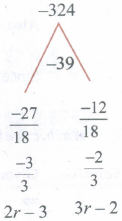
⇒ 39r = 18r2 + 18
⇒ (2r- 3) (3r- 2) =0
⇒ \(r={3\over2},{2\over 3}\)
Case (i) When \(a=18,r={3\over 2},\)the numbers in G.P. are \({18\over {3\over 2}},18,18\left(2\over 3\right)⇒27,18,12\)
Case (ii) When \(a=18,r={2\over 3},\) the numbers in G.P. are \({18\over {2\over 3}},18,18\left(2\over 3\right)⇒27,18,12\)
92.
\(\frac { 1-4x-{ x }^{ 2 } }{ ex } \) = (1-4x-x2)e-x
(1-4x-x2) =\(\left( 1+\frac { (-x) }{ 1! } +\frac { { \left( -x \right) }^{ 2 } }{ 2! } +\frac { { \left( -x \right) }^{ 3 } }{ 3! } +.....\infty \right) \)
(1-4x-x2) =\(\left( 1-x\frac { { \left( x \right) }^{ 2 } }{ 1! } +\frac { { \left( x \right) }^{ 3 } }{ 2! } +\frac { { \left( x \right) }^{ 4 } }{ 3! } +\frac { { \left( x \right) }^{ 5 } }{ 4! } +.....\infty \right) \)
Getting the x5 term alone,
\(=\frac { { -x }^{ 5 } }{ 5! } -4x\times \frac { { x }^{ 4 } }{ 4! } +{ x }^{ 2 }\times \frac { { x }^{ 3 } }{ 3! } =\left( -\frac { 1 }{ 120 } -\frac { 4 }{ 24 } +\frac { 1 }{ 6 } \right) { x }^{ 5 }=-\frac { 1 }{ 120 } { x }^{ 5 }\)
\(\therefore\) co-efficient of x5 is \(\frac {- 1 }{ 120 } \)
93.
Fourth root of 623 = \(\left( \frac { -2 }{ 625 } \right) \)
\(\left( \frac { -2 }{ 625 } \right) \)
\(={ \left[ 625\left( 1-\frac { 2 }{ 625 } \right) \right] }^{ \frac { 1 }{ 4 } }=5{ \left[ 1+\left( -\frac { 2 }{ 625 } \right) \right] }^{ \frac { 1 }{ 4 } }\)
\(={ 5\left[ 1+\frac { 1 }{ 4 } \left( \frac { -2 }{ 625 } \right) +\frac { \frac { 1 }{ 4 } \left( -\frac { 3 }{ 4 } \right) }{ 1.2 } { \left( \frac { -2 }{ 625 } \right) }^{ 2 } \right] }\)
Other terms will have more than seven zeroes after the decimal]
= 5[1-0.0008 - 0.0000009]
\(\sqrt [ 4 ]{ 623 } =4.9959955\)
94.
Let Tn be the nth term of the given series.
\(\therefore { T }_{ n }=\frac { { 1 }^{ 3 }+{ 2 }^{ 3 }+3^{ 3 }+....+n\quad terms }{ 1+3+5....+n\quad terms } =\frac { \Sigma { n }^{ 3 } }{ \frac { n }{ 2 } (2(1)+(n-1)2) } \)
\(\frac { { \left( \frac { n(n+1) }{ 2 } \right) }^{ 2 } }{ \frac { n }{ 2 } (2n) } \left[ \because \Sigma { n }^{ 3 }={ \left( \frac { n(n+1) }{ 2 } \right) }^{ 2 } \right] \)
\(=\frac { { n(n+1) }^{ 2 } }{ \frac { n }{ 2 } (2n) } =\frac { 1 }{ 4 } ({ n }^{ 2 }+2n+1)\)
\(=\frac { { n(n+1) }^{ 2 } }{ \frac { n }{ 2 } (2n) } =\frac { 1 }{ 4 } ({ n }^{ 2 }+2n+1)\)
\(=\frac { 1 }{ 4 } (\Sigma { n }^{ 2 }+\Sigma 2n+n)=\frac { 1 }{ 4 } \left[ \frac { n(n+1)(2n+1) }{ 6 } +\frac { 2.n(n+1) }{ 2 } +n \right] \)
\(=\frac { 1 }{ 4 } \left[ \frac { n(n+1)(2n+1)+6n(n+1)+6n }{ 6 } \right] \)
\(=\frac { n }{ 24 } \left[ { 2n }^{ 2 }+9n+13 \right] =\frac { n({ 2n }^{ 2 }+9n+13) }{ 24 } \)
95.
Given series is \(\sum_{n=1}^{\infty}{1\over 2^{n-1}}\left({1\over 9^{n-1}}+{1\over9^{2n-1}}\right)\)
\(S_\infty=1\left(1+{1\over9}\right)+{1\over2}\left( {1\over9}+{{1\over9^3}} \right)+{1\over 2^2}\left( {1\over9^2}+{1\over9^5} \right)+...\)
\(=\left( 1+{1\over9} \right)+{1\over2}\left( {1\over9}+{1\over 9^3} \right)+{1\over2^2}\left( {1\over2^2}+{1\over 9^5} \right)+..\)
Separating the first term and second term from each bracket, we get
\(=\left[ 1+{1\over 2}+{1\over 9}+{1\over 2^2}\left( {1\over 9^2}\right)+..\right]+\left[ {1\over9}+{1\over2}\left( {1\over 9^5} \right)+...\right]\)
\(=\left[1+{1\over2}\left(1\over 9\right)+{1\over 2^2}\left( {1\over 9^2} \right)+...\right]+{1\over9}\left[1+{1\over2}\left( {1\over 9^2}\right) +{1\over2^2} \left( {1\over 9^4} \right)+...\right]\)
Now consider \({1+{1\over2}}\left(1\over9\right)+{1\over 2^2}\left(1\over 9^2\right)+...\)
Here a = 1, \(r={1\over 18}\)
\(∴\ S_\infty={a\over 1-r}={1\over 1-{1\over 8}}={18\over 17}\)
In \(1+{1\over2}\left(1\over9^2\right)+{1\over 2^2}\left(1\over 9^4\right)+...\)
\(a=1,r={1\over 81\times2}={1\over162}\)
\(∴\ S_\infty =1, r={a\over 1-r}={1\over 1-{1\over 162}}={162\over 161}\)
Substituting these values in (1) we get
\(S_\infty={18\over 17}+{1\over 9}\times{162\over161}={18\over17}+{162\over 1449}={26082+2754\over 17\times1499}={28836\over 24633}\)
\({ S }_{ \infty }=1.170\)
96.
\(\frac { 3-4x+{ x }^{ 2 } }{ { e }^{ 2x } } =\left( 3-4x+{ x }_{ 2 } \right) { e }^{ -2x }\)
\(=\left( 3-4x+{ x }^{ 2 } \right) \left( 1-\frac { 2x }{ 1! } +\frac { { \left( 2x \right) }^{ 2 } }{ 2! } -\frac { { \left( 2x \right) }^{ 3 } }{ 3! } +\frac { { \left( 2x \right) }^{ 4 } }{ 4! } -... \right) \)
\(=\left( 3-4x+{ x }^{ 2 } \right) \left( 1-2x+\frac { { 4x }^{ 2 } }{ 2 } -\frac { { 8 }^{ 3 } }{ 6 } +\frac { { 16 }^{ 4 } }{ 24 } -... \right) \)
\(=\left( 3-4x+{ x }^{ 2 } \right) \left( 1-2x+{ 2x }^{ 3 }-\frac { { 4x }^{ 3 } }{ 3 } +\frac { { 2x }^{ 4 } }{ 3 } -... \right) \)
\(=2+\frac { 16 }{ 3 } +2=\frac { 6+16+6 }{ 3 } =\frac { 28 }{ 3 } \)
Hence coefficient of x4 is \(\frac { 28 }{ 3 } \)
97.
The given series is 1 + 5(-1)+9(1)+13(-1)+....
= 1 + 5(-1)+9(-1)2+13(-1)3+....
This is an arithmetic - geometric series with corresponding A.P. 1, 5, 9, 13.... and G.P. 1, -1, (-1)2, (-1)3, ....
\(\therefore\) Tn of A.G. series = (Tn of A.P) (Tn of G.P)
= [ 1 + ( n - 1)4 ] [ 1 (-1)n-1] [ \(\because\) Tn in A.P. is a + (n - 1)d, Tn in G.P. is a rn-1 ]
= (4n-3)(-1)n-1
Let Sn be the Sum of the first n terms of AG series
Sn = T1 + T2 + T3 + ... Tn-1 + Tn
Sn = 1 + 5(-1)+9(-1)2 + .. + (4n-7)(-1)n-2 + (4n-3) (-1)n-1 ...(2)
Multiplying by (-1) we get,
-1 Sn = 1 + 5(-1)+9(-3)3 + .. + (4n-7)(-1)n-1 + 4n-3(-1)n
(2)-(3) we get,
Sn + Sn = 1 + [4(-1) + 4(-1)2]+...+4(-1)n-1]-(4n-3)(-1)n
\(\Rightarrow\) \(2S_n=1+{4(-1)[1-(-1)^{n-1}]\over1-(-1)}-(4n-3)(-1)^n\) \(\begin{bmatrix} \because For\ GP, S_N={a(1-r^n)\over 1-r} \\a=1,r=-1 \end{bmatrix}\)
\(\Rightarrow\) \(2S_n=1-2()1-(-1)^{n-1}-(4n-3){(-1)}^{n}\)
\(\Rightarrow\) \(S_n={1\over 2}-1+{(-1)}^{n-1}-{4n-3\over 2}{(-1)}^{n-1}(-1)\)
\(\Rightarrow\) \(S_n={-{1\over 2}}+{2+4n-3\over 2}{(-1)}^{n-1}\)
\(\Rightarrow\) \(S_n={1\over 2}[-1+(4n-14){(--1)}^{n-1}].\)
98.
Given series is \(1+2\left( {1 \over 5} \right)+3{\left( {1\over 5} \right)}^{2}+4{\left({1\over 5} \right)}^{2}+....\) ...(1)
This is an arithmetico - geometric series with corresponding A.P. 1, 2, 3, 4, .... and G.P: \(1,{1 \over 5},\left( {1\over 5} \right)^2,{\left( {1\over 5} \right)}^{3},......\)
Let \(S=1+2\left({1\over 5} \right)+3{\left( {1\over 5} \right)}^{2}+4{\left({1\over 5} \right)}^{3}+....\) ...(2)
Multiplying both sides by the common ratio \(={1\over 5}\) of G.P. we get,
\({1\over 5}S={1\over5}+2{\left( {1 \over 5} \right)}^{2}+3{\left( {1\over 5} \right)}^{3}+4{\left( {1\over 5} \right)}^{4}+....\)
(2) - (1), we get,
\(S-{1\over5}S=1+(2-1)\left( {1\over5} \right)(3-2){\left( {1\over 5} \right)}^{2}+(4-3){\left({1\over 5} \right)}^{2}+...\)
\(\Rightarrow\) \(S-{1\over 5}S=1+\left[ {1\over5}+{\left( {1\over 5} \right)}^{2}+{\left( {1\over 5} \right)}^{3}+... \right]\)
\(=1+\frac { \frac { 1 }{5 } }{ 1-\frac { 1 }{ 5 } } \) \(\left[ \because {S}_{\infty}={a \over 1-r} \right]\)
\(=1+\frac { \frac { 1 }{ 5 } }{ \frac { 4 }{ 5 } } =1+{1\over 4}={5\over 4}\) \(\left[ \because |{1\over 5}| ={1\over 5}<1\right]\)
\(\Rightarrow\) \(S={5\over 4}\times{5\over 5}={25\over16}\)
99.
Let the numbers be a and b.
\(\therefore\) H.M \(={2ab \over a+b}\) and G.M \(=\sqrt{ab}\)
Given \({2ab\over a+b}:\sqrt{ab}=12:13\)
\(\Rightarrow\) \({2ab \over (a+b)\sqrt{ab}}={ 12 \over 13}\)
\(\Rightarrow\) \({\sqrt{ab}\over a+b }={12\over 13}\)
\(\Rightarrow\) \({\sqrt{ab} \over a+b}={6\over 13}\Rightarrow6a+6b=13\sqrt{ab}\)
Dividing by b we get,
\(6\left( {a \over b} \right)+6=13\sqrt{a \over b}.\)
\(\Rightarrow\) \(6\left( { a \over b} \right)-13\sqrt{{a \over b}}+6=0\)
\(\Rightarrow\) \(\sqrt{a\over b}=13\pm\sqrt{169-144\over 12}\) \(\begin{bmatrix}x = {-b \pm \sqrt{b^2-4ac} \over 2a} \\a=6,b=-13,c=6 \end{bmatrix}\)
\(\Rightarrow\ \ \sqrt{a\over b}={13+5\over 5}={2\over 3}\) or \({3\over 2}\)
\(\therefore\quad {a\over b}={4\over 9}\) or \({9\over 4}\)
\(\therefore\) a : b = 4 : 9 or 9 : 4.
100.
Let the H.P. be \({{1}\over{a}},{1\over a+d},{1\over a+2d},...\)
\(\therefore\) \({T}_{1}={1\over a}={2 \over 5}\) and \({T}_{2}={ 1 \over a+d}={12 \over 13}\)
\(\Rightarrow\) \(a={5\over 2}\) and \(a+d={13 \over 12}\)
\(\Rightarrow\) \(a={5\over 2}\) and \({5\over 2}+d={13 \over 12}\Rightarrow d{13 \over 12}-{5\over 2}\Rightarrow d={13-20\over12 }={-17\over 12}\)
Now, \({T}_{n}-{1 \over {a+(n-1)d}}={{1}\over{{{5}\over{2}}+(n-1)\left( {{-17}\over{12}} \right)}}={12\over30-17n+17}\)
\(={12\over47-17n}\)
Tn is largest when 47 - 17n is least and positive
For n = 2, 47 - 17n is least and positive
\(\therefore\) Tn is largest when n = 2
\(\therefore\) The largest term \(={12\over 47-17(2)}={12\over13}.\)
101.
Let the positive numbers be a, b. Let a > b.
\(\therefore A=\frac { a+b }{ 2 } \Rightarrow a+b=2A \ \text {and} G=\sqrt { ab } \Rightarrow ab\Rightarrow { G }^{ 2 }\)
we know, (a + b)2 = (a-b)2 + 4ab
\(\Rightarrow\) 4A2 = (a - b)2 + 4G2
\(\Rightarrow\) (a - b)2 = 4 (A2 -G2)
\(\Rightarrow\) a-b = 2\(\sqrt { { A }^{ 2 }-{ G }^{ 2 } } \)
(1)+(3) \(\rightarrow\)2a = 2\(\sqrt { { A }^{ 2 }-{ G }^{ 2 } } \)
\(\Rightarrow\) )a = A+ \(\sqrt { { A }^{ 2 }-{ G }^{ 2 } } \)
(1)-( 3) \(\rightarrow\) 2b = 2\(\sqrt { { A }^{ 2 }-{ G }^{ 2 } } \)
\(\Rightarrow\) b = A -\(\sqrt { { A }^{ 2 }-{ G }^{ 2 } } \)
The Numbers are A\(\pm \) \(\sqrt { { A }^{ 2 }-{ G }^{ 2 } } \)
102.
Let a and r be the first term and common ratio of the G.P.
\(\therefore\) \({S}_{n}={a(1-r^n)\over1-r},n\epsilon N\)
LHS \(={{S}_{10}-{S}_{20}}^{2}=\left[ {a(1-{r}^{10})\over1-r}-{a(1-{r}^{20})\over1-r} \right]^{2}\)
\(={{a}^{2}\over{{(1-r)}^{2}}}[1-{r}^{10}-1+{r}^{20}]^2\)
\(={{a}^{2}\over{(1-r)}^{2}}.{r}^{20}{({r}^{10}-1)}^{2}={{a^2.{r}^{20}.{({r}^{10}-1)}^{2}}\over{{(1-r)}^{2}}}\)
RHS = S10 (S30 - S20)
\(={a(1-{r}^{10}\over1-r)}\left[ {a(1-{r}^{30})\over1-r}-{{a(1-{r}^{30})}\over{1-r}} \right]\)
\(={{a^2}\over{(1-r^2)}}(1-{r}^{10})[1-{r}^{30}-1+{r}^{20}]={{a^2(1-{r}^{10})}\over{{(1-r)}^{2}}}.{r}^{20}(1-{r}^{10})\)
\(={{a^3.{r}^{20}(1-{r}^{10})^2}\over{{(1-r)}^{2}}}={{{a}^{2}.{r}^{20}{({r}^{10}-1)}^{2}}\over{{(1-r)}^{2}}}\)
\(\therefore\) LHS = RHS.
103.
Let the production in the first year = a units.
Let the annual increase be d units.
\(\therefore\) Production in first year, second year, third year ......... are a, a+d, a+2d, ...
This is an A.P. with first term a and common difference d.
Let Tn be the nth term of this A.P.
Given T3 = 600, T7 = 700
\(\therefore\) a + 2d = 600 (1) and a+6d=700 ....(2)
(2) - (1) \(\rightarrow\) 4d = 100 \(\Rightarrow\) d = 25
\(\therefore\) a + 2 (25) = 600 [ Substituting d = 25 in (1) ]
\(\Rightarrow\) a + 50 = 600 \(\Rightarrow\) a = 550.
(i) Production in the first year = a = 550 units.
(ii) Total production in 7 years.
= \({S}_{7}={7\over2}[2(550)+6(25)]\left[S_n={n\over 2} \right[2a+(n-1)d]]\)
S7 = 4375 units
(iii) production in the 10th year = T10 = 550 + 9 (25) = 775 units.
104.
Given Tp+1 = 2.Tq+1
\(\Rightarrow\) a+(+1-1)d = 2[a+(q+1-1)d] [ \(\because\) Tn = a + ( n - 1) d ]
\(\Rightarrow\) a + pd = 2a +2qd
\(\Rightarrow\) a = ( p - 2q ) d ...(1)
Now T3p+1 = a+ ( 3p + 1 - 1 )d = a + 3pd
= ( p - 2q ) d + 3pd (using (1))
= 4pd - 2qd
= 2d (2p-q) ...(2)
Also Tp+q+1 = a + (p+q+1-1)d
= a+(p+q)d
= (p-2q)d + (p+q)d (using (1))
= d(p-2q+p+q) = d(2p-q) ...(3)
From (2) and (3), T3p+1 = 2. Tp+q+1.
105.
Let p = q+h
h is numerically very small and so h12 h3 ... may be neglected
RHS \(={(n+1)p+(n-1)q\over (n-1)p+(n+1)q}={(n+1)(q+h)+(n-1)q\over (n+1)(q+h)+(n+1)q}\)
\(={nq+q-nh+h+nq-q\over nq-q+nh-h+nq+q}={2nq+(n+1)h\over2nq+(n-1)h}\)
\(={1+{n+1\over2n}.{q\over h}\over1+{n-1\over2n}.{h\over q}}=\left(1+{n+1\over2n}.{h\over q}\right)\left(1+{n-1\over2n}.{h\over q}\right)^{-1}\)
\(=\left({1+{n+1\over2n}.{h\over q}}\right)\left(1-{n-1\over2n}.{h\over q}\right)=1+\left({n+1\over 2n}-{n-1\over2n}\right){h\over q}\)
\(={1+{1\over n}}.{h\over q}\)
LHS \(={p\over q}^{1\over n}=\left(q+h\over q\right)^{1\over n}=\left(1+{h\over q}\right)^{1\over n}=1+{1\over n}.{h\over q}\)
From (1) and (2), LHS = RHS
Now \(\sqrt[8]{15\over16}={(8+1)(15)+(8-1)(16)\over(8-1)(15)+(8+1)(16)}\) [n = 8, p = 15 and q = 16]
\(={(9)(15)+7(16)\over(7)(15)+9(16)}={135+112\over105+144}={247\over 249}\)
\(\left( \frac { 15 }{ 16 } \right) =0.9919\)
106.
\(\log { \left( \frac { 1-2x }{ 1+2x } \right) } =log(1-2x)-log(1+2x)\)
\(\log { \left( \frac { 1-2x }{ 1+2x } \right) } =\left[-2x-{(2x)^2\over2}-{(2x)^3\over3}-{(2x)^4\over4}-...\right]-\left[3x-{4x^2\over2}+{8x^3\over3}-{16x^4\over4}+...\right]\)
\(-\left[ 2x-{4x^2\over 2}+{8x^3\over3}-{16x^4\over4}+{32x^5\over 5}+{64x^6\over 6}+{1287x^7\over7}...\right]\)
\(=2\left[-2x-{8x^3\over3}-{32x^3\over5}-{128x^7\over7}-...\right]\)
\(=-2\left[ 2x+{8x^3\over 3}+{32x^5\over 5}+{128x^7\over 7}+...\right]\)
This expression is valid only when \(\left| 2x \right| <1\Rightarrow \left| x \right| <\frac { 1 }{ 2 } \)
This expression is valid in the interval \(-\frac { 1 }{ 2 } \)
107.
\(log\left(1+3\over1-3x\right)=log(1+3x)-log(1-3x)\)[using logarithmic, quotient rule]
\(=\left[ 3x-{(3x)^2\over2}+{(3x)^3\over3}-{(3x)^4\over4}+...\right]-\left[-3x-{(3x)^2\over2}-{(3x)^3\over3}-{(3x)^4\over4}-...\right]\)
\(=\left[ 3x-{9x^2\over2}+{27x^3\over3}-{81x^4\over4}+...\right]-\left[ -3x-{9x^2\over2}-{27x^3\over3}-{81x^4\over4}+...\right]\)
\(=3x-{9x^2\over2}+{27x^3\over3}-{81x^4\over4}x^4+...+3x+{9x^2\over2}+{27x^3\over3}+{81x^4\over4}+...\)
\(=2\left[ 3x+{37x^3\over3}+{243x^5\over5}+{2187x^7\over7}+...\right]\)
This series is valid only when \(\left| 3x \right| <1\Rightarrow \left| x \right| <\frac { 1 }{ 3 } \)
Hence, this series is valid in the interval \(-\frac { 1 }{ 3 }< x<{1\over3}\)
108.
\(\frac { { \left( 1-2x \right) }^{ \frac { 2 }{ 3 } }{ \left( 4+5x \right) }^{ \frac { 3 }{ 2 } } }{ \sqrt { 1-x } } =\frac { \left( 1+\frac { 2 }{ 3 } (-2x)+..... \right) { \left( 4 \right) }^{ \frac { 3 }{ 2 } }{ \left( 1+\frac { 5 }{ 4 } x \right) }^{ \frac { 3 }{ 2 } } }{ { \left( 1-x \right) }^{ \frac { 1 }{ 2 } } } \) [using binomial theorem for rational index]
\(={ \left( 1-\frac { 4x }{ 3 } \right) (8) }{ \left( 1+\frac { 3 }{ 2 } \left( \frac { 5 }{ 4 } x \right) \right) }\left( 1-\frac { 1 }{ 2 } (-x) \right) \) [neglecting x2, x3 terms....]
\(=8\left( 1-\frac { 4x }{ 3 } \right) \left( 1+\frac { 15x }{ 8 } \right) \left( 1+\frac { x }{ 2 } \right) \)
\(=8\left( 1-\frac { 4x }{ 3 } +\frac { 15x }{ 8 } \right) \left( 1+\frac { x }{ 2 } \right) \)
\(=8\left( 1+\frac { 13x }{ 24 } \right) \left( 1+\frac { x }{ 2 } \right) =8\left( 1+\frac { 13x }{ 24 } +\frac { x }{ 2 } \right) =8\left( 1+\frac { 25x }{ 24 } \right) \)
When x = 0.001, the value of \(\frac { { \left( 1-2x \right) }^{ \frac { 2 }{ 3 } }{ \left( 4+5x \right) }^{ \frac { 3 }{ 2 } } }{ \sqrt { 1-x } } \)
= 8 + \(\frac { 25 }{ 3 } \)(0.001) = 8.01 (up to 2 places )
109.
In (a+b)n, the general term is Tr+1 = nCr an-r br
To find the Coefficient of 4th term, put r = 3 in (1)
∴ T4 = nC3 an-3 b3
To find the Coefficient of 13th term
Put r = 12 in (1)
T13 = nC12 an-12 b12
Given nC3 = nC12
3 +12 = n
n = 15
110.
General term in (1+x)n is
Tr+1 = nCr(1)n-r.xr = nCrxr
\(\therefore\) Co-efficient of Tr+1 is n Cr.
Let the Co-efficients of Tr+1, Tr+2 and Tr+3 be in the ratio 1 : 3 : 5
\(\therefore\) nCr : nCr+1 : nCr+2 = 1: 3: 5
\(\Rightarrow\) \({{n{C}_{n1}}\over{n{C}_{r}}}={3\over 1}\) ....(1)
and \({n{C}_{n+2}\over{C}_{n+1}}={5\over3}\) ...(2)
From (1) \(\rightarrow{\frac { \frac { n! }{ (r+1)!(n-r-1)! } }{ \frac { n! }{ r!(n-r)! } } }=3\)
\(\Rightarrow\) \(\frac{r!(n-r)!}{(r+1)!(n-r-1)!}=3\)
\(\Rightarrow\) 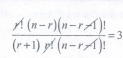
\(\Rightarrow{n-r\over+1}=3\)
Similarly (1) implies
\(\frac { \frac { n! }{ (r+2)!(n-r-2)! } }{ \frac { n! }{(r+1)!(n-r-1)! } } =\frac{5}{3}\)
\(\frac{(r+1)!(n-r-1)!}{(r+2)!(n-r-2)!}=\frac{5}{3}\Rightarrow\) 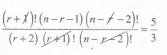
\(\Rightarrow{n-r-1 \over r+2}={5\over 3}\Rightarrow 3n-3t-3=5r+10\)
\(\Rightarrow\) 3n - 8r - 13 = 0
(3) X 2 \(\rightarrow\) 2n-8r-6 = 0
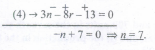
111.
We have (x + y) n = nC0xny0 + nC1xn-1y1 + nC2xn-2y2+....+ nCnx0y2
= (nC0 xny0 + nC2 xn-2y2+...) + (nC1 xn-1y + nC3xn-3y3+....) [Separated the odd and even terms]
(x + y) n = P + Q ...(1) [ \(\because\) P in the sum of odd terms and Q is the sum of even terms ]
Also (x-y)n = nC0xny0- nC1xn-1y1 + nC1xn-1y1 + nC2xn-2y2+......+ nCnx0(-y)n
= (nC0xny0+nC2xn-2y2+3...)-(nC1xn-1y1+nC3xn-3y3+.....)...(2)
(x - y)n = P-Q
(i) Multiplying (1) and (2) we get,
(x+y)n(x-y)n = (P+Q)(P-Q)
\(\Rightarrow\) [(x+y)(x-y)]n = P2-Q2
\(\Rightarrow\)(x2-y2)n = P2- Q2. Hence proved..
(ii) From (1) (x+y)2n = (P+Q)2 = P2 + Q2 + 2PQ ....(3)
From (2) (x-y)2n = (P-Q)2 = P2+Q2-2PQ ....(4)
Subtracting (4) from (3) we get,
(x+y)2n - (x-y)2n = P2+Q2+2PQ-(P2+Q2-2PQ)
= P2 + Q2 + 2PQ - P2 - Q2 + 2PQ
= 4PQ.
112.
Let a = b + a -b = b+ (a-b)
an = [b + (a-b)]n
Using binomial theorem
an = bn + nC1 bn-1 (a-b) + nC2 bn-2 (a-b)2 + ...+ (a-b)n
an-bn = nC1 bn-1 (a-b) + nC2 (a-b)2 bn-2 +...+(a-b)n
an-bn = (a-b) [nC1 bn-1 + nC2 bn-2 (a-b) +...+ (a-b)n-1]
an-bn = (a-b) K [where k = nC1 bn-1 +nC2 bn-2 (a-b) +...+(a-b)n-1
Thus, (a - b) is a factor of an - bn
113.
We have (1 + x)n = nCo(1)n + nC1(1)n-1 . x1 + nC2(1)n-2 x2 + ...+ nCnxn;
⇒ (1 + x)n = C0 + C1x + C2x2+ ...+ Cnnxn ...(i)
Similarly, (x + 1)n = C0xn + C1xn-1 + C2xn-1 + ...+ Cn
Multiplying equations (1) and (2) we get
(1 + x)n (x + 1)n = [Co + C1x + C2x2 + ...+Cnxn] [C0xn + C1xn-1 + C2xn-2+...+ Cn]
(1 + x)2n = [C0 + C1x + C2x2+ ... +Cnxn][C0xn + C1xn-1 + C2xn-2 +...+ Cn] ...(3)
This relation is true for all values of n. Let us equate the co-efficients of xn both sides
General term in (1 + x)2n is Tr+1 = 2nCr(1)2n-rxr
Putting r = n we get
Tn+1= 2nCn.xn
⇒ Co-efficient of xn of LHS of(3) is 2nCn
Now, co-efficient of xn in RHS of (3) is
\(C_0^2+C_1^2+C_2^2+...+C_n^2\)
\(∴\ C_0^2+C_1^2+C_2^2+...+C_n^2=2_nC_n\)
\(⇒\ C_0^2+C_1^2+C_2^2+...+C_n^2={(2n)!\over n!n!}\left[ ∵ nC_r={n!\over r!(n-r)!}\right]\)
\(={(2n)!\over (n!)^2}\)
Hence \({ C }_{ 0 }^{ 2 }+{ C }_{ 1 }^{ 2 }+{ C }_{ 2 }^{ 2 }+...C_{ n }^{ 2 }=\frac { (2n)! }{ (n)! } \)
114.
In (1 + x)n, the general term is
Tr+1 = nCr (1)n-r xr ....(1)
To find the co-efficients of 5th... , 6th .. and 7th ... terms, put r = 4, 5, 6 in (1) respectively.
∴Coefficients of 5th ... , 6th .... and 7th ... terms in (1 +x)n are nC4, nC5 and nC6 respectively.
Given that nC4, nC5 and nC6 are in A.P
\(∴\ 2nC_5=nC_4+nC_6\)
\(⇒\ 2={nC_4\over nC_5}+{nC_6\over nC_5}\) \(\left[∵{nC_r\over nC_{r-1}}={n-r+1\over r}\right]\)
\(⇒ 2={5\over n-4}+{n-5\over 6}\)
\(⇒\ 12={30+(n-5)(n-4)\over 6(n-4)}\)
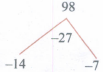
⇒ 12(n - 4) = 30 + n2 - 4n - 5n + 20
⇒ 12n - 48 = n2 - 9n + 50
⇒ n2 - 9n + 50 - 12n + 48 = 0
⇒ n2 - 21n + 98 = 0
⇒ (n - 14)(n - 7) = 0
⇒ n = 7 or 14.
115.
Let the three consecutive terms be rth... (r + 1)th ... and (r + 2)th... terms.
General term in (x + a)n is Tr+ 1 = nCrxn-r ar ... (1)
Then, co-efficients of rth.. (r + 1)th .. and (r + 2)th .. terms are nCr-1, nCr and nCr+1 respectively.
Given that nCr-1 : nCr: nCr+1 = 1:7:42
Consider \({nC_{r-1}\over nC_r}={1\over7}\)
\({{n!\over (r-1)!(n-r+1)!}\over {n!\over r!(n-r)!}}={1\over 7}\) \(\left[ ∵ nC_r \right]={n!\over r!(n-r)!}\)
\({n!\over(r-1)!(n-r+1)(n-r)!}\times{r(r-1)!(n-r)!\over n1}={1\over 7}\)
\({r\over n-r+1}={1\over 7}\)
⇒ 7r = n-r+1
⇒ n - 8r+ 1 = 0 ....(2)
and \({nC_r\over nC_{r+1}}r+1{}={7\over 42}\)
\({r+1\over n-r}={1\over 6}\) \(\left[ ∴{nC_{r+1}\over nC_r}={n-r\over r+1}\right]\)
⇒ 6r + 6 = n-r
⇒ n -7r- 6 = 0 ....(3)
(2) - (3)
(n - 8r+ 1) - (n -7r- 6) = 0
⇒ -r + 7 = 0
⇒ r = 7
Substituting r = 7 in (2) we get
n - 8(7) + 1 = 0
⇒ n - 56 + 1 = 0
⇒ n-55 = 0
⇒ n = 55
Hence n = 55 and r = 7.
116.
We know (1 +x)n = nC0 +nC1 x +nC2 x2 +...+nCn-1 xn-1 +nCnXn
Putting x = 8
(1 +8)n = nC0 + nC1 (8) + nC2 (64) +..+ nCn-1 8n-1 + nCn . 8N
9n = 1 + 8n + nC2 (64) + nC3 + ..+ nCn 8n-2
9n - 8n -1 is divisible by 64 for all positive integer n
putting N = n +1 we get
9n+1 -8(n+1) -1 is divisible by 64 for all positive integer n
(9n-1 -8n -8 -1 ) is divisible by 64
9n-1 - 8n -9 is always divisible by 4
117.
Consider 3600
= (32)300 = 9300
3600 = (10 -1 )300
Using binomial theorem
3600 = 300C0 (10)300 - 300C1(10)299 + ...-300C299 (10)1 + 1
= (10)300 - 300 (10)299 + ... - 300(10)+1
3600 = (10)300 - 300 (10)299 +... - 3000 + 1
Hence, it is clear that the last two digits in 3600 are 01
118.
LHS = \(\sqrt { \frac { 1-x }{ 1+x } } \)
\(\sqrt { \frac { 1-x }{ 1+x } } =\sqrt{(1-x)(1-x)\over(1+x)(1-x)}\)
\(={1-x\over\sqrt{1-x^2}}\)
\(=(1-x)(1-x^2)^{-1\over2}\)
\(=(1-x)\left[ 1+{-1\over2}(-x^2)-{\left(-1\over2\right)\left({-1\over2}-1\right)\over2.1}(-x^2)+... \right]\)∵ x is very small, [x2 is also very small]
\(=(1-x)\left[ 1+{x^2\over2}+{\left(1\over2\right)\left(3\over2\right)\over1.2}(x^4)+... \right]\)
\(=(1-x)\left[1+{x^2\over2}+{3\over8}x^4+...\right]=1-x+{x^2\over2}-{x^2\over2}+{3\over8}x^4+...\)
\(\left( 1-x+\frac { { x }^{ 2 } }{ 2 } \right) \) approximately
RHS.
Hence proved.
119.
LHS = \({ \left( { x }^{ 3 }+6 \right) }^{ \frac { 1 }{ 3 } }-{ \left( { x }^{ 3 }+3 \right) }^{ \frac { 1 }{ 3 } }\)
\(={ x }^{ 3\times \frac { 1 }{ 3 } }{ \left( 1+\frac { 6 }{ { x }^{ 3 } } \right) }^{ \frac { 1 }{ 3 } }-{ x }^{ 3\times \frac { 1 }{ 3 } }{ \left( 1+\frac { 3 }{ { x }^{ 3 } } \right) }^{ \frac { 1 }{ 3 } }\)
\(=x\left[ 1+\frac { 1 }{ 3 } \left( \frac { 6 }{ { x }^{ 3 } } \right) \right] -x\left[ 1+\frac { 1 }{ 3 } \left( \frac { 3 }{ { x }^{ 3 } } \right) \right] \)
\(=x+\frac { 2 }{ { x }^{ 2 } } -x-\frac { 1 }{ { x }^{ 2 } } \)
\(=\frac { 2 }{ { x }^{ 2 } } -\frac { 1 }{ { x }^{ 2 } } =\frac { 1 }{ { x }^{ 2 } } =RHS\)
Hence proved.
120.
In \(\left( { 2x }^{ 3 }-\frac { 1 }{ { 3x }^{ 2 } } \right) ^{ 5 }.n = 5, x = 2x^3, a=-{1\over 3x^2}\)
∴ General term is
Tr+1 = nCr xn-rar
\(=5C_r (2x^3)^{5-r}\left(-{1\over 3x^2}\right)^r\)
\(= 5C_r 2^{5-r}x^{15-3r}{(-1)^r\over 3^r.x^{2r}}\)
\(=5C_r{2^{5-r}\over 3^r}(-1)^rx^{15-3r-2r}\)
To get the constant term, put 15 - 5r = 0
⇒ 15-5r = 0
⇒ 15 = 5r ⇒ \(r={15\over 5}=3\)
Putting r = 3 in (1) we get
\(T_4=5C_3{2^2\over 3^3}.(-1)^3.x^0\)
\(=-5C_3{(4)\over 27}\)
\(=-{5\times4\times3\over 3\times2\times1}\times{4\over 27}\)
= \(-\frac { 40 }{ 27 } \)
Hence the constant term is \(-\frac { 40 }{ 27 } \)
121.
Given \(\left(x^2+{1\over x}\right)^5(1+x^3)^{50}\)
Let us expand \(\left(x^2+{1\over x}\right)^5\)
\(=(x^2)^5+5C_1(x^2)^4\left(1\over x\right)^1+5C_2(x^2)^3\left(1\over x\right)^2+5C_3(x^2)^2\left(1\over x\right)^3+5C_4(x^2)^1\left(1\over x\right)^4+{1\over x^5}\)
\(=x^{10}+5{x^8\over x}+{5\times4\over 2\times1}.{x^6\over x^2}+{5\times4\over 2\times1}{x^4\over x^3}+5{x^2\over x^4}+{1\over x^5}\)
\(=x^{10}+5x^7+10x^4+10x+{5\over x^2}+{11\over x^5}\)
General term in (1 + x3)50
Tr+1 = 50Cr(1)50-r (x3y)r = 50Cr . x3r
\(=\left(x^2+{1\over x}\right)^5(1+ x^3)^{30}\)
\(=\left(x^{10}+5x^7+10x^4+10x+{5\over x^2}+{1\over x^5}\right)(1+x^3)^{50}\)
\(=\left(x^{10}+5x^7+10x^4+10x+{5\over x^2}+{1\over x^5}\right)(50C_0+50C_1x^3+50C_2x^6+50C_3x^6+50C_3x^9+ ...)\)
\(=\left(x^{10}+5x^7+10x^4+10x+{5\over x^2}+{1\over x^5}\right)(1 + 50x^3 + 1225 x^6 + 19600 x^9 + ...)\)
Now, Co-efficient of x4
= 10[Constant term in (1 + x3)50] + 10[Co-efficient of x3 in (1 + x3)50] + 5[Co-efficient of x6] +1[Co-efficient of x9]
= 10(1) + 10(50C1) + 5(50C2) + 1(50C3) [using (1)]
\(= 10+ 10 \times 50+ 5 \times{50\times49\over 2\times1}+{50\times49\times48\over 3\times2\times1}=10 + 500 + 6125 + 19600 = 26235\)
∴ Co-efficient of x4 is 26235
122.
\(\left( { x }^{ 2 }+\frac { 1 }{ { x }^{ 3 } } \right) ^{ 6 }\)n = 6, x = x2 and \(a={-1\over x^3}\)
∴ The general term is Tr+1 = nCrxn-1 d
\(T_{r+1} = 6C_r(x^2)^{6-r}.\left(-1\over x^3\right)^r\)
= 6Cr.xI2-2r (-1)r . x-3r
= (-1)r 6Crx12-5r
To find the Co-efficient x6, put
12 - 5r = 6 ⇒ 12 - 6 = 5r ⇒ 6 = 5r
\(r={5\over6}\)which is not possible
∴ There wont be x6 term.
To find the Co-efficient of x2, put 12 - 5r = 2
12-2 = 5r ⇒ 10 = 5r ⇒ r = 2
Putting r = 2 in (1) we get,
\(T_3 = (-1)^2 6C_2 x^{12-10} ={6\times5\over 2\times1}x^2=15x^2\)
Co-efficient x2 is 15
123.
\(\left( { x }^{ 2 }+\frac { 1 }{ { x }^{ 3 } } \right) ^{ 10 }\)n = 10, x = x2, \(a={1\over x^3}\)
So the general term is Tr+1 = nCr xn-1 ar
\(⇒\ T_{r+1}=10C_r(x^2)^{10-r}\left(1\over x^3\right)\)
= 10Cr x20-2r.x-3r
= 10Cr x20-5r
To find the Co-efficient of x15
put 20-5r = 15
⇒ 20 - 15 = 5r
⇒ 5 = 5r
⇒ r = 1
putting r = 1 in (1) we get
T2 = 10C1x20-5 = 10x15
∴ Co-efficient x2 is 10
124.
(100 - 1)4 (a -b)n = nC0 an b0 - nC1 an-1 b1 +...nCn a0 bn, n \(\epsilon \) N
= 1004 - 4C1 (100)3 (1)1 + 4C2 (100)2 (1)2 - 4C3 (100)(13)+14
= 100000000 + 4(1000000) + \(\frac { 4\times (3) }{ 2\times 1 } \)(10000) - 400+1
= 100000000 -4000000 +60000 - 400 +1
= 96,059,601
125.
Given a = 5
Since the particle gets doubled, the G.P will be 5, 10,20,40, ... 1,50,000
⇒ a.rn-1 > 1,50,000
⇒ a.(2n-1) > 1,50,000
⇒ 5(2n-1) > 1,50,000
⇒ \(2^{n-1}>{1,50,000\over5}\)
⇒ 2n-1 > 30,000
⇒ 2n-1 > 24 x 1875
⇒ \({2^{n-1}\over24}>1875\)
⇒ 2n-5 > 1875
⇒ (n - 5) log 2 > log 1875
⇒ \(n-5>{log1875\over log2}\)
⇒ \(n-5>{3.2730\over 0.3010}\)
⇒ n-5 > 10.873
⇒ n > 10.873 + 5
⇒ n > 15.873
⇒ n = 15
Hence the 15th day, the infectious Virus particles just grow over 1,50,000 units.
126.
We have P = Principal = Rs. 500, R = rate of interest = 10%
Amount at the end of one year = \(\left(P+{R\over100}\right)\)
\(=P\left(1+{R\over100}\right)\)
Amount at the end of second year
\(=P\left(1+{R\over100}\right)+P\left(1+{R\over100}\right)\left(R\over 100\right)\)
\(=P\left(1+{R\over100}\right)\left(1+{R\over100}\right)=P\left(1+{R\over 100}\right)^2\)
and so on.
Clearly amount at the end of various year form a G.P. with first term and common ratio \(1+{R\over100}\)
∴ Amount at the end of 10th year
= 11th term of the G.P
\(=P\left(1+{R\over100}\right)^{10}\)
\(=500\left(1+{10\over100}\right)^{10}=500\left(11\over10\right)^{10}\)
Amount at the end of the 10th year = 500 (1.1)10 = 1296.87 of the 10 th year.
127.
Clearly, number of bacteria at the end of different hours forms a G.P. with
a = 30 and r = 2.
Number of bacteria present at the end of 2nd hour
t3 = a . r2 = 30 \(\times\) 22 = 30 \(\times\) 4 = 120.
Number of bacteria present at the end of 4th hour
t5 = a . r4 = 30 (24) = 30 (16) = 480.
Number of bacteria present at the end of nth hour
tn+1 = a . rn = 30 (2n).
128.
According to the given information, we have the following diagram.

Distance travelled to bring first ball = 24 + 24 = 2 \(\times\) 24 = 48 m
Distance travelled to bring second ball = 2 (24 + 4) = 2(28) = 56 m
Distance travelled to bring third ball = 2 (24 + 4 + 4) = 2(32) = 64 m
\(\therefore\) The series of distances are 48, 56, 64 ...
Here a = 48, d = 56 - 48 = 8 and n = 20.
To find the total distance that he runs in bringing back all balls, we have to find the sum of 20 terms of the above series
\(\therefore\) \({ S }_{ 20 }=\frac { 20 }{ 2 } \left[ 2\left( 48 \right) +19\left( 8 \right) \right] \)
= 10[96 + 152]
= 10[248]
S20 = 2480 m.
129.
Suppose the loan is cleared in n months. Clearly the amount forms an A.P. with a = 20 and d = 15
∴ Sum of the amounts = 3250
Sn = 3250
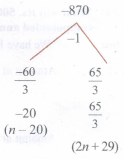
\(⇒\ {n\over2}[2a + (n -1)d]=3250\)
\(⇒\ {n\over2}[40+(n-1)15]=3250\)
⇒ n(40 + 15n - 15) = 6500
⇒ n (15n + 25) = 6500
⇒ 15n2 + 25n = 6500
⇒ 15n2 + 25n = 6500
⇒ 3n2 + 5n - 1300 = 0
⇒ (n - 20) (3n + 65) = 0
⇒ n = 20 or \(n={-65\over 3}\) which is not possible
∴ n = 20
Thus, the amount is cleared in 20 months.
130.
Given series is \(\sqrt { 3 } +\sqrt { 75 } +\sqrt { 243 } +.... .\) and \(S_n =435\sqrt { 3 }\)
Given series is \(1(\sqrt3)+5(\sqrt3)+9(\sqrt3)+...\)
Here a = √3, d = 4√3
∴ The given series an arithmetic progression
\(∴\ S_n={n\over2}[2a+(n-1)d]\)
\(435\sqrt3={n\over2}[2\sqrt3 +(n -1)4\sqrt3]\) [∵ given Sn = 435√3J]
\(435\sqrt3={n\over2}[2\sqrt3+4n\sqrt3-4\sqrt4]\)
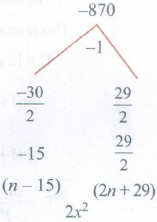
\(⇒\ 435\sqrt3={n\over2}[4n\sqrt3-2\sqrt3]\)
\(⇒\ 435\sqrt3=2{\sqrt3.n\over2}[2n-1]\)
⇒ 435 = 2n2-n
⇒ 2n2- n - 435 = 0
⇒ (n = 15)(2n + 29) = 0
⇒ \(n-15\ or\ n={-29\over2}\) which is not possible
⇒ n = 15
131.
Let Tn be the nth term of the given series
Then Tn = 1 + 4 + 42 + 43 + ...
\(=1\left(4^n-1\over 4-1\right)\)
\(={4^n-1\over 3}\)
Let Sn be the sum to n terms of the given series
Then \(S_n={\sum_{k=1}^n}T_k=\sum_{k=1}^n{4^n-3\over3}\)
\(⇒\ S_n={1\over3}\left[ \sum_{k=1}^n4^n-\sum_{k=1}^n3\right]\)
\(⇒\ S_n= {1\over3}[4^1+4^]+...+4^n-3^n\)
\(⇒\ S_n={1\over3}\left[ 4{(4^n-1)\over4-1}-3n\right]\)
\(⇒\ S_n={1\over3}\left[ 4{(4^n-1)\over4-1}-3n\right]={1\over 3}\left[4{(4^n-1)-9n\over3}\right]\)
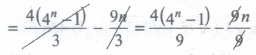
\({ S }_{ n }=\frac { 4 }{ 9 } \left[ \left( { 4 }^{ n }-1 \right) -n/3 \right] \)
132.
Let = 6 + 66 + 666 + ... upto n terms
= 6 (1 + 11 + 111+ ....) upto n terms
\(={6\over9}(9+99+999+ ...)\) upto n terms
\(={63\over 6}[(10 -1) + (10^2-1) + (10^3 -1) + ...]\) upto n terms
\(={6\over 9}[(10+ 10^2 + 10^3+ ...) - (1+ 1+1...)]\) upto n terms
\(={6\over9}\left[{ 10(10^n-1)\over 10-1}n\right]\)[In a G.P with a = 10 r = 10, \(S_n={(r^n-1)\over r-1}\)]
\(={6\over9}\left[{ 10(10^n-1)\over 10-1}n\right]={6\over9}\left[ 10(10^n-1)-9n\over9\right]\)
\({ S }_{ n }=\frac { 6 }{ 81 } \left[ 10\left( { 10 }^{ n }-1 \right) -9n \right] \)
133.
Let Sn = 8 + 88 + 888 + 8888 + .... upto n terms
= 8 (1 + 11 + 111 + 1111 + ....) upto n terms
\(={8\over9}(9 + 99 + 999 + ...)\)
\({ S }_{ n }=\frac { 8 }{ 81 } \left[ \left( { 10 }^{ n }-1 \right) -9n \right] \) [multiplying and dividing by 9]
\(={8\over9}[10 -1) + (100 -1) + (1000 -1) + ...]\)
\(S_n={8\over 9}[(10^1 +10^2 +10^3 + ... +10^n)-(1+1+1+ ... +1n\ terms)]\)
In 10 + 102 + 103 + ... + 10n, a = 10, r= 10, and it forms a G.P.
\(∴\ S_n={a(r^n-1)\over r-1}=10{(10^n-1)\over 10-1}={10\over 9}(10^n)-1\) and 1 + 1 + 1 ... + upto n terms = n
Substituting these values in (1) we get
\(S_n={8\over 9}\left[ 10(10^n-1)n\over 9\right]\)
\(S_n={8\over 81}[(10^n-1)-9n]\)
134.
Let Tn be the nth term of the given series
\(T_n={1^3+2^3+..+n^3\over 1+3+5+...+(2n-1)}={\left[n(n+1)\over\right]^2\over{n\over2}(1+2n-n)}\ \ \left[ ∵\ S_n={n\over2}(a+1)\right]\)
\(={n^2(n+1)^2\over4}/{n\over2}(2n)\)
\(={n^2(n+1)^2\over4}\times{1\over n^2}={(n+1)^2\over2}\)
\(={1\over2}(n^2+2n+1)\)
Let Sn denote the sum of n terms of the given series
Then \(S_n=\sum _{k=1}^nT_k={1\over 4}(k^2+2k+1)\)
\(={1\over4}\left[ \sum_{k=1}^nK^2+2\sum_{k=1}^nk+\sum_{k=1}^n1\right]\)
\(={1\over24}[n(n + 1)(2n + 1)+ 6(n)(n + 1)+ 6n]\)
\(={1\over24}[(n^2 +n)(2n+1)+6n^2 +6n+6n]\)
\(={1\over24}[2n^3 + n^2 + 2n^2 + n + 6n^2 + 12n]\)
\(S_n={1\over24}[2n^3 +9n^2 +13n]={n\over 24}[2n^2+9n+13]]\)
Now we have to find S17
\(∴ S={17\over24}[2(17)^2 + 9(17)+ 13]={17\over 24}[578+153+13]\)
\(={17\over 24}(744)=17(31)=527\)
S17 = 527
135.
= [(x-a)n = xn + nC1xn-1(-a)1+nC2xn-1(-a)2+.....(-a)n]
= \(\left[ \left( { 2x }^{ 2 } \right) ^{ 4 }-4C_{ 1 }\left( 2x^{ 2 } \right) \left( 3\sqrt { 1-{ x }^{ 2 } } \right) ^{ 2 }+4C_{ 2 }\left( { 2x }^{ 2 } \right) (3\sqrt { 1-{ x }^{ 2 }) } ^{ 2 }-4C_{ 3 }({ 2x }^{ 2 })^{ 1 }(3\sqrt { 1-{ x }^{ 2 } } )^{ 3 }+(3\sqrt { 1-{ x }^{ 2 } } )^{ 4 } \right] \) \(=\left[ \left( { 2x }^{ 2 } \right) ^{ 4 }-4C_{ 1 }\left( 2x^{ 2 } \right) ^{ 3 }\left( 3\sqrt { 1-{ x }^{ 2 } } \right) ^{ 1 }+4C_{ 2 }\left( { 2x }^{ 2 } \right) (3\sqrt { 1-{ x }^{ 2 }) } ^{ 2 }+4C_{ 3 }({ 2x }^{ 2 })(3\sqrt { 1-{ x }^{ 2 } } )^{ 3 }+(3\sqrt { 1-{ x }^{ 2 }) } ^{ 4 } \right] \)= \(2\left[ \left( { 2x }^{ 2 } \right) ^{ 4 }+4C\left( { 2x }^{ 2 } \right) ^{ 2 }(3\sqrt { 1-{ x }^{ 2 } } )^{ 2 }+(3\sqrt { 1-{ x }^{ 2 } } )^{ 4 } \right] \)
= \(2\left[ \left( 16{ x }^{ 8 } \right) +\frac { 4\times 3 }{ 2\times 1 } \times { 4x }^{ 4 }\times 9(1-{ x }^{ 2 })+{ 3 }^{ 4 }(1-{ x }^{ 2 })^{ 2 } \right] \)
= \(2\left[ 16{ x }^{ 8 }+216{ x }^{ 4 }(1-{ x }^{ 2 })+81(1-{ x }^{ 2 })^{ 2 } \right] \)
136.
Let A be the first term and R be the common ratio of the given G.P.
Then a = pth term ⇒ a = ARPp-1
⇒ log a log A+(p-1 )logR...(1)
b = qth term b = ARq-1
⇒ log b = logA +(q-1) log R...(2)
c = rth term ⇒ c = ARr-1
⇒ log c = log A + (r-1) log R
Now, LHS = (q - r) log a + (r - p) log b + (p - q) log c
= (q - r) [log A + (p - 1) log R] + (r - p) [log A + (q - 1) log R] + (p - q)[log A + (r-1) log R]
= log A [q - r + r - p + P - q] + log R [(p - 1) (q - r) + (q - 1) (r - p) + (r - 1) (p - q)]
= log A (0) + log R [pq - pr - q + r + qr - pq - r + p + rp - rq - p + q]
= log R [0] = 0
∴ (q - r) log a + (r- p) log b + (p - q) log c = 0.
137.
Given equation is (q - r).x2+ (r - p)x +p - q = 0
a = q - r, b = r - p, c = p - q
Since the roots of the quadratic equation are equal, b2 - 4ac = 0
\(\Rightarrow\) (r - p)2 - 4(q - r)(p - q) = 0
\(\Rightarrow\) r2 +p2 - 2rp - 4(pq - q2 - rp + rq) = 0
\(\Rightarrow\) r2 + p2 - 2rp - 4pq + 4q2 + 4rp - 4rq = 0
\(\Rightarrow\) r2 + p2 + 4q2 + 2rp - 4pq - 4rq = 0
\(\Rightarrow\) (r + p - 2q)2 = 0
\(\Rightarrow\) r + p - 2q = 0
\(\Rightarrow\) 2q = r + p
\(\Rightarrow\) q - p = r - p
\(\Rightarrow\) common difference is equal for p, q, r
Hence p, q, r are in A.P.
138.
RHS = \(1+n\left( 1-\frac { 1 }{ x } \right) +\frac { n(n+1) }{ 1.2 } \left( 1-\frac { 1 }{ x } \right) ^{ 2 }+...\)
put \(y=1-\frac { 1 }{ x } ,1+ny+\frac { n(n+1) }{ 1.2 } { y }^{ 2 }+....={ (1-y) }^{ -n }\)
\(\left[ 1-\left( 1-\frac { 1 }{ x } \right) \right] ^{ -n }=\left( \frac { 1 }{ x } \right) ^{ -n }={ x }^{ n }=LHS\)
139.
\(\sqrt { { x }^{ 2 }+25 } -\sqrt { { x }^{ 2 }+9 } =x\left( 1+\frac { 25 }{ { x }^{ 2 } } \right) ^{ 1/2 }-x\left( 1+\frac { 9 }{ { x }^{ 2 } } \right) ^{ 1/2 }\)
\(=x\left[ 1+\frac { 1 }{ 2 } \left( \frac { 25 }{ { x }^{ 2 } } \right) +\frac { \frac { 1 }{ 2 } \left( -\frac { 1 }{ 2 } \right) }{ 1.2 } \left( \frac { 25 }{ { x }^{ 2 } } \right) ^{ 2 }+.... \right] -x\left[ 1+\frac { 1 }{ 2 } \left( \frac { 9 }{ { x }^{ 2 } } \right) +\frac { \frac { 1 }{ 2 } \left( -\frac { 1 }{ 2 } \right) }{ 1.2 } \left( \frac { 9 }{ { x }^{ 2 } } \right) ^{ 2 }+.... \right] \)
\(=x+\frac { 25 }{ 2x } -\frac { 625 }{ 8{ x }^{ 3 } } +.....-x-\frac { 9 }{ 2x } +\frac { 81 }{ 8{ x }^{ 3 } } +....=\frac { 16 }{ 2x } =\frac { 8 }{ x } approximately\)
140.
\(\frac { 1 }{ \sqrt [ 3 ]{ 128 } } =\frac { 1 }{ { (128) }^{ \frac { 1 }{ 3 } } } =\frac { 1 }{ { (125+3) }^{ \frac { 1 }{ 3 } } } =\frac { 1 }{ 5\left( 1+\frac { 3 }{ 125 } \right) ^{ \frac { 1 }{ 3 } } } =\frac { 1 }{ 5 } \left( 1+\frac { 3 }{ 125 } \right) ^{ \frac { 1 }{ 3 } }\)
\(=\frac { 1 }{ 5 } (1+0.024)^{ \frac { 1 }{ 3 } }=\frac { 1 }{ 5 } \left[ 1-\frac { 1 }{ 3 } (0.024)+\frac { \frac { 1 }{ 3 } \left( \frac { 4 }{ 3 } \right) }{ 1.2 } { (0.024) }^{ 2 }.... \right] \)
= \(\frac{1}{5}\)[1- 0.008 + 0.000128] = 0.1984256
141.
\(\sqrt [ 3 ]{ 1003 } ={ (1003) }^{ \frac { 1 }{ 3 } }={ (1000+3) }^{ 1/3 }={ (1000) }^{ 1/3 }\left[ 1+\frac { 3 }{ 1000 } \right] ^{ 1/3 }=10[1+0.003]^{ 1/3 }\)
\(=10\left[ 1+\frac { 1 }{ 3 } (0.003)+\frac { \left( \frac { 1 }{ 3 } \right) \left( -\frac { 2 }{ 3 } \right) }{ 1.2 } { (0.003) }^{ 2 }+... \right] \)
= 10 [1 + 0.001 - 0.0000001 + ...] = 10.00999 = 10.0100
142.
\(\frac { 1 }{ \sqrt [ 6 ]{ 6-3x } } =\frac { 1 }{ { (6-7x) }^{ 1/3 } } =-\frac { 1 }{ { 6 }^{ 1/3 }\left( 1-\frac { x }{ 2 } \right) ^{ 1/3 } } =\frac { 1 }{ 6^{ 1/3 } } \left[ 1-\frac { x }{ 2 } \right] ^{ \frac { 1 }{ 3 } }\)
\(=\frac { 1 }{ 6^{ 1/3 } } \left[ 1+\frac { 1 }{ 3 } \left( \frac { x }{ 2 } \right) +\frac { \left( \frac { 1 }{ 3 } \right) \left( \frac { 4 }{ 3 } \right) }{ 1.2 } \left( \frac { x }{ 2 } \right) ^{ 2 }+\frac { \left( \frac { 1 }{ 3 } \right) \left( \frac { 4 }{ 3 } \right) \left( \frac { 7 }{ 3 } \right) }{ 1.2.3 } \left( \frac { x }{ 2 } \right) ^{ 3 } \right] \)
\(=\frac { 1 }{ 6^{ 1/3 } } \left[ 1+\frac { x }{ 6 } +\frac { { x }^{ 2 } }{ 18 } +\frac { 7 }{ 324 } { x }^{ 3 }+.... \right] \)
143.
\(\frac { 1 }{ { (2+x) }^{ 4 } } =\frac { 1 }{ { \left[ x\left( 2/x+1 \right) \right] }^{ 4 } } \left| x \right| >2,1>\left| \frac { 2 }{ x } \right| \)
\(=\frac { 1 }{ { x }^{ 4 }\left( 1+2/x \right) ^{ 4 } } =\frac { 1 }{ { x }^{ 4 } } \left( 1+2/x \right) ^{ -4 }=\frac { 1 }{ { x }^{ 4 } } \left[ 1-4\left( \frac { 2 }{ x } \right) +\frac { 4.5 }{ 12 } \left( \frac { 2 }{ x } \right) ^{ 2 }-\frac { 4.5.6 }{ 1.2.3 } \left( \frac { 2 }{ x } \right) ^{ 3 } \right] \)
\(=\frac { 1 }{ { x }^{ 4 } } \left[ 1-\frac { 8 }{ x } +\frac { 40 }{ { x }^{ 2 } } -\frac { 160 }{ { x }^{ 3 } } +... \right] =\frac { 1 }{ { x }^{ 5 } } \left[ x-8+\frac { 40 }{ x } -\frac { 160 }{ { x }^{ 2 } } +... \right] \)
144.
7 + 77 + 777 + 7777 + ...
Sn = 7 + 77 + 777 + 7777 + ... to n terms
= \(\frac{7}{9}[9+99+999+9999+\)...to n terms]
= \(\frac{7}{9}[(10-1)+(10^{2}-1)+(10^{3}-1)+(10^{4}-1)+..\).to n terms]
= \(\frac{7}{9}[(10+10^{2}+10^{3}+... to n terms)-(1+1+1+... n terms)]\)
= \(\frac{7}{9}[\frac{10(10^{n}-1)}{10-1}-n]=\frac{7}{9}[\frac{10}{9}(10^{n}-1)-n]\)
= \(\frac{7}{81}[10^{n+1}-9n-10]\)
145.
(1 + x) + (1 + x + x2) + (1 + x + x2 + x3) + ... up to n terms
= \(\frac{1-x^{2}}{1-x}+\frac{1-x^{3}}{1-x}+..\frac{1-x^{4}}{1-x}+...\) to n terms
= \(\frac{1}{1-x}[(1+1+1+... to\ n\ terms)-(x^{2}+x^{3}+x^{4}.... to\ n\ terms)\)
= \(\frac{1}{1-x}[n-\frac{x^{2}(1-x^{n})}{1-x}]\)
146.
(x + y) + (x2+ Xy + y2)+ (x2+ x2y + xy + y3) + ...to n terms
= \(\frac{x^{2}-y^{2}}{x-y}+\frac{x^{3}-y^{3}}{x-y}+\frac{x^{4}-y^{4}}{x-y}\)+... to n terms
= \(\frac{1}{x-y}[(x^{2}-y^{2}+(x^{3}-y^{3}+(x^{4}-y^{4})\)+...to n terms]
= \(\frac{1}{x-y}[(x^{2}+x^{3}+x^{4}+...to n terms)-[(y^{2}+y^{3}+y^{4}+...to n terms)]\)
= \(\frac{1}{x-y}[\frac{x^{2}(x^{n}-1)}{x-1}-\frac{y^{2}(y^{n}-1)}{y-1}]\)
147.
Here, \(\frac{S_{3}}{S_{6}}=\frac{125}{152}\)
⇒ \(\frac{a(r^{3}-1)/(r-1)}{a(r^{6}-1)/(r-1)}=\frac{125}{152}\Rightarrow \frac{r^{3}-1}{r^{6}-1}=\frac{125}{152}\)
∴ \(\frac{r^{3}-1}{(r^{3}-1)(r^{3}+1)}=\frac{125}{152}\Rightarrow \frac{1}{r^{3}+1}=\frac{125}{152}\)
∴ 152 = 125 r3 + 125 or 125r3 = 27
ஃ r3=\(\frac{27}{125}=(\frac{3}{5})^{3}\)
⇒ r = {\((\frac{3}{5})^{3}\)}1/3 = \(\frac{3}{5}\)
Hence, the common ratio of the G.P. is \(\frac{3}{5}\)
148.
Let 'a' be the first term and d, the common difference of A.P.
Using the given in information, we have \(\frac{S_m}{S_n}=\frac{m^{2}}{n^{2}}\)
∴ \(\frac{\frac{m}{2}[2a+(m-1)d]}{\frac{n}{2}[2a+(n-1)d]}=\frac{m{2}}{n^{2}}\Rightarrow \frac{2a+(m-1)d}{2a+(n-1)d} \overset{-}{n}\)
⇒ 2an + (mn - n) d = 2am + (mn - m) d
⇒ 2an - 2am = (mn - m - mn + n) d
⇒ 2a (n - m) = (n - m) d⇒ d = 2a, [n-m≠0, as n≠m]
Now, \(\frac{a_{m}}{a_{n}}=\frac{a+(m-1d)}{a+(n-1)d}=\frac{a+(m-1).2a}{a+(n-1).2a}=\frac{a(1+2m-2)}{1+2n-2}=\frac{2m-1}{2n-1}\)
Hence, the required ratio is (2m - 1) : (2n - 1)
149.
Let A be the first term and R, the common ratio of G.P.
∵ ap = x ஃ x = ARp-1 --- (1)
∵ aq = y ஃ y = ARq-1 -- (2)
∵ ar = z ஃ z = ARr-1 --- (3)
Raising (1), (2), (3) to the powers q - r; r - p, p - q respectively, we get
xq-r = Aq-r , R(q-r)(p-1) --- (4)
yr-p = Ar-p , R(r-p)(q-1) --- (5)
zp-q = Ap-q, R(p-q)(r-1) --- (6)
Multiplying (4), (5) and (6), we get
xq-r, yr-p, zp-q = Aq-r+r-p+p-q, R(q-r)(p-1)+(r-p)(q-1)+(p-q)(r-1)
= \(A^{0}\times R^{0}=1\times 1=1\)
Hence xq-r, yr-p, zp-q =1.
150.
∵ a, b, c are in A.P.
∴ 2b = a + c --- (1)
∵ p is the A.M. between a and b
∴ p = \(\frac{a+b}{2}\) --- (2)
∵ q is the A.M. between band c
∴ q = \(\frac{b+c}{2}\) --- (3)
Adding (2) and (3), we get p+q = \(\frac{a+b}{2}\)+\(\frac{b+c}{2}\) = \(\frac{a+c+2b}{2}=\frac{2b+2b}{2}\) = 2b [Using 1]
∴ 2b = p + q or b = \(\frac{p+q}{2}\)
Hence, b is the A.M. between p and q.
151.
Let A be the first term and D, the common difference of A.P.
ap = a, ∴ A + (p -1)D = a --- (1)
aq = b, ∴ A+(q-1)D = b --- (2)
a, = c, ∴ A+(r-1)D = c --- (3)
∴ a (q - r) + b (r - p) + c (p - q) = [A + (p - 1) D] (q - r) + [A + (q -1) D]
(r - p) + [A + (r - 1) D] (p - q) [Using (1), (2) and (3)]
= (q - r + r - p + P - q) A + [ (p -1)(q - r) + (q -1)(r - p) + (r -1) (p - q)] D
= (0) A + (pq - pr - q + r + qr - pq - r + p + pr - p - qr + q) D
= (0) A + (0) D =0.
152.
Let 'a' be the first term and 'd' the common difference of A.P.
Then, a1 = a, a2 = a + (2 -1) d = a + d
a3 = a + (3-1) d = a + 2d, a4 = a + (4-1) d = a + 3d
We have to show that a2.a3 - a1.a4 = 2 (a2 - a1)2
LHS = a2a3 -a,a4 = (a + d)( a+ 2d) - a(a + 3d)
= a2 + 3ad + 2d2 - a2 - 3ad = 2d2
RHS = 2 ( a2 - a1 )2 = 2 ( a + d - a)2 = 2d2
Since LHS = RHS. Hence proved.
153.
Let a1 be the first term and d, the common difference. Here n = 21.
∴ The three middle terms are a10, a11, a12
Now, a10 + a11 + a12 = 129 [Given]
∴ \((a_1+9d)+(a_1+10d)+(a_1+11d)=129\)
⇒ \(3a_1+30d=129 \Rightarrow a_1+10d=43\) --- (i)
The last three terms are a19, a20, a21
∴ a19 + a20 + a21 [Given]
∴ \((a_1+8d)+(a_1+19d)+(a_1+20d)=237\)
(i.e)\(3a_1+57d=237, \)
∴ a1 + 19d = 79 -- (ii)
Subtracting (i) from (ii), we get 9d = 36, ∴ d = 4
∴ From(i), a1 + 40 = 43, ∴ a1 = 3
Hence, the series is 3, 7, 11, 15 ....
154.
Here a1 = 4, and an+1 = 2nan.
Putting n = 1, a2 = 2 \(\times\) 1\(\times\) a1 = 2 \(\times\) 1\(\times\) 4 = 8
Putting n = 2, a3 =2\(\times\)2\(\times\)a2 = 4 \(\times\) 8 = 32
Putting n = 3, a4 = 2\(\times\)3\(\times\)a3 = 6 \(\times\) 32 = 192
Putting n = 4, a5 = 2\(\times\)4\(\times\)a4 = 8 \(\times\) 192 = 1536
Putting n = 5, a6 = 2\(\times\) 5\(\times\) a5 = 10\(\times\)1536 = 15360
155.
Here a1 = a2 = 1,an = an-1 + an-2 (n≥3)
Putting n = 3, a3 = a2 + a1 = 1 + 1= 2
Putting n = 4, a4 = a3 + a2 = 2 + 1= 3
Putting n=5, a5 = a4 + a3 = 3 + 2 = 5
Putting n = 6, a6 = a5 + a4 = 5 + 3 = 8
First six terms of the sequence are 1, 1, 2, 3, 5, 8.
156.
When n = 18 (even)
an = n (n + 2) = 18 (18 + 2) = 18 (20) = 360
When n = 25 (odd)
\(a_{n}=\frac{4n}{n^{2}+1}=\frac{4(25)}{(25)^{2}+1}=\frac{100}{625+1}=\frac{100}{626}=\frac{50}{313}\)
157.
Here a1 = 1
Substituting n = 2, we obtain a2 = a1 + 2 = 1+ 2 = 3
Substituting n = 3, 4 and 5, we obtain respectively
a3 = a2 + 2 = 3 + 2 = 5, a4 = a3 + 2 = 5 + 2 = 7
a5 = a4 + 2 = 7 + 2 = 9
Thus, the first five terms are 1, 3, 5, 7 and 9.
158.
In the equation of \((\frac{p}{2}+2)^{8}\), Number of terms = 8 + 1 = 9 (odd)
∴ There is only one middle term i.e.\((\frac{9+1}{2})\)th or 5th term
Tr+1 = 8Cr\((\frac{P}{2})^{r}(2)^{8-r}\)
∴ \(T_{5}=T_{4+1}= {^8C_{r}}(\frac{P}{2})^{4}(2)^{8-4}=1120 \) (Given)
⇒ \(\frac{8!}{4!4!}(\frac{p}{2})^{4}(2)^{4}=1120\)
⇒ \(\frac{8\times7\times6\times5}{4\times3\times2\times1}p^{4}=1120 \Rightarrow 70p^{4}=1120\)
⇒ \(p^{4}=\frac{1120}{70}=16 \Rightarrow p^{2}=4 \)so, p = ±2.
159.
The general term in the expansion is
Tr+1 = 15Cr(x4)15-r\((-\frac{1}{x^{3}})^{r}\)
= 15Cr(-1)r x60-4r x-3r
= 15Cr(-1)rx60-4r-3r
= 15Cr(-1)r x60-7r
This will involve x-17 if 60-7r
= -17 ⇒ 7r = 77 ⇒ r = 11
∴ T11+1 =15C11(-1)11 x-17 = \(\frac{-15\times14\times13\times12}{4\times3\times2\times1}x^{-17}=-1365 x^{-17}\)
Hence, the coefficient of \(\frac{1}{x^{17}}\) in the expansion of \((x^{4}-\frac{1}{x^{3}})^{15}\) is -1365.
160.
Given that, Sum of the coefficients in the expansion of (x+y)n = 4096
∴ nC0 + nC1 + nC2 +..+nCn = 4096
[∴ Sum of binomial coefficients in the expansion of (x + a)n is 2n]
⇒ 2n = 4096 = 212
⇒ n = 12 (even)
So the greatest coefficient = Coefficient of the middle term \((\frac{n}{2}+1)\)th term
= Coefficient of the middle term \((\frac{12}{2}+1)\)th term
= Coefficient of the 7th term
Hence the greatest coefficient = 12C6=\(\frac{(12)!}{6!(12-6)!}=\frac{(12)!}{6!6!}=\frac{12\times11\times10\times9\times8\times7}{6\times5\times4\times3\times2\times1}=924\)
161.
Let Tr+1 be the term in whichx32 and x-17 occurs,
\(\therefore T_{r+1}= {^{15}C_{r}}.(x^{4})^{15-r}(-\frac{1}{x^{3}})^{r}\)
= \({^{15}C_{r}},(-1)^{r},x^{60-4r},x^{-3r}={^{15}C_r},(-1)^{r}, x^{60-7r}\)
(i) Since x32 occurs in this term
∴ Exponent of x = 32
⇒ 60 - 7r = 32 ⇒ 7r = 28
∴ r = 28 ÷ 7 = 4
∴ Coefficient ofthe term containing x32 is = 15C4(-1)4 = 1365
(ii) Since x-17occurs in this term
∴ Exponent of x = -17
⇒ 60-7r = -17
⇒ 7r = 77, ∴ r = 11
∴ Coeffiicciient of the term containing x-17=15C11(-1)11= -15C11(-1)11 = -15C15-11 = -15C4= -1365.
162.
If we take y = 3x, then \({1\over (1+3x)^2}={1\over (1+y)^2}\)
Now \({1\over(1+y)^2}\) can be expanded using binomial theorem in powers of y. The expansion is valid only for values of y satisfying lyl < 1.
Replacing y by 3x we can get an expansion of \({1\over (1+3x)^2}.\)
The expansion is valid only for values of x satisfying |3xl< 1; that is the expansion is valid only for values of x satisfying Ixl < \(1\over3\)
\({1\over (1+3x)^2}=(1+3x)^{-2}\)
\(=1-2(3x)+{2(2+1)\over 2!}(3x)^2-{2(2+1)(2+2)\over3!}(3x)^3+{2(2+1)(2+2)(2+3)\over 4!}(3x)^4-......\)
Hence, \({1\over (3+2x)^2}=1-6x+27x^2-108x^3+405x^4-...,|x|<{1\over 3}\)
163.
Here n = \(2\over 3\)
\({n(n-1)\over 2!}={{2\over3}({2\over3})-1\over 2!}={{2\over3}({-1\over3})\over 2}={-1\over9}\)
\({n(n-1)(n-1)\over 2!}={{2\over 3}({2\over 3}-1)({2\over 3}-2)\over 3!}={{2\over 3}({-1\over 3})({-4\over 3})\over 6}={4\over 18}\)
Thus(1+x)\(2\over3\) = \(1+{2\over3}x-{1\over 9}x^2+{4\over 81}x^3+.....\)
164.
\(\frac{1}{2}\)
165.
\(3(3-\sqrt 5),6,3(3+\sqrt 5)\)
166.
3, 5, 7
167.
zero
168.
3,5,7,9,11
169.
Here a = 1 d = 3 and r \(={1\over5}\)
\(s_\infty={a\over 1-r}+{dr\over (1-r)^2}\)
\(={1\over 1-{1\over5}}+{3\times{1\over 5}\over({1-{1\over 5}})^2}\)
\(={5\over 4}+({3\over 5})({25\over 16})={35\over 16}\)
170.
Let a, ar, ar2, ... be the geometric series having the given properties.
Since the 4th, 5th and 6th terms are ar3, ar4 and ar5, their product is a3r12. Thus a3r12 = 4096.
Similarly a3r15 = 32768.
Therefore \({a^3r^15\over a^3{r}^{12}}={32768\over 4096}.\)
Hence r3= 8. This implies that r = 2. a3r12 = 4096 we have a3 = 1.
Therefore a = 1.
The sum of the first 8 terms is \({a(1-r^8)\over1-r}={1-2^8\over1-2}=255.\)
171.
Since a = 4 and 4 + 8d = 7 we get \(d={3\over 8}.\)
So the required 7 numbers are \(4{3 \over 8},4{6\over8},5{1\over8},5{4\over8},5{7\over8},6{2\over8},6{5\over8}.\)
Since a = 12 and \({ar}^{5}={3\over 8}\) we get \({1\over 32}\) and hence \(r={1\over 2}.\)
Thus the required 4 numbers are \(6, 3, 1{1\over 2},{3\over 4}.\)
172.
Let hn be the harmonic progression and let \(a_n={1\over h_n}.\)
Then a5 = 19 and a9 = 35.
As an's from an arithmetic progression, we have a + 4d = 19 and a + 8d = 35.
Solving these two equations, we get a = 3 and d = 4.
Thus a12 = a + 11d = 47.
Thus the 12th term of the harmonic progression is \({1\over 47}.\)
173.
If a, b, c are HP, then \({1\over a},{1\over b},{1\over c}\) are in AP.
Then we have \({2\over b}={1\over a}+{1\over c},\) which gives ab-ac = ac - bc.
So, a(b-c) = c(a-b), which gives \({a\over c}={a-b\over b-c}.\)
On the other hand, if \({a\over c}={a-b\over b-c},\) then a(b-c) = c(a - b).
Dividing each term by abc, we get \({1\over c}-{1\over b}={1\over b}-{1\over a}.\)
Thus \({1\over a},{1\over b},{1\over c}\) are in AP and hence a, b, c are in HP.
174.
\((x+y)^n:\) The middle terms are \({{{T}_{n-1}}\over{2}}\) and \({{{T}_{n+1}}\over{2}}\)
Their coefficients are \(^n{C}_{{n+1\over2}}\) and \(^n{C}_{{n-1\over2}}\)
To prove they are equal \(^n{C}_{{n+1\over2}}=^n{C}_{{n-\left( {n+1\over 2}\right)}}\) \([\because ^n{C}_{{r}}=^n{C}_{{n-r}}]\)
\(=^nC_{{2n-n+1\over2}}=^nC_{n-1\over2}\)
175.
We have \({\left( 2x-{1\over 2x} \right)}^{4}\) = 4C0(2x)4 \({\left(-{1\over 2x} \right)}^{0}\) +4C1(2x)3\({\left(-{1\over 2x} \right)}^{1}\) + 4C2(2x)2\({\left(-{1\over 2x} \right)}^{2}\)+4C3(2x)1\({\left(-{2\over x} \right)}^{3}\) + 4C4(2x)0\({\left(-{1\over 2x} \right)}^{4}\)
= (2x)4 - 4(2x)3\({\left({1\over 2x} \right)}\) + 6(2x)2\({\left({1\over 2x} \right)}^{2}\)- 6(2x)\({\left({1\over 2x} \right)}^{2}+{\left({1\over 2x} \right)}^{4}\)
\(=16x^4-16x^2+6-{3\over2x^2}+{1\over16x^4}\)
176.
Let us take a = 2 and b = - 3x in the binomial expansion of (a + b)7.
Then, x3 will appear in the term containing (- 3X)3 and nowhere else. So the term containing x3 is
\(^7{C}_{4}a^4b^3={7\times6\times54\over 3\times2\times1}2^4(-3)^3=3=35\times2^4\times(-3)^3x^3\)
So coefficient of x6 in the expansion of (2 - 3x)7 is 35 \(\times\) 16 \(\times\) (-27) = -15120
177.
Let us take a = 3 and b = 2x in the binomial expansion of (a + b)10.
Then, x6 will appear in the term containing (2x)6 and nowhere else. So the term containing x6 is
\(^{10}{C}_{4}a^4b^6={10\times 9\times8\times 7\over4\times 3\times 2\times 1 }3^4{(2x)}^{6}=210\times3^4\times2^6x^6\)
So coefficient of x3 in the expansion of (3 + 2x)10 is 210 \(\times\) 3426
178.
Since a, b, c are in A.P
\(b=\left( \frac { a+c }{ 2 } \right) \)....(1)
and b, c, d are in G.P\(\Rightarrow\) c = \(\sqrt { bd } \)......(2)
Also c,d,e in H.P \(\Rightarrow\) d\(\frac { 2ce }{ c+e } \)
From (2), C2 = bd = \(\left( \frac { a+c }{ 2 } \right) \left( \frac { 2ce }{ c+e } \right) \)
\(=\left( \frac { (a+c)ce }{ c+e } \right) \)
\(\Rightarrow\) \(c=\frac { (a+c)e }{ c+e } \)
\(\Rightarrow\) C2+ c e = ae + ce
\(\Rightarrow\) c2 = ae
a, c, e are in G.P
179.
Let the G.P. be a, ar, ar2, .. with |r|<1 ....(1)
Given a + ar + ar2+...= 23 ...(2)
and a2+(ar)2+(ar2)2+....= 69 ..(3)
\((1)\Rightarrow{a\over1-r}=23\Rightarrow a=23(1-r)\)
\((2)\Rightarrow{a^2\over 1-r^2}=69\)
\(\Rightarrow\) a2 = 39 (1-r2)
\(\Rightarrow\) 232(1-r)2 = 69(1-r2) [from (3)]
\(\Rightarrow\) 232 (1-r)2 = 3(1+r)(1-r)
\(\Rightarrow\) 23(1-r) = 3(1+r)
\(\Rightarrow\) 23-23r = 3 + 3r
\(\Rightarrow\) \(20=26r\Rightarrow r={20\over60}={10\over13}.\)
From (3) \(a=23\left(1-{{10}\over{13}} \right)=23\left({3\over 13} \right)={69\over 13}\)
\(\therefore\)The G.P is \(\frac { 69 }{ 13 } ,\frac { 69 }{ 13 } \left( \frac { 10 }{ 13 } \right) ,\frac { 69 }{ 13 } \left( \frac { 10 }{ 13 } \right) ^{ 2 },..\)
180.
The given G.P. is \(\sqrt{3},3,\sqrt [ 3 ]{ 3 } ,...\)
Here \(a=\sqrt{3},r={{3}\over{\sqrt{3}}}=\sqrt{3}\)
Let \(39+\sqrt [ 13 ]{ 3 } \) be the sum of n terms of the G.P.
\(\therefore\ S_n=39+13\sqrt{3}\)
\(\Rightarrow\) \(\sqrt{3}\left( 1-{{1-{\sqrt{3}}^{n}}\over{1-\sqrt{3}}} \right)=39+13\sqrt{3}\) \(\left[ \because S_n=a\left( { 1-r^n\over1-r} \right) \right]\)
\(\Rightarrow\) \(\sqrt{3}\left(1-\sqrt{3}^n \right)=(1-\sqrt{3})(39+13\sqrt{3})\)
\(\Rightarrow\) \(\sqrt{3}\left( 1-{\sqrt{3}}^{n} \right)=39+13\sqrt{3}-39\sqrt{3}-39\)
\(\Rightarrow\) \(\sqrt{3}\left( 1-{\sqrt{3}}^{n} \right)=-26\sqrt{3}\)
\(\Rightarrow\) \(1-{3}^{{n\over2}}=-26\Rightarrow{3}^{{n\over 2}}=1+26=2\)
\(\Rightarrow {3}^{{n\over 2}}=27\Rightarrow{3}^{{n\over2}}={3}^{3}\Rightarrow{n\over2}=3\Rightarrow n=6.\)
181.
Let the numbers be a and b.
ஃ a, g1, g2 , b are in G. P
\(\Rightarrow \frac { { g }_{ 1 } }{ a } =\frac { { g }_{ 2 } }{ { g }_{ 1 } } =\frac { b }{ g_{ 2 } } \)
\( { g }_{ 1 }^{ 2 }=a{ g }_{ 2 },\quad and\quad { g }_{ 2 }^{ 2 }=ag_{ 2 }\)
\(\Rightarrow \frac { { g }_{ 1 }^{ 2 } }{ { g }_{ 2 } } =a\quad and\quad \frac { { g }_{ 2 }^{ 2 } }{ { g }_{ 1 } } =b\)
\(\Rightarrow \frac { { g }_{ 1 }^{ 2 } }{ { g }_{ 2 } } +\frac { { g }_{ 2 }^{ 2 } }{ { g }_{ 1 } } =a+b\)
\(Also\quad a,A,b\quad are\quad in\quad A.P\)
\(\Rightarrow A-a=b-A\Rightarrow A=\frac { a+b }{ 2 } \)
\(\Rightarrow 2A=a+b\)
\(From(1)\quad and\quad (2),\frac { { g }_{ 1 }^{ 2 } }{ { g }_{ 2 } } +\frac { { g }_{ 2 }^{ 2 } }{ { g }_{ 1 } } =2A\)
182.
Let the H.P. be \(\frac{1}{a},\frac{1}{a+d},\frac{1}{a+2d},...\)
\(\therefore { T }_{ m }=\frac { 1 }{ a+\left( m-1 \right) d } =n\) and \(\therefore { T }_{ n }=\frac { 1 }{ a+\left( n-1 \right) d } =m\)
a + (m - 1)d = \(\frac{1}{n}(1)\) and a + (n - 1)d = \(\frac{1}{m}\)
(1) - (2) \(\Rightarrow\) (m - 1 - n + 1)d = \(\frac{1}{n}-\frac{1}{m}\) \(\Rightarrow\) (m - n) d = \(\frac{m-n}{mn}\Rightarrow d=\frac{1}{mn}\)
\({ T }_{ p }=\frac { 1 }{ a+\left( p-1 \right) d } =\frac { 1 }{ \frac { 1 }{ mn } +\left( b-1 \right) \frac { 1 }{ mn } } =\frac { mn }{ 1+p-1 } \)
\({ T }_{ p }=\frac { mn }{ p } \)
183.
Let T1,T2,T3... be a sequence which is A.P as well as G.P
Let Tn = a+(n-1)d for all n ∈ N
∴ The sequence is a, a+d, a+2d,...
Now, this is also a G.P
\(\therefore \frac { { T }_{ n+1 } }{ { T }_{ n } } =\frac { { T }_{ n+2 } }{ { T }_{ n+1 } } \) for all n ∈ N
⇒ \(\frac { a+nd }{ a+(n-1)d } =\frac { a(n+1)d }{ a+nd } \)
⇒ \((a+nd)^{ 2 }=(a+nd+d)(a+nd-d)\)
⇒ \((a+nd)^{ 2 }=(a+nd)^{ 2 }-{ d }^{ 2 }\)
⇒ d2 = 0 ⇒ d = 0
∴ The sequence is a+0, a+2(0), a+3(0) +...
⇒ a,a,a...
∴ Only a constant sequence can be both A.P and G.P.
184.
Let r be the common ratio of the G.P
Here a = 1 and T3+T5 = 90
⇒ ar2+ar4 = 90 [∵ T3 = a.r2,T4 = a.r3]
⇒ r2+ r4 = 90 (∵ a = 1)
⇒ r2+ r4-90 = 0
⇒ r2 = \(\frac { -1\pm \sqrt { 1+360 } 2 }{ 2 } \) \(\left[ \because \ x=\frac { x={ -b\pm \sqrt { b^{ 2 }-4ac } } }{ 2a } a=1,b=1,c=-90 \right] \)
⇒ r2 = \(\frac { -1\pm 19 }{ 2 } \)
⇒ r2 = \(\frac { -1+19 }{ 2 } \) or \(\frac { -1-19 }{ 2 } \)
⇒ r2 = 9 ⇒ r = -3, [∵ r2 = -10 is impossible ]
∴ r = 3 or -3
185.
Let the number be a and b
∴ a + b = \(\frac { 13 }{ 6 } \)
Let A1, A2,..A2n be the 2n A,M s between a and b ....(1)
= \(2n\left( \frac { a+b }{ 2 } \right) =n(a+b)=n\times \frac { 13 }{ 6 } (2)\) using (1)
Also A1+ A2+ A2n = 2n+1(given) ...(3)
From (2) and (3),\(\frac { 13n }{ 6 } \) = 2n+1
⇒ 13n = 12n + 6
⇒ n = 6
∴ No of A.M's inserted = 2n - 2(6) = 12
186.
\(\frac { 2 }{ 5 } +\frac { 2 }{ { 3.5 }^{ 3 } } +\frac { 2 }{ { 5.5 }^{ 5 } } ....\infty \)
\(=2\left[ \frac { 1 }{ 5 } +\frac { 1 }{ { 3.5 }^{ 3 } } +\frac { 1 }{ { 5.5 }^{ 5 } } ....\infty \right] \)
= \(2\left[ \left( \frac { 1 }{ 5 } \right) +\frac { \left( \frac { 1 }{ 5 } \right) ^{ 3 } }{ 3 } +\frac { \left( \frac { 1 }{ 5 } \right) ^{ 5 } }{ 3 } +..\infty \right] =2.\frac { 1 }{ 2 } log\left[ \frac { 1+\frac { 1 }{ 5 } }{ 1-\frac { 1 }{ 5 } } \right] \)\(\left[ \because \frac { 1 }{ 2 } log\left( \frac { 1+x }{ 1-x } \right) =x+\frac { { x }^{ 3 } }{ 3 } +\frac { { x }^{ 5 } }{ 5 } +\frac { { x }^{ 7 } }{ 7 } +.... \right] \)
= \(log\left( \frac { \frac { 6 }{ 5 } }{ \frac { 4 }{ 5 } } \right) =log\left( \frac { 3 }{ 2 } \right) \)
187.
Given Series 1 + (a+bx) + \(\frac { (a+bx) }{ 2! } +\frac { (a+bx)^{ 3 } }{ 3! } \)
ea+bx [using exponential series]
ea . ebx
ea \(\left[ 1+\frac { bx }{ 1! } +\frac { { bx }^{ 2 } }{ 2! } +\frac { { bx }^{ 3 } }{ 3! } +..\frac { { bx }^{ n } }{ n! } +...\infty \right] \)
\({ e }^{ a }+\frac { { e }^{ a }.bx }{ 1! } +\frac { { e }^{ a }.{ b }^{ 2 }{ x }^{ 2 } }{ 2! } +\frac { { e }^{ q }.{ b }^{ 3 }{ x }^{ 3 } }{ 3! } +..+\frac { { e }^{ a }.{ b }^{ n }{ x }^{ n } }{ n! } +...\infty \)
Co-efficient of xn in the given series is \(\frac { { e }^{ a }.{ b }^{ n } }{ n! } \)
188.
Let the A.P be a, a+d, a + 2d,...
Given Sn = 3n2
We have Tn = n-Sn-1
⇒ Tn = 3n2-3(n-1)2
⇒ Tn = 3n2-3(n2-2n + 1)
⇒ Tn = 3n2- 3n2 + 6n - 3
⇒ Tn = 6n - 3
∴ T1 = 6(1)-3 = 3
T2 = 6(2)-3 = 9
T3 = 6(3)-3 = 15
∴ The A.P is 3, 9, 15...
189.
Given 3 + 10 + 17 +...
a1 = 3, d1 = 10 - 3 = 7
∴ Tn = a1(n-1)d1 = 3 + (n-1)7 = 7n-4 ...(1)
Also, given 63 + 65 + 67+..
a2 = 63, d2 = 65 - 63 = 2
∴ Tn = a2+(n-1)d2 = 63 + (n-1) 2 = 2n + 61 ..(2)
Let nth term of given series be equal
⇒ 7n - 4 =2n + 61
⇒ 5n = 65 [From (1) and (2)]
⇒ n = 13
190.
Here T2-T1 = \(log\frac { { a }^{ 2 } }{ b } -log\quad a=log\frac { { a }^{ 2 }/b }{ a } \)
= \(log\frac { a }{ b } \)
T3-T2 = \(log\frac { a^{ 3 } }{ b^{ 2 } } -log\frac { a^{ 2 } }{ b^{ 2 } } =log\frac { a^{ 3 } }{ b^{ 2 } } +log\frac { a^{ 2 } }{ b^{ 2 } } \)
= \(log\frac { a^{ 3 } }{ b^{ 2 } } \times \frac { b }{ { a }^{ 2 } } =log\frac { a }{ b } \)
∴ T2-T1 = T3-T2 = \(log\left( \frac { a }{ b } \right) \)
∴ The given sequences is an A.P
191.
In (1 + x)n, (r + 1)th term from the beginning.
Tr+1 = nCr 1n-r. xr = nCrxr ....(1)
Its co-efficient is nCr
In (1 + x)n, there are (n + 1) terms
So, the (r +1)th term from the end will have (n + 1) - (r + 1) = n - r terms
∴ Tn-r+1 = nCn-r 1n-(n-r).xn-r = nCn-rxn-r ...(2)
Its Co-efficient is nCn-r
From (1) and (2), the Co-efficient of (r + 1)th term from the beginning and from the end are equal
192.
Using binomial theorem, we have
(1 + ax)n-1 + nC1(ax) + nC2(ax)2+.......+anxn
= \(1+nax+{{n(n-1)}\over{2}}a^2x^2+....a^nx^n\)
Given (1 + ax)n = 1 + 12x + 64x2 +....
Comparing the Co-efficient of x and x2, we get
n a = 12
and \({n(n-1)\over 2}a^2=64\)
\((n-1).{na.a\over2}=64\Rightarrow(n-1){(12)a\over2}=64\)
\((n-1)6a=64\Rightarrow(n-1)a={{64}\over{6}}\) \(\left[ \because na=12\Rightarrow a={12\over n} \right]\)
\(\Rightarrow(n-1)\left( {12\over n} \right)={64 \over 6}\)
\(={n-1\over n}={ 64 \over 6\times 12}\Rightarrow{n-1\over n}={8\over 9}\)
\(\Rightarrow\) 9n - 9 = 8n
\(\Rightarrow\) n = 9 and \(a=\frac { 12 }{ n } =\frac { 12 }{ 9 } =\frac { 4 }{ 3 } \)
193.
the terms in the numerator are 3, 5, 7 ..which forms an AP
tn = 3 + (n-1)2 = 3 +2n -2 = 2n + 1
the terms in the denominator are 1222, 2232, 3242
tn = [n(n+1)]2
∴ nth terms of the given sequence is
= \(\frac { (2n+1) }{ [n(n+1)]^{ 2 } } =\frac { { n }^{ 2 }+2n+1-{ n }^{ 2 } }{ { n }^{ 2 }(n+1)^{ 2 } } \)
= \(\frac { ({ n }^{ 2 }+2n+1)-{ n }^{ 2 } }{ { n }^{ 2 }(n+1)^{ 2 } } =\frac { (n-1)^{ 2 }-{ n }^{ 2 } }{ { n }^{ 2 }(n+1)^{ 2 } } \)
= \(\frac { (n+1)^{ 2 } }{ { n }^{ 2 }(n+1)^{ 2 } } -\frac { { n }^{ 2 } }{ { n }^{ 2 }(n+1)^{ 2 } } =\frac { 1 }{ { n }^{ 2 } } -\frac { 1 }{ (n+1)^{ 2 } } \)
= \({ t }_{ n }=\frac { 1 }{ { n }^{ 2 }- } -\frac { 1 }{ (n+1)^{ 2 } } \)
194.
Given \(y=x+\frac { { x }^{ 2 } }{ 2 } +\frac { { x }^{ 3 } }{ 3 } +\frac { { x }^{ 4 } }{ 4 } +....\)
Multiplying by -1, both sides we get
\(-y=-x-\frac { { x }^{ 2 } }{ 2 } -\frac { { x }^{ 3 } }{ 3 } -\frac { { x }^{ 4 } }{ 4 } -....\)
⇒ -y = log(1-x) [∵ log(1-x) = -x-{x^2\over2}-{x^3\over3}-...]
⇒ e-y = (1-x)
⇒ x = 1 - e-y
\(⇒\ x=1-\left[1-{y\over1!}+{y^2\over 2!}-{y^3\over3!}+{y^4\over4!}-...\right]\)
\(⇒\ x=1-1+{y\over11}-{y^2\over2!}+{y^3\over3!}-{y^4\over4!}+...\)
\(⇒\ x=y-{^2\over2!}+{y^3\over3!}-{y^4\over 4!}+...\)
\(x=y-\frac { { y }^{ 2 } }{ 2! } +\frac { { y }^{ 3 } }{ 3! } -\frac { { y }^{ 4 } }{ 4! } +...\)
195.
We have log (1 - x) = \(-x-\frac { { x }^{ 2 } }{ 2 } -\frac { { x }^{ 3 } }{ 3 } -\frac { { x }^{ 4 } }{ 4 } ....\)
\(\therefore \log { \left( 1-2x \right) } =-\left( 2x \right) -\frac { { \left( 2x \right) }^{ 2 } }{ 2 } -\frac { { \left( 2x \right) }^{ 3 } }{ 3 } -\frac { { \left( 2x \right) }^{ 4 } }{ 4 } +\frac { { \left( 2x \right) }^{ 5 } }{ 5 } -\frac { { \left( 2x \right) }^{ 6 } }{ 6 } +....\)
\(\log { \left( 1-2x \right) } =-2x-\frac { { 4x }^{ 2 } }{ 2 } -\frac { { 8x }^{ 3 } }{ 3 } -\frac { { 16x }^{ 4 } }{ 4 } -\frac { { 32x }^{ 5 } }{ 5 } -\frac { 6{ 4x }^{ 6 } }{ 6 } +....\)
This series is valid only when \(\left| 2x \right| <1\Rightarrow \left| x \right| <\frac { 1 }{ 2 } \)
Hence, this series is valid only in the interval \(-\frac { 1 }{ 2 }
196.
We have log (1 + x) = \(x-\frac { { x }^{ 2 } }{ 2 } +\frac { { x }^{ 2 } }{ 3 } -\frac { { x }^{ 4 } }{ 4 } +...\)
\(\therefore \log { \left( 1+4x \right) } =4x-\frac { { \left( 4x \right) }^{ 2 } }{ 2 } +\frac { { \left( 4x \right) }^{ 3 } }{ 3 } -\frac { { \left( 4x \right) }^{ 4 } }{ 4 } +\frac { { \left( 4x \right) }^{ 5 } }{ 5 } -\frac { { \left( 4x \right) }^{ 6 } }{ 6 } +...\)
\(=4x-\frac { { 16x }^{ 2 } }{ 2 } +\frac { { 64x }^{ 3 } }{ 3 } -\frac { 256x^{ 4 } }{ 4 } +\frac { { 1024x }^{ 5 } }{ 5 } -\frac { { 4096x }^{ 6 } }{ 6 } +...\)
\(=4x-{ 8x }^{ 2 }+\frac { { 64x }^{ 3 } }{ 3 } -{ 64x }^{ 4 }+\frac { { 1024x }^{ 5 } }{ 5 } -\frac { { 2048x }^{ 6 } }{ 3 } +...\)
The series is valid only when \(\left| 4x \right| <1\)
\(\Rightarrow \left| x \right| <\frac { 1 }{ 4 } \)
Hence, This series is valid only in the interval \(-\frac { 1 }{ 4 }
197.
In (1+x)n, n = n, x = 1, A = x
general terms tr+1 = nCr, Xn-r ar
tr+1 = nCr, (1)n-r ar
tr+1 = nCr xr
∴ Co-efficient of Xr is nCr
Putting r = n -r in (1) we get
Tn-r+1 = nCn-r Xn-r
Co-efficient of xn-r is nCn-r
But nCr = nCn-r Using the property of combination
ஃ Coefficients of xr and Co-efficients of xn-r are equal
198.
we have \({ e }^{ x }=1+\frac { x }{ 1! } +\frac { { x }^{ 2 } }{ 2! } +\frac { { x }^{ 3 } }{ 3! } +\frac { { x }^{ 4 } }{ 4! } +..\)
\({ e }^{ \frac { 1 }{ 2 } x }=1+\frac { \left( \frac { 1 }{ 2 } x \right) }{ 1! } +\frac { { \left( \frac { 1 }{ 2 } x \right) }^{ 2 } }{ 2! } +\frac { { \left( \frac { 1 }{ 2 } x \right) }^{ 3 } }{ 3! } +\frac { { \left( \frac { 1 }{ 2 } x \right) }^{ 4 } }{ 4! } +...\)
\(=1+\frac { x }{ 2 } +\frac { { x }^{ 2 } }{ 8 } +\frac { { x }^{ 3 } }{ 48 } +\frac { { x }^{ 4 } }{ 388 } +\frac { { x }^{ 5 } }{ 32\times 5 } +...\)
\({ e }^{ \frac { 1 }{ 2 } x }=1+\frac { x }{ 2 } +\frac { { x }^{ 2 } }{ 8 } +\frac { { x }^{ 3 } }{ 48 } +\frac { { x }^{ 4 } }{ 388 } +\frac { { x }^{ 5 } }{ 3840 } +...\)
199.
we have \({ e }^{ -x }=1+\frac { x }{ 1! } +\frac { { x }^{ 2 } }{ 2! } +\frac { { x }^{ 3 } }{ 3! } +\frac { { x }^{ 4 } }{ 4! } +\frac { { x }^{ 5 } }{ 5! }+..\)
\(\therefore { e }^{ -2x }=1-\frac { \left( 2x \right) }{ 1! } +\frac { { \left( 2x \right) }^{ 2 } }{ 2! } -\frac { { \left( 2x \right) }^{ 3 } }{ 3! } +\frac { { \left( 2x \right) }^{ 4 } }{ 4! } -\frac { { \left( 2x \right) }^{ 5 } }{ 5! } +.....\)
\(=1-2x+\frac { { 4x }^{ 2 } }{ 2 } -\frac { { 8x }^{ 3 } }{ 6 } +\frac { 16x^{ 4 } }{ 24 } -\frac { 32x^{ 5 } }{ 120 } +......\)
\({ e }^{ -2x }=1-2x+{ 2x }^{ 2 }-\frac { { 4x }^{ 3 } }{ 3 } +\frac { 2 }{ 3 } { x }^{ 4 }-\frac { 4 }{ 15 } { x }^{ 5 }+......\)
200.
We have \({ e }^{ 5x }=1+\frac { x }{ 1! } +\frac { { x }^{ 2 } }{ 2! } +\frac { { x }^{ 3 } }{ 3! } +\frac { { x }^{ 4 } }{ 4! } +..\)
\({ e }^{ 5x }=1+\frac { 5x }{ 1! } +\frac { { \left( 5x \right) }^{ 2 } }{ 2! } +\frac { { \left( 5x \right) }^{ 3 } }{ 3! } +\frac { { \left( 5x \right) }^{ 4 } }{ 4! } +\frac { { \left( 5x \right) }^{ 5 } }{ 5! } +.....\)
\(=1+5x+\frac { { 25x }^{ 2 } }{ 2 } +\frac { { 125x }^{ 3 } }{ 6 } +\frac { 6{ 25x }^{ 4 } }{ 24 } +\frac { 6{ 25x }^{ 5 } }{ 24 } +....\)
201.
Given (x + y)n
If n is odd, the two middle terms in (x + y)n are \({T_{n-1}\over 2}\ and \ {T_{n+1}\over 2}\)
\({T_{n-1}\over 2}=nC_{n+1\over 2}x^{n+1\over 2}y^{n-1\over 2}\ and\ {T_{n+1}\over2}=nC_{n-1\over2}x^{n-1\over 2}y^{n+1\over 2}\)
The co-efficients of middle terms are \(nC_{n+1\over2}\ and \ nC_{n-1\over2}\)
\(nC_{n+1\over2}=nC_{n-1\over2}⇒{n+1\over2}={n-1\over 2}\ or\ {n+1\over2}+{n-1\over 2}=n\)
[∴ nCx = nCy ⇒ x = y or x + y = n]
\(⇒\ {n+1\over 2}={n-1\over 2}0=2\) which is not possible
Also, \({n+1\over 2}+{n-1\over 2}=n⇒{n+n+1-1\over 2}=n\)
⇒ \({2n\over 2}=n⇒ n=n\)
∴ \(nC_{n+1\over 2}=nC_{n-1\over 2}\). Hence the coefficients of two middle terms are equal
202.
\((x+2)^{-2\over3}=(2+x)^{-2\over3}\)
\(=2^{-2\over3}\left(1+{x\over2}\right)\left[∵(1+x)^{-p\over q}=1-\left(p\over q\right)x+{\left(p\over q\right)\left({p\over q}-1\right)\over2!}x^2-{\left(p\over q\right)\left({p\over q}-1\right)\left({p\over q}-2\right)\over3!}x^3+... \right]\)
\(={1\over 2^{2\over3}} \left( 1-{2\over3}\left(x\over2\right)+{\left(-{2\over3} \right)\left(-{2\over3}-1 \right)\over2!} \left( x\over2 \right)^2+{\left(-{2\over3} \right)\left(-{2\over3}-1\right)\left(-{2\over3}-2 \right)\over3!\left({x\over2} \right)^3}+{\left(-{2\over3} \right)\left(-{2\over3} -1 \right)\left(-{2\over3}-2 \right)\left(-{2\over3}-3 \right)\over 4!}\left({x\over2} \right)^4+{\left( - {2\over3} \right)\left( - {2\over3}-1 \right)\left( -{2\over3}-2 \right)\left(- {2\over3}-3 \right)\left( - {2\over3} -4 \right)\over5!}\left( {x\over2} \right)^5+.... \right)\)\(={1\over 2^{2\over3}}\left[ 1-{x\over3}+{\left( -{2\over3}\right)\left( -{5\over3}\right)\over2 }{x^2\over4}+{\left( -{2\over3}\right)\left( -{5\over3}\right)\left( -{8\over3}\right)\over6}{x^3\over8}+{\left( -{2\over3}\right)\left( -{5\over3}\right)\left( -{8\over3}\right)\left( -{11\over3}\right)\over24}{x^4\over16}+... \right]\)
\(={ 2 }^{ \frac { -2 }{ 3 } }\left[ 1-\frac { x }{ 3 } +\frac { { 5x }^{ 2 } }{ 36 } -\frac { 5 }{ 81 } .{ x }^{ 3 }+\frac { 55 }{ 1944 } { x }^{ 4 }-.. \right] \)
203.
\((1+x)^{ \frac { p }{ q } }=\left[ 1+\frac { p }{ q } x+\frac { \frac { p }{ q } \left( \frac { p }{ q } -1 \right) }{ 2! } { x }^{ 2 }+\frac { \left( \frac { p }{ q } \right) \left( \frac { p }{ q } -1 \right) \left( \frac { p }{ q } -2 \right) }{ 3! } { x }^{ 2 }+... \right] \)
= \({ 5 }^{ \frac { 2 }{ 3 } }\left( 1+\frac { { x }^{ 2 } }{ 5 } \right) ^{ \frac { 2 }{ 3 } }\)
= \({ 5 }^{ \frac { 2 }{ 3 } }\left( 1+\frac { 2 }{ 3 } \left( \frac { { x }^{ 2 } }{ 5 } \right) +\frac { \left( \frac { 2 }{ 3 } \right) \left( \frac { 2 }{ 3 } -1 \right) }{ 2! } \left( \frac { { x }^{ 2 } }{ 5 } \right) ^{ 2 }+\frac { \left( \frac { 2 }{ 3 } \right) \left( \frac { 2 }{ 3 } -1 \right) \left( \frac { 2 }{ 3 } -2 \right) }{ 3! } \left( \frac { { x }^{ 2 } }{ 5 } \right) ^{ 3 }+... \right) \)
= \({ 5 }^{ \frac { 2 }{ 3 } }\left[ 1+\frac { 2x^{ 2 } }{ 15 } +\left( \frac { 2 }{ 3 } \right) \left( \frac { -1 }{ 3 } \right) .\frac { { x }^{ 4 } }{ 50 } +\left( \frac { 2 }{ 3 } \right) \left( \frac { -1 }{ 3 } \right) \left( \frac { -2 }{ 3 } \right) \frac { { x }^{ 6 } }{ 125\times 6 } +.... \right] \)
= \({ 5 }^{ \frac { 2 }{ 3 } }\left[ 1+\frac { 2x^{ 2 } }{ 5 } -\frac { 2x^{ 2 } }{ 9\times 50 } +\frac { 4 }{ 3\times 3\times 3 } \frac { { x }^{ 6 } }{ 125\times 6 } .... \right] \)
= \({ 5 }^{ \frac { 2 }{ 3 } }\left[ 1+\frac { 2x^{ 2 } }{ 5 } -\frac { { x }^{ 4 } }{ 225 } +\frac { 2x^{ 6 } }{ 10125 } ..... \right] \).
The expansion is valid only if \(\left| \frac { { x }^{ 2 } }{ 5 } \right| <1\Rightarrow { x }^{ 2 }<5\)
204.
Let \({1\over (3+4x)^2}={1\over 3^2\left(1+{4x\over3}\right)}\)
\(={1\over 9}\left(1+{4x\over 3}\right)^{-2}\)
\(={1\over9}(1+y)^{-2}\)where \(y={4x\over3}\)
\(={1\over9}(1-2y+3y^2-4y^3+5y^4+...)\)
\({1\over (3+4x)^2}={1\over9}\left(1-2\left(4x\over3\right)+3\left(4x\over3\right)^2-4\left(4x\over3\right)^3+...\right)\)
\({2\over (33+4x)^2}={2\over9}\left[1-2\left(4x\over3\right)+3\left(4x\over3\right)^2-4\left(4x^3\over3\right)+...\right]\)
The expansion is valid if |y| < 1
But \(y={4x\over3}\)
Hence, the expansion is valid only if \(\left| \frac { 4x }{ 3 } \right| <1\Rightarrow \left| x \right| <\frac { 3 }{ 4 } \)
205.
\(\frac { 1 }{ 5+x } \) = (5 + x)-1
= \({ 5 }^{ -1 }{ \left( 1+\frac { x }{ 5 } \right) }^{ -1 }\)
= \(\frac { 1 }{ 5 } \left[ 1\left( -1 \right) \left( \frac { x }{ 5 } \right) +{ \left( \frac { x }{ 5 } \right) }^{ 2 }-{ \left( \frac { x }{ 5 } \right) }^{ 3 }+... \right] \)
= \(\frac { 1 }{ 5 } \left[ 1-\frac { x }{ 5 } +\frac { { x }^{ 2 } }{ 25 } -\frac { { x }^{ 3 } }{ 125 } +... \right] \)
The expansion is valid only if \(\left| \frac { x }{ 5 } \right| <1\ is\left| x \right| <5.\)
206.
Consider (1.01)1000000 - 10, 000
= ( 1 + 0.1 )1000000 - 10000
= 100000 C0 + 1000000 C1 (O1) + 1000000 C2 (.01)2 + ...+ (0.1)1000000 - 10, 000
= ( 1 + 1000000 x (0.1) + other positive terms ) -10000
1 + other positive terms
(1.01)1000000 - 10, 0000 > 0
1.01 1000000 > 10, 000
(1.01)1000000 is larger
207.
(10 -1)7 (a -b)n = nC0 an b0 - nC1 an-1 b1 +... nCn a0 bn, n \(\in\) N
= 107 - 7C1 106 (1) + 7C2 105 (1)2 - 7C3 104 (1)3 +7C4 (10)3 (1)4 - 7C5(10)2 (1)5 + 7C6(10)1(1)6 - (1)7
= 10000000 - 7(1000000 ) + \(\frac { 7\times 6 }{ 2\times 1 } \)(100000) -\(\frac { 7\times 6\times 5 }{ 3\times 2\times 1 } \) 10000 + \(\frac { 7\times 6\times 5 }{ 3\times 2\times 1 } \) 1000
= - \(\frac { 7\times 6 }{ 2\times 1 } \) (100) + 7(10) - 1
= 10000000 - 7000000 + 21.00000 -350000 + 35000 - 2100 + 70 - 1
= 4782969
208.
209.
Let Tn be the nth term of the given sequence.
Given sequence is \({1\over1},{4\over3},{7\over9},{10\over27}....\)
Consider the terms in the numerator
1, 4, 7, 10,...
Here a = 1, d = 3
The terms in the denominator are \({1\over3^0},{1\over3^1},{1\over 3^2}\), which is a G.P with \(r={1\over3}\)
∴ The given sequence can be written in the form of a, (a + d)r, (a + 2d)r2,(a + 3d), r3, ...
This is an arithmetic - geometric progression.
∴ Tn = [a+(n-1)d]rn-1
\(=[1+(n -1)3]\left(1\over3\right)^{n-1}\)
\(=({1+3n-3})\left(1\over 3^{n-1}\right)={3n-2\over 3^{n-1}}\)
\(∴\ T_n={3n-2\over 3^{n-1}}\)
Let Sn be the sum to n terms of the given sequence
\(S_n=\sum_{k=1}^n{3k-2\over 3^{k-1}}\)
\(={\sum_{k=1}^n3k-2.{1\over{\sum_{k=1}^n}3^{k-1}}}\)
\(= 3[1+ 2 + 3+ ...+ n] - 2n \left[ 1\over3^0+3^2+...+3^{r-1}\right]\)
\(=\left[ 3{n(n+1)\over2}-2n\right]\left[ 1\over 1\left(3^n-1\over 3-1\right)\right]\)
\(=\left[{3n^2+3n\over2}-2n\right]\left[2\over 3^n-1\right]={3n^2+3n-4n\over2}\times{2\over3^n-1}\)
\(\frac { { 3n }^{ 2 }-n }{ { 3 }^{ n }-1 } =\frac { n\left( n-1 \right) }{ { 3 }^{ n }-1 } \)
210.
=[(x-a)n = xn + nC1xn-1(-a)1+nC2xn-1(-a)2+.....(-a)n]
= \(\left({ 2x }^{ 2 } \right) ^{ 3 }+3C_{ 1 }\left( { 2x }^{ 2 } \right) ^{ 2 }\left( \frac { 3 }{ x } \right) ^{ 1 }+{ 3C }_{ 2 }\left( { 2x }^{ 2 } \right) ^{ 1 }\left( \frac { 3 }{ x } \right) ^{ 2 }+\left( -\frac { 3 }{ x } \right) ^{ 3 }\)
= \({ 8x }^{ 6 }+3\left( { 4x }^{ 4 } \right) \left( -\frac { 3 }{ x } \right) +\frac { 3\times 2 }{ 2\times 1 } \left( { 2x }^{ 2 } \right) \left( \frac { 9 }{ { x }^{ 2 } } \right) -\frac { 27 }{ { x }^{ 3 } } \)
= \({ 8x }^{ 6 }-{ 36x }^{ 3 }+54-\frac { 27 }{ { x }^{ 3 } } \)
211.
\(\sqrt [ 3 ]{ 126 } ={ (125) }^{ 1/3 }=(125+1)^{ 1/3 }=\left\{ 125\left( 1+\frac { 1 }{ 125 } \right) \right\} ^{ 1/3 }=(125)^{ 1/3 }\left[ 1+\frac { 1 }{ 125 } \right] ^{ 1/3 }\)
\(=5\left[ 1+\frac { 1 }{ 3 } \times \frac { 1 }{ 125 } +... \right] \left( \therefore \frac { 1 }{ 125 } <1 \right) =5\left[ 1+\frac { 1 }{ 3 } (0.008) \right] =5(1+0.002666)=5.01\)
212.
In the expansion of (1+a)m+n
Coefficient of am = m+nCm = \(\frac{(m+n)!}{m!(m+n-m)!}=\frac{(m+n)!}{m!n!}\) --- (1)
Coefficient of an = m+nCn = \(\frac{(m+n)!}{n!(m+n-m)!}=\frac{(m+n)!}{n!m!}\) --- (2)
(1) = (2) ⇒ Coefficient of am = Coefficient of an.
213.
The general term in the expansion of (1 + x)m is Tr+1 = nCr(1)m-r xr
On putting r = 2, we get T3 = mC2(1)m-2 x2 = mC2 x2
∴ Coefficient of x2 = mC2
Also, coefficient of x2 in the expansion of (1+x)m is 6
∴ mC2 = 6 ⇒ \(\frac{m(m-1)}{2.1}=6 \Rightarrow m(m-1)=12\)
⇒ m(m-1) = 4.3
⇒ m = 4
214.
\({ a }_{ n }=\begin{cases} 1 \\ 2 \\ { a }_{ n-1 }+{ a }_{ n-2 }ifn>2 \end{cases}\)
a1 = 1, a2 = 2
a3 = a2 + a1 =2 +1 = 3
a4 =a3 + a2 = 3+2 = 5
a5 = a4 + a3 = 5 +3 = 8
a6 = a5 + a4 = 8 +5 = 13
hence the first 6 terms are 1, 2, 3, 5, 8, 13
215.
Here a = 1 d = 5 and \(r={1\over 7}\) \(S_n={a-(a+(n-1)d)r^n\over 1-r}+dr\left( {1-{r}^{n-1}\over(1-r)^2} \right)\)
\(={1-(1+5(n-1)){({1\over 7})}^{n}\over1-{1\over7}}+5\times{1\over 7}\left( {{1-\left( 1\over 7 \right)^{n-1}}\over{\left( 1-{1\over 7}\right)}^2 } \right)\)
\(={{1-{5n-4\over 7^n}}\over{6\over 7}}+{{5\over 7}({7}^{n-1}-1)\over{7}^{n-1}{\left( {6\over 7} \right)}^{2}}\Rightarrow {7^n-5n+4\over {7}^{n-1}6}+{5({7}^{n-1}-1)\over{7n}^{-1}6}\)
216.
T8 and T9
217.
n.2n
218.
\(T_6:^{-12}C_5\frac{a^7b^5}{c^5}\)
219.
T11 =15C10310
220.
As n = 7 which is odd, the terms containing x4y3 and x3y4 are the two middle terns.
They are 7C3 x4y3 and 7C4x3y4 which are equal 35x4y3 and 35x3y4.
221.
Here n = 6, which is even.
Thus the middle term in the expansion of (x +y)6 is the term containing \({x}^{{6\over 2}}{y}^{{6\over 2}},\) that is the term 6C3 x3y3 which is equal to 20x3y3.
222.
By taking a = 100, b = 2 and n = 4 in the binomial expansion of (a - b)n we get
984 = (100-2)4
= 4C01004 - 4C1 10032 + 4C2 100222- 4C3 100123 + 4C4 100024
= 100000000 - 8000000 + 240000 - 3200 + 16
= 92236816.
223.
By taking a = 2x, b = 3 and n = 5 in the binomial expansion of (a + b)n we get
(2x + 3)5 = (2x)5 + 5(2x)43 + 10(2x)332 + 10(2x)233 + 5(2x)34 + 35
= 32x5 + 240x4 + 720x3 + 1080x2 + 810x + 243.
224.
Given series is 3 - 6 + 9 - 12+ ...
= 3 (1) + 6 (- 1) + 9 (-1)2 + 12 (- 1)3+ . . .
This is an arithmetic geometric (AG) series with corresponding A.P 3, 6, 9, 12 ... and G.P 1, -1, (-1)2,(-1)3.
\(\therefore\). nth term of the given A. G. series is
= (nth term of 3, 6, 9, ... ) (nth term of 1, - 1, (-1)2, ... )
= [3 + (n - 1)3] [1 (-1)n-1] [\(\because\) For AP, a = 3, d = 3 for GP = a = 1, r = -1]
= (3 + 3n - 3) (-1)n-1
= 3n (-1)n-1.
225.
Since H is the H. M. between a and b,
\(we\quad get\quad H=\frac { 2ab }{ a+b } \quad ........(1)\)
\(LHS=(H-2a)(H-2b)\)
\(=\left( \frac { 2ab }{ a+b } -2a \right) \left( \frac { 2ab }{ a+b } -2b \right) \)
\(=\left( \frac { 2ab-2{ a }^{ 2 }-2ab }{ a+b } \right) \left( \frac { 2ab--2ab-{ ab }^{ 2 } }{ a+b } \right) \)
\(=\left( \frac { { -2a }^{ 2 } }{ a+b } \right) \left( \frac { { -2b }^{ 2 } }{ a+b } \right) =\left( \frac { { 4a }^{ 2 }{ b }^{ 2 } }{ { \left( a+b \right) }^{ 2 } } \right) { \left( \frac { 2ab }{ a+b } \right) }^{ 2 }\)
\(={ H }^{ 2 }[using\quad 1]\)
226.
Given a,b,c are in G.P.
Let b = ar and c = ar2.
∴ a + b + c = bx
⇒ a + ar + ar2 = arx
⇒ r2 + r + 1 = rx
⇒ r2+ (1-x) r + 1 = 0
Since x is real we have b2- 4ac ≥ 0
Here a = 1, b = 1-x, c = 1
⇒ (1-x)2-4(1)(1) ≥ 0
⇒ 1+x2-2x-4 ≥ 0
⇒ x2-2x-3 ≥ 0
⇒(x+1)(x-3) ≥ 0
⇒ x lies outside of -1 and 3 [∵ (x-a)(x-β) ≥ 0 ⇒ x lies outside of a and β]
⇒ x ≤ -1 or x ≥ 3
227.
Given a, b, c are in A.P
\(\Rightarrow b=\frac { a+c }{ 2 } \)
RHS = 4[b2 - ac]
\(=4\left[ { \left( \frac { a+c }{ 2 } \right) }^{ 2 }-ac \right] =4\left[ { \left( \frac { a+c }{ 4 } \right) }^{ 2 }-ac \right] \)
\(=4\left[ \frac { { \left( a+c \right) }^{ 2 }-4ac }{ 4 } \right] ={ a }^{ 2 }+{ c }^{ 2 }+2ac-4ac\)
= a2 + c2 - 2ac
= (a - c)2 = LHS
Hence proved.
228.
Given G is the G. M. between a and b
\(\Rightarrow G=\sqrt { ab } \Rightarrow { G }^{ 2 }=ab\)
\(LHS=\frac { 1 }{ { G }^{ 2 }-{ a }^{ 2 } } +\frac { 1 }{ { G }^{ 2 }-{ b }^{ 2 } } =\frac { 1 }{ { ab }-{ a }^{ 2 } } +\frac { 1 }{ { ab }-{ b }^{ 2 } } \)
\(=\frac { 1 }{ a(b-a) } +\frac { 1 }{ b(a-b) } \)
\(=\frac { 1 }{ a(b-a) } +\frac { 1 }{ b(b-a) } =\frac { 1 }{ b-a } \left[ \frac { 1 }{ a } -\frac { 1 }{ b } \right] \)
\(=\frac { 1 }{ b-a } \left[ \frac { b-a }{ ab } \right] =\frac { 1 }{ ab } =\frac { 1 }{ { G }^{ 2 } } =RHS\)
229.
Given x = a + \(\frac{a}{r}+\frac{a}{r^{2}}+...\infty\)
\(=a(1+\frac{1}{r}+\frac{1}{r^{2}}+...+\infty)\) \([\because S=\frac{a}{1-r}]\)
= \(a(\frac{1}{1-\frac{1}{r}})=a(\frac{r}{r-1})\)
x = \(\frac{ar}{r-1}\) --- (1)
y = \(b-\frac{b}{r}+\frac{b}{r^{2}}...b(\frac{1}{1-(\frac{-1}{r})})=\frac{b}{1+\frac{1}{r}}\)
y = \(\frac{br}{r+1}\) --- (2)
z = c + \(\frac{c}{r^{2}}+\frac{c}{r^{4}}+..\) = \(\frac{c}{1-\frac{1}{r^{2}}}=\frac{cr^{2}}{r^{2}-1}\) ---- (3)
ஃ \(\frac{xy}{z}=(\frac{ar}{r-1}.\frac{br}{r+1})/\frac{cr^{2}}{r^{2}-1}=\frac{abr^{2}}{r^{2}-1}\times\frac{r^{2}-1}{cr^{2}}=\frac{ab}{c}\) [∵ using (1),(2) and (3)]
⇒ \(\frac{xy}{z}=\frac{ab}{c}\)
230.
Let the G.P. be a, ar, ar2 ,...
Given T1 = 31 Tn = 96 and Sn = 189
Tn = 96 ⇒ a.rn-1 = 96
Also, Sn = 189 ⇒ \(\frac{a(1-r^{n})}{1-r}=189\)
⇒ \(\frac{a-a.r^{n-1}.r}{1-r}=189\)
⇒ \(\frac{3-(96)r}{1-r}=189\) [∵a = 3 and arn-1 = 96]
⇒ 3 - 96r = 186(1-r)
⇒ 189-189r = 3 - 96r
⇒ 189 - 3 = 189r - 96r
⇒ 186 = 93r
⇒ r = 2
Substituting r = 2 in (1) we get,
a.rn-1 = 96 ⇒ 3.2n-1= 96
⇒ 2n-1= 32 ⇒ 2n-1 = 25
⇒ n-1 = 5
⇒ n = 6
231.
Given Tr = \(\frac{1}{3}r+\frac{1}{6}\)
T1 = \(\frac{1}{3}+\frac{1}{6}=\frac{3}{6}=\frac{1}{2}\)
T2 = \(\frac{1}{3}(2)+\frac{1}{6}=\frac{5}{6}\)
T3 = \(\frac{1}{3}(3)+\frac{1}{6}=\frac{7}{6}\)
The series is \(\frac{1}{2}+\frac{5}{6}+\frac{7}{6}+..\)
Here T2 - T1 = \(\frac{5}{6}-\frac{1}{2}=\frac{5-3}{6}=\frac{2}{6}=\frac{1}{3}\)
and T3 - T2 = \(\frac{7}{6}-\frac{5}{6}=\frac{2}{6}=\frac{1}{3}\)
The series is an arithmetic series with common difference \(\frac{1}{3}\).
232.
Let Tn be the nth term of the sequence
Then, given T1 = 3, T2 = 3, T3 = 6 and
Tn = Tn-1 + Tn-2, n > 2.
T3 = T2 + T1 = 3 + 3 = 6
T4 = T3 + T2 = 6 + 3 = 9
T5 = T4 + T3 = 9 + 6 = 15.
233.
In (1+2x)8 , we have n = 8, x = 1, a = 2x.
Tr+1 = nCr xn-r ar
⇒ Tr+1 = 8Cr(1)8-r.(2x)r = 8Cr 2r.xr --- (1)
and Tr-1 = 8Cr-1.(2x)r-1 = 8Cr-1.2r-1xr-1 ----- (2)
Dividing (2) ÷ (1) we get,
\(\frac{T_{r+1}}{T_r}=\frac{8C_r.2^{r}.x^{r}}{8C_{r-1}.2^{r-1}.x_{r-1}}=\frac{8!}{r!(8-r)!}.\frac{(r-1)!(8-r+1)}{8!}2x\)
= \(\frac{8-r+1}{r}.2r=\frac{9-r}{r}.2(2)\) [since x=2]
= \(\frac{36-4r}{r}\)
Now Tr+1 ≥T r if \(\frac{T_{r+1}}{T_{r}}\ge1\)
⇒ \(\frac{36-4r}{r}\ge1\)
⇒ 36 - 4r≥1
⇒ 5r ≤ 36
⇒ r ≤ \(\frac{36}{5}\)
⇒ r ≤ 7.2
∴ the greatest possible value of r is 7.
The greatest possible value of r is 7.
234.
Given \({ \left( x-\frac { 1 }{ 2y } \right) }^{ 10 }\)
Here n = 10, x = x and \(a=\left( \frac { -1 }{ 2y } \right) \)
Middle term = \({ T }_{ \frac { 10+2 }{ 2 } }={ T }_{ 6 }\)
General term is \({ T }_{ r+1 }=nCr{ x }^{ n-r }{ a }^{ r }\)
Putting r = 5 we get,
\({ T }_{ 6 }=10{ C }_{ 5 }{ x }^{ 10-5 }{ \left[ -\frac { 1 }{ 2y } \right] }^{ 5 }=\frac { 10\times 9\times 8\times 7\times 6 }{ 5\times 4\times 3\times 2\times 1 } .{ x }^{ 5 }\left( \frac { -1 }{ 32.{ y }^{ 5 } } \right) \)
\(=-225.{ x }^{ 5 }.\frac { 1 }{ 32{ y }^{ 5 } } { T }_{ 6 }=\frac { -63{ x }^{ 5 } }{ 8{ y }^{ 5 } } \)
235.
Given \({ \left( \frac { 4x }{ 5 } -\frac { 5 }{ 2x } \right) }^{ 9 }\)
Here n = 9, x = \(\frac{4x}{5}\) and a = \((\frac{-5}{2x})\)
\(\therefore { T }_{ r+1 }={ 9C }_{ r }{ \left( \frac { 4x }{ 5 } \right) }^{ 9-r }{ \left( \frac { -5 }{ 2x } \right) }^{ r }\)
\(={ 9C }_{ r }.\frac { { 4 }^{ 9-r } }{ { 5 }^{ 9-r } } .{ x }^{ 9-r }{ \left( -1 \right) }^{ r }.\frac { { 5 }^{ r } }{ { 2 }^{ r }.{ x }^{ r } } \)
\(={ \left( -1 \right) }^{ r }9Cr\frac { { 12 }^{ 18-3r } }{ { 5 }^{ 9-2r } } .\frac { { 5 }^{ r } }{ { 2 }^{ r } } .{ x }^{ 9-2r }\)
\({ T }_{ r+1 }={ \left( -1 \right) }^{ r }9Cr\frac { { 12 }^{ 18-3r } }{ { 5 }^{ 9-2r } } .{ x }^{ 9-2r },0\le r\le 9.\)
236.
We have en = \(1+\frac { n }{ 1! } +\frac { n^{ 2 } }{ 2! } +\frac { n^{ n } }{ n! } \)
⇒ \({ e }^{ n }>\frac { { n }^{ n } }{ n! } \)
⇒ \(n!>\frac { { n }^{ n } }{ { e }^{ n } } \)
⇒ \(n!>\left( \frac { n }{ e } \right) ^{ n }\). Hence proved
237.
\((1+x)^{ m }=1+mx+\frac { m(m-1) }{ 2! } { x }^{ 2 }+..\) [Binomial theorem for rational index]
∴ Co-efficient of x2 = \(\frac { m(m-1) }{ 2 } \)
Given \(\frac { m(m-1) }{ 2 } \) = 6 ⇒ m2- m = 12
⇒ m2-m -12 = 0 ⇒ (m - 4) (m + 3) = 0
⇒ m = 4 or -3
∴ Negative value of m is -3
238.
Given series is 12 + 32 + 52 +...
Let Tn be the nth term
Tn = (nth term of 1, 3, 5,...)2
= [1+(n-1)2]2 = (1 + 2n - 2)2 = (2n-1)2
= 4n2 + 1 - 4n
∴ Sum of n terms = \(\sum { 4{ n }^{ 2 } } -4n+1=4\sum { n^{ 2 } } -4\sum { n } +n\)
= \(4\frac { (n)(n+1)(2n+1) }{ 6 } -\frac { 4n(n+1)+n }{ 2 } \)
= \(\frac { n }{ 2 } \) [2(n + 1)(n + 1) - 6(n + 1) + 3]
= \(\frac { n(4{ n }^{ 2 }-1) }{ 3 } \)
239.
odd terms are 6, 4, 2, 0...
tn = 6 +( n -1 ) (-2) = 6 -2n + 2
= 8 -2n
Even terms are 10, 12, 14 , 16
Here a = 10, d = 2
tn = 10 + ( n - 1) (2) = 10 + 2n -2
= 8 + 2n
nth term of the given sequence is \(\begin{cases} 8-2n \\ 8+2n \end{cases}\)
240.
Numerators are 1, 3, 4, 7, 9
a = 1 d = 2 -1
an = 1 + ( n -1) 2 = 1 + 2n - 2 = 2n -1
denominator 2, 4, 6, 8, 10
a = 2, d = 2
an = 1 +( n- 1) 2 = 1 + 2n - 2 = 2n
Hence nth term of the given sequence is \(\frac { 2n-1 }{ 2n } =1-\frac { 1 }{ 2n } \)
241.
Consider the terms in the numerator 1, 2, 3....
a = 1, d = 2 -1 = 1 an = a + (n-1) d
an = 1 + (n-1) (1) = 1 + n - 1 = n
The terms in the denominator are 2, 3, 4, 5, 6...
here a = 2, d = 1
an = 2 + (n-1) 1 = 2 + n -1 = n + 1
Hence nth term of the given sequence is \(\frac { n }{ n+1 } \)
242.
2,2,4,4,6,6
Given sequences is 2, 2, 4, 4, 6, 6,
the odd term are 2, 4, 6 .. and even terms are also 2, 4, 6
\(\therefore { \ a }_{ n= }\begin{cases} n+1 \\ 1 \end{cases}\)
if n is odd
if n is even
243.
\({ z }_{ n }=\begin{cases} n \\ { a }_{ n-1 }+{ a }_{ n-2 }+{ a }_{ n-3 } \end{cases}\)
a1 = 1, a2 = 2, a3 = 3
a4 = a3 + a2 + a1 = 3 + 2 + 1 = 6
a5 = a4 + a3 + a2 = 6 + 3 + 2 = 11
a6 = a5 +a4 +a3 = 11 + 6 + 3 = 20
the first 6 terms are 1, 2, 3, 6, 11, 20
244.
\({ a }_{ n }=\begin{cases} n+1\quad if\quad n\quad is\quad odd \\ n\quad \quad if\quad n\quad is\quad even \end{cases}\)
a1 = 1 + 1 = 2, a2 = 2, a3 = 3 + 1 = 4
a4 = 4, a5 = 5 +1 = 6, a6 = 6
hence the first 6 terms are 4, 2, 2, 4, 6, 6...
245.
Let \(a_n={3n-2\over 3^{n-1}}\)
\(a_1={1\over 30}=1\)
\(a_2={3(2)-2\over 3^1}={4\over 3}\)
\(a_3={3(3)-2\over 3^2}={7\over9}\)
\(a_4={3(4)-2\over 3^3}={10\over 27}\)
∴ The sequence \({1\over1},{4\over 3},{7\over 9},{10\over 27},...\)
\(=1,4\left(1\over3\right),7\left(1\over3\right)^2+10\left(1\over3\right)^3+...\)
∴ 1, 4, 7, 10 is an A.P and \(\left( \frac { 1 }{ 3 } \right) ^{ 0 },\left( \frac { 1 }{ 3 } \right) ^{ 1 },\left( \frac { 1 }{ 3 } \right) ^{ 2 }\) g.P
Hence the given sequence is an arithmetic - geometric progression.
246.
2018
Let an = 2018
then the first 6 terms are 2018, 2018, 2018, 2018, 2018, 2018
It is not an AP, GP, AGP and HP.
247.
Let an = \(\frac { 2n+3 }{ 3n+4 } \)
\({ a }_{ 1 }=\frac { 2+3 }{ 3+4 } =\frac { 5 }{ 9 } \)
\({ a }_{ 2 }=\frac { 4+3 }{ 6+4 } =\frac { 7 }{ 10 } \)
\({ a }_{ 3 }=\frac { 6+3 }{ 9+4 } =\frac { 9 }{ 13 } \)
\({ a }4=\frac { 8+3 }{ 12+4 } =\frac { 11 }{ 16 } \)
\({ a }_{ 5 }=\frac { 10+3 }{ 15+4 } =\frac { 13 }{ 19 } \)
\({ a }_{ 6 }=\frac { 12+3 }{ 18+4 } =\frac { 15 }{ 22 } \)
\(\frac { 5 }{ 9 } ,\frac { 7 }{ 10 } ,\frac { 9 }{ 13 } ,\frac { 11 }{ 16 } ,\frac { 13 }{ 19 } ,\frac { 15 }{ 22 } ...\)
this is neither A.P, G.P nor AGP
248.
Let \(a_n={(-1)^n\over 1}\)
\(a_1={(-1)^1\over 1}=-1, a_2={(-1)^2\over 2}={1\over 2}, a_3={(-1)^3\over 3}={-1\over 3}\)
\(a_4 ={(-1)^4\over 4}={1\over 4},a_5 ={(-1)^5\over 5}=-{1\over 5},a_6 ={(-1)^6\over 6}={1\over 6}\)
∴ The sequence is \(-1,{1\over 2},-{1\over 3},{12\over4},-{1\over 5}, {1\over 6},...\)
That is \(-1,{1\over 2},-{1\over 3},{12\over4},-{1\over 5}, {1\over 6},...\)
Consider 1, 2, 3, 4, .... which is an A.P.
Since d = 2 - 1 = 3 - 2 = 1
and -1, 1, -1,1, ... is a G.P. where
\(r=\frac { 1 }{ -1 } =\frac { -1 }{ 1 } =-1\)
Hence this is an arithmetico-geometric progression.
249.
Let an = 4\(\left( \frac { 1 }{ 2 } \right) ^{ n }\)
\({ a }_{ 1 }= 4\left( \frac { 1 }{ 2 } \right) ^{ 1 }=\frac { 4 }{ 2 } =2\)
\({ a }_{ 21 }= 4\left( \frac { 1 }{ 2 } \right) ^{ 2 }=\frac { 4 }{ 4 } =1\)
\({ a }_{ 3 }= 4\left( \frac { 1 }{ 2 } \right) ^{ 3 }=\frac { 4 }{ 8 } =\frac { 1 }{ 2 } \)
\({ a }_{ 5 }= 4\left( \frac { 1 }{ 2 } \right) ^{ 4 }=\frac { 4 }{ 32 } =\frac { 1 }{ 8 } \)
\({ a }_{ 6 }= 4\left( \frac { 1 }{ 2 } \right) ^{ 5 }=\frac { 4 }{ 64 } =\frac { 1 }{ 16 } \)
the sequence is \(2,1,\frac { 1 }{ 2 } ,\frac { 1 }{ 4 } ,\frac { 1 }{ 8 } ,\frac { 1 }{ 16 } \)
a = 2; r = \(\frac{1}{2}\)
It is of the form. a, ar, ar2
It is geometric progression.
250.
\({ a }_{ 1 }=\frac { \left( 1+1 \right) \left( 1+2 \right) }{ \left( 1+3 \right) (1+4) } =\frac { 2(3) }{ 4(5) } =\frac { 6 }{ 20 } =\frac { 3 }{ 10 } \)
\({ a }_{ 2 }=\frac { \left( 2+1 \right) \left( 2+2 \right) }{ \left( 2+3 \right) (2+4) } =\frac { 3(4) }{ 5(6) } =\frac { 12 }{ 30 } =\frac { 2 }{ 5 } \)
\({ a }_{ 3 }=\frac { \left( 3+1 \right) \left( 3+2 \right) }{ \left( 3+3 \right) (3+4) } =\frac { 4(5) }{ 6(7) } =\frac { 10 }{ 21 } \)
\({ a }_{ 4 }=\frac { 5(6) }{ 7(8) } =\frac { 15 }{ 28 } \)
\({ a }_{ 5 }=\frac { 6(7) }{ 8(9) } =\frac { 7 }{ 12 } \)
\({ a }_{ 6 }=\frac { 7(8) }{ 9(10) } =\frac { 28 }{ 45 } \)
The sequence is \(\frac { 3 }{ 10 } ,\frac { 2 }{ 5 } ,\frac { 10 }{ 21 } ,\frac { 15 }{ 28 } ,\frac { 7 }{ 12 } ,\frac { 28 }{ 45 } \)
None of A.P, G.P or H.P
251.
\(\frac { 1 }{ 2^{ n+1 } } \)
\({ a }_{ 1 }\frac { 1 }{ 2^{ n+1 } } =\frac { 1 }{ { 2 }^{ 2 } } ,{ a }_{ 2 }=\frac { 1 }{ { 2 }^{ 2+1 } } \frac { 1 }{ { 2 }^{ 3 } } \)
\({ a }_{ 2 }=\frac { 1 }{ 2^{ 3+1 } } =\frac { 1 }{ { 2 }^{ 4 } } \)
\({ a }_{ 3 }=\frac { 1 }{ 2^{ 4+1 } } =\frac { 1 }{ { 2 }^{ 5 } } ,{ a }_{ 5 }=\frac { 1 }{ 2^{ 5+1 } } =\frac { 1 }{ { 2 }^{ 6 } } ,{ a }_{ 6 }=\frac { 1 }{ { 2 }^{ 6+1 } } =\frac { 1 }{ { 2 }^{ 7 } } \)
ஃ the first 6 terms of the sequence are \(\frac { 1 }{ { 2 }^{ 2 } } ,\frac { 1 }{ { 2 }^{ 3 } } ,\frac { 1 }{ { 2 }^{ 4 } } ,\frac { 1 }{ { 2 }^{ 5 } } ,\frac { 1 }{ { 2 }^{ 6 } } and\frac { 1 }{ { 2 }^{ 7 } } \)
Since \({ a }_{ 1 }=\frac { 1 }{ { 2 }^{ 2 } } \& r=\frac { 1 }{ { 2 }^{ 3 } } \div \frac { 1 }{ { 2 }^{ 2 } } =\frac { 1 }{ { 2 }^{ 3 } } \times { 2 }^{ 2 }=\frac { 1 }{ 2 } \)
\(r=\frac { 1 }{ { 2 }^{ 4 } } \div \frac { 1 }{ { 2 }^{ 3 } } =\frac { 1 }{ 2 } \times { 2 }^{ 3 }=\frac { 1 }{ 2 } \)
the given sequence is a geometric progression
252.
Given \(\sqrt [ 3 ]{ 1001 } ={ \left( 1000+1 \right) }^{ \frac { 1 }{ 3 } }={ \left( 1000 \right) }^{ \frac { 1 }{ 3 } }{ \left( 1+\frac { 1 }{ 1000 } \right) }^{ \frac { 1 }{ 3 } }\)
\(={ 10 }^{ 3\times \frac { 1 }{ 3 } }{ \left[ 1+\frac { 1 }{ 1000 } \right] }^{ \frac { 1 }{ 3 } }\)
\(\sqrt [ 3 ]{ 1001 } =10{ \left( 1+.001 \right) }^{ \frac { 1 }{ 3 } }\)
\(=10\left[ 1+\frac { .001 }{ 3 } +\left( \frac { 1 }{ 3 } \right) \left( -\frac { 2 }{ 3 } \right) \left( \frac { .000001 }{ 2 } \right) \right] app\)
\(=10\left[ 1+.00033-\frac { .000001 }{ 9 } \right] app\)
= 10 [1.00033 - .00000011] app
= 10 [1.000329]
= 10 [1.00033]
\(\\ \\ { \left( 1000 \right) }^{ \frac { 1 }{ 3 } }\cong 10.0033\)
253.
Tn = a + (n - 1)d
Tm+n = a + (m + n - 1)d
& Tm-n = a + (m - n - 1)d
Tm+n + Tm-n = a + (m + n - 1)d + a + (m - n - 1)d
= 2a + d(m + n - 1 + m - n - 1)
= 2a + d(2m - 2)
= 2[a + (m - 1)d]
Tm+n + Tm-n = 2. Tm

11th Standard Syllabus & Materials
11th Standard
TN 11th Tamil பீடு பெற நில் - செய்யுள் - காவடிச்சிந்து Important Questions And Answers Study Material - QB365 Set A
NEW11th Standard
TN 11th Tamil பீடு பெற நில் - உரைநடை - மலை இடப்பெயர்கள் : ஓர் ஆய்வு Important Questions And Answers Study Material - QB365 Set A
NEW11th Standard
TN 11th Tamil மாமழை போற்றுதும் - துணைப்பாடம் - யானை டாக்டர் Important Questions And Answers Study Material - QB365 Set A
NEW11th Standard
TN 11th Tamil மாமழை போற்றுதும் - செய்யுள் - ஐங்குறுநூறு Important Questions And Answers Study Material - QB365 Set A



Tamilnadu Stateboard 11th Standard Subjects
Maths

Commerce

Economics

Biology

Business Maths and Statistics

Accountancy

Computer Science

Physics

Chemistry
Maths
Biology
Economics
Physics
Chemistry

History
Business Maths and Statistics

Computer Science
Accountancy

Computer Applications
History
Computer Technology
Commerce
Computer Applications
Computer Technology

Tamil

English

French
Tamilnadu Stateboard Standards

