
 100% FREE ACCESS
11th Standard Syllabus & Materials
11th Standard
TN 11th Tamil இயற்கை வேளாண்மை,சுற்றுச்சூழல் -செய்யுள் - மனோன்மணீயம் Important Questions And Answers Study Material - QB365 Set A
NEW11th Standard
TN 11th Tamil என்னுயிர் என்பேன் -துணைப்பாடம் - இசைத்தமிழர் இருவர் Important Questions And Answers Study Material - QB365 Set A
NEW11th Standard
TN 11th Tamil மொழி கலை -செய்யுள் - ஒவ்வொரு புல்லையும் Important Questions And Answers Study Material - QB365 Set A
NEW11th Standard
TN 11th Tamil பீடு பெற நில் - இலக்கணம் - பகுபத உறுப்புகள் Important Questions And Answers Study Material - QB365 Set A
NEW11th Standard
TN 11th Tamil பீடு பெற நில் - துணைப்பாடம் - வாடிவாசல் Important Questions And Answers Study Material - QB365 Set A
NEW11th Standard
TN 11th Tamil பீடு பெற நில் - செய்யுள் - குறுந்தொகை Important Questions And Answers Study Material - QB365 Set A

Published on: 28/07/2018
Based on the Combinations and Mathematical Induction, some of the important questions are covered in this question paper. The questions are prepared from the book back and the creative questions.
Download Tamil Nadu 11th Standard Maths question papers, model tests, one-mark questions, important questions, and public exam papers in PDF format. Free study materials and answer keys for TN State Board students.
Questions + Answers key
Take MCQ Maths Test1.
Determine the number of permutations of the letters of the word SIMPLE if all are taken at a time?
2.
Three men have 4 coats, 5 waist coats and 6 caps. In how many ways can they wear them?
3.
Suppose 8 people enter an event in a swimming meet. In how many ways could the gold, silver and bronze prizes be awarded?
4.
Three persons enter into a conference hall in which there are 10 seats. In how many ways they can take their seats?
5.
How many two-digit numbers can be formed using 1, 2, 3, 4, 5 without repetition of digits?
6.
There are 3 types of toy car and 2 types of toy train available in a shop. Find the number of ways a baby can buy a toy car and a toy train?
7.
By the principle of mathematical induction, prove that, for n\(\in \)N, cos α + cos(α + β) + cos(α + 2β)+...+ cos(α +(n - 1)β) = \(\left( \alpha +\frac { (n-1)\beta }{ 2 } \right) \times \frac { sin\left( \frac { n\beta }{ 2 } \right) }{ sin\left( \frac { \beta }{ 2 } \right) } \).
8.
In how many ways can the following prizes be given away to a class of 30 students, first and second in mathematics, first and second in physics, first in chemistry and first in English?
9.
How many three-digit numbers, which are divisible by 5, can be formed using the digits 0, 1, 2, 3, 4, 5 if
(i) repetition of digits are not allowed?
(ii) repetition of digits are allowed?
10.
In 2nC3 : nC3 = 11 : 1 then n is
5
6
11
7
11.
In a plane there are 10 points are there out of which 4 points are collinear, then the number of triangles formed is
110
10C3
120
116
12.
If 10 lines are drawn in a plane such that no two of them are parallel and no three are concurrent, then the total number of points of intersection are
45
40
10!
210
13.
Number of sides of a polygon having 44 diagonals is
4
4!
11
22
14.
There are 10 points in a plane and 4 of them are collinear. The number of straight lines joining any two points is
45
40
39
38
15.
If a2-a \(C_2 = ^{a^2-a}\) C4 then the value of 'a' is
2
3
4
5
16.
The number of five digit telephone numbers having at least one of their digits repeated is
90000
10000
30240
69760
17.
The product of r consecutive positive integers is divisible by
r!
(r-1)!
(r+1)!
rr
18.
If (n+5)P(n+1)=\((\frac { 11(n-1) }{ 2 } )\).(n+3)Pn, then the value of n are
7 and 11
6 and 7
2 and 11
2 and 6
19.
In 3 fingers, the number of ways four rings can be worn is _______ ways.
43-1
34
68
64
20.
If 9P5 + 5.9P4 = 10Pr , find r.
1.
There are 6 letters in the word 'SIMPLE'.
So, total number of words is equal to the number of arrangements of these letters, taken all at a time. Sum order of such arrangements is 6 P6 = 6! = 720
2.
4 coats can be given to 3 men in 4 p3 ways.5 waistcoats can be given to 3 men in 5P3 ways 6 caps can be given to 3 men in 6 P3 ways.
∴ Total number of ways of wearing them
= 4P3 \(\times\) 5P3 \(\times\) 6 P3
= \(\frac { 4! }{ 1! } \times \frac { 5! }{ 2! } \times \frac { 6! }{ 3! } \)
= \(4\times 3\times 2\times \frac { 5\times 4\times 3\times 2! }{ 2! } X\frac { 6\times 5\times 4\times 3! }{ 3! } \)
= 24 \(\times\) 60 \(\times\) 120
= 1,72,800
3.
Gold medal can be awarded to anyone of the 8 candidates in 8 ways.
Silver medal can be awarded to anyone of the remaining 7 candidates in 7 ways.
Bronze medal can be awarded to anyone of the remaining 6 candidates in 6 ways.
∴ Total numbers of ways of awarding the prize
= 8 \(\times\) 7 \(\times\) 6 = 336
4.
Number of ways of getting a seat for 1st person = 10
Number of ways of getting a seat for 2nd person = 9
Number of ways of getting a seat for 3rd person = 8
∴ By fundamental principle of multiplication, number of ways of getting seats for 3 persons in conference hall = 10 \(\times\) 9 \(\times\) 8 = 720.
5.
| tens | one's |
| 4 | 5 |
The one's place can be filled up in 5 ways using 1,2,3,4,5 and tens place can be filled up in 4 ways.
∴ Number of two digit numbers using the digits 1,2,3,4,5 is 4 x 5 = 20.
6.
Number of ways of buying a toy car from 3 types of car = 3
Number of ways of buying a toy train from 2 types of train = 2.
∴ By fundamental principle of multiplication, number of ways of buying a toy car and a toy train = 3 \(\times\) 2 = 6.
7.
Let P(n): = cos α + cos(α + β) + cos(α + 2β)+... + cos(α + (n - 1)β). Then,
P(1) = \(cos(\alpha )=\frac { cos(\alpha ).sin\left( \frac { \beta }{ 2 } \right) }{ sin\left( \frac { \beta }{ 2 } \right) } \)
Which shows P(1) is true. We now assume that P(n) is true for n=k. That is,
\(\cos \alpha +\cos (\alpha +\beta)+\cos(\alpha +2\beta)+....+\cos(\alpha+(k-1)\beta)=\cos\left(\alpha+{(k-1)\beta}\over 2 \right)\times{{\sin({k\beta\over 2})}\over{\sin({\beta\over2})}}.\)
We need to prove P(k + 1) is true, Now,
\(\underbrace { cos(\alpha )+cos(\alpha +\beta )+cos(\alpha +2\beta )+...+cos(\alpha +(k-1)\beta +cos(\alpha +k\beta ) } \)
Then P(k+1) = P(k) + cos(α + kβ)
= \(\frac { cos(\alpha +\frac { (k-1)\beta }{ 2 } )sin\left( \frac { k\beta }{ 2 } \right) }{ sin\left( \frac { \beta }{ 2 } \right) } +cos(\alpha +k\beta )\)
= \(\frac { 1 }{ sin\left( \frac { \beta }{ 2 } \right) } \left[ \left( \alpha +\frac { (k-1)\beta }{ 2 } \right) sin\left( \frac { k\beta }{ 2 } \right) +cos(\alpha +k\beta )sin\left( \frac { \beta }{ 2 } \right) \right] \)
= \(\frac { 1 }{ sin\left( \frac { \beta }{ 2 } \right) } \left[ cos\left( \alpha +\left( \frac { k\beta }{ 2 } \right) \right) -\frac { \beta }{ 2 } )sin\left( \alpha +\left( \frac { k\beta }{ 2 } \right) \right) +cos(\alpha +k\beta )sin\left( \frac { \beta }{ 2 } \right) \right] \)
= \(\frac { 1 }{ sin\left( \frac { \beta }{ 2 } \right) } \left[ (cos\left( \alpha +\frac { k\beta }{ 2 } \right) cos\left( \frac { \beta }{ 2 } \right) +sin\left( \alpha +\frac { k\beta }{ 2 } \right) sin\left( \frac { \beta }{ 2 } \right) sin\left( \frac { k\beta }{ 2 } \right) +cos(\alpha +k\beta )sin\left( \frac { \beta }{ 2 } \right) \right] \)
= \(\frac { 1 }{ sin\left( \frac { \beta }{ 2 } \right) } \left[ cos\left( \alpha +\frac { k\beta }{ 2 } \right) cos\left( \frac { \beta }{ 2 } \right) sin\left( \frac { k\beta }{ 2 } \right) +sin\frac { \beta }{ 2 } sin\left( \alpha +\frac { k\beta }{ 2 } \right) sin\left( \frac { k\beta }{ 2 } \right) +cos(\alpha +k\beta ) \right] \)
= \(\frac { 1 }{ sin\left( \frac { \beta }{ 2 } \right) } \left[ cos\left( \alpha +\frac { k\beta }{ 2 } \right) cos\left( \frac { \beta }{ 2 } \right) sin\left( \frac { k\beta }{ 2 } \right) +\frac { sin\frac { \beta }{ 2 } }{ 2 } (2sin\left( \alpha +\frac { k\beta }{ 2 } \right) sin\left( \frac { k\beta }{ 2 } \right) +2cos(\alpha +k\beta ) \right] \)
= \(\frac { 1 }{ sin\left( \frac { \beta }{ 2 } \right) } \left[ cos\left( \alpha +\frac { k\beta }{ 2 } \right) cos\left( \frac { \beta }{ 2 } \right) sin\left( \frac { k\beta }{ 2 } \right) +\frac { sin\frac { \beta }{ 2 } }{ 2 } [(cos\alpha -cos(\alpha +k\beta )+2cos(\alpha +k\beta ) \right] \)
=\(\frac { 1 }{ sin\left( \frac { \beta }{ 2 } \right) } \left[ cos\left( \alpha +\frac { k\beta }{ 2 } \right) cos\left( \frac { \beta }{ 2 } \right) sin\left( \frac { k\beta }{ 2 } \right) +\frac { sin\frac { \beta }{ 2 } }{ 2 } (cos\alpha +cos(\alpha +k\beta )) \right] \)
= \(\frac { 1 }{ sin\left( \frac { \beta }{ 2 } \right) } \left[ cos\left( \alpha +\frac { k\beta }{ 2 } \right) cos\left( \frac { \beta }{ 2 } \right) sin\left( \frac { k\beta }{ 2 } \right) +\frac { sin\frac { \beta }{ 2 } }{ 2 } \left( 2cos \right) \left( \alpha +\frac { k\beta }{ 2 } \right) cos\left( \frac { -k\beta }{ 2 } \right) \right] \)
= \(\frac { cos\left( \alpha +\frac { k\beta }{ 2 } \right) }{ sin\left( \frac { \beta }{ 2 } \right) } \left[ sin\left( \frac { k\beta }{ 2 } \right) cos\left( \frac { \beta }{ 2 } \right) +sin\frac { \beta }{ 2 } cos\left( \frac { k\beta }{ 2 } \right) \right] \)
= \(\frac { cos\left( \alpha +\frac { k\beta }{ 2 } \right) sin\left( \frac { (k+1)\beta }{ 2 } \right) }{ sin\left( \frac { \beta }{ 2 } \right) } \)
That is, cos α + cos(α + β) + cos(α + 2β) ...+ cos(α +(k - 1)β) + cos(α + kβ)
= \(cos\left( \alpha +\frac { k\beta }{ 2 } \right) \times \frac { sin\left( \frac { (k+1)\beta }{ 2 } \right) }{ sin\left( \frac { \beta }{ 2 } \right) }\)
This implies that P(k + 1) is true.
The validity of P(k + 1) follows from that of P(k).
Therefore by the principle of mathematical induction.
cos α + cos(α + β) + cos(α + 2β) +... cos(α+(n-1)β)
= \(cos\left( \alpha +\frac { (n-1)\beta }{ 2 } \right) \times \frac { sin\left( \frac { n\beta }{ 2 } \right) }{ sin\left( \frac { \beta }{ 2 } \right) } \)
8.
Here we have to give prizes in four subjects and the process of distributing prizes can be completed by giving prizes in the four subjects.
First and second prizes can be given in mathematics in (30 \(\times\) 29) ways.
First and second prizes can be given in physics in (30 \(\times\) 29) ways.
First prize for chemistry can be given in 30 ways. First prize for English can be given in 30 ways. Hence, the number of ways to give prizes in all the four subjects = (30 \(\times\) 29) \(\times\) (30 \(\times\) 29) \(\times\) 30 \(\times\) 30.
= 6.8121 \(\times\) 108
9.
(i) Repetition of digits are not allowed?
| hundreds | tens | unit |
| 3 | 6 | 2 |
Unit digit can be filled in 2 ways using the digit 0 or 5, since the three-digit number is divisible by 5.
Hundreds place can be filled in 4 ways (excluding 0 and 5)
Tens place can also be filled in 4 ways by the remaining digits.
∴ By fundamental principle of multiplication, required number of 3 digit numbers = 4 \(\times\) 4 \(\times\) 2 = 32 Ways.
(ii) Repetition of digits are allowed?
| hundreds | tens | unit |
| 5 | 6 | 2 |
Unit place can be filled in 2 ways using the digit 0 and 5, since the three digit number is divisible by 5.
Hundreds place can be filled in 5 ways excluding 0
Tens place can be filled in 6 ways, since repetition of digits are allowed.
∴ By fundamental principle of multiplication, required number of three digit numbers = 5 \(\times\) 6 \(\times\) 2 = 60 ways
10.
\(\frac{{ }^{2 n} C_{3}}{{ }^{n} C_{3}} =\frac{11}{1} \)
\(\frac{(2 n)(2 n-1)(2 n-2)}{n(n-1)(n-2)} =\frac{11}{1} \)
\(\frac{2 n(2 n-1) 2(n-1)}{n(n-1)(n-2)} =11 \)
\(4(2 n-1) =11(n-2) \)
\(8 n-4 =11 n-22 \)
\(18 =3 n \)
\(n = 6\)
11.
\(\text { Number of triangles }={ }^{10} \mathrm{C}_{3}-{ }^{4} \mathrm{C}_{3}\)
\(=\frac{10 \times 9 \times 8}{1 \times 2 \times 3}-4 \)
\(=120-4 =116 \)
12.
\(\text { Number of points of intersection }={ }^{10} \mathrm{C}_{2}\)
\(=\frac{10 \times 9}{1 \times 2}=45\)
13.
\(\text { Number of diagonals }={ }^{n} C_{2}-n\)
\(\frac{n(n-1)}{2}-n=44 \)
\(n^{2}-n-2 n=88 \)
\(n^{2}-3 n-88=0 \)
\((n-11)(n+8)=0 \)
\(n=11(\text { or }) n=-8 \)
14.
\(\text { No. of lines }{ }^{10} \mathrm{C}_{2}-{ }^{4} \mathrm{C}_{2}+1=45-6+1=40\)
15.
\(a^{2}-a^{a} C_{2} =a^{2}-a^{a} C_{4} \)
\(a^{2}-a^{a} C_{2} =a^{2}-a^{a} C_{a-a-4}\left(\because^{n} C_{r}={ }^{n} C_{n-r}\right) \)
\(a^{2}-a-4 =2 \)
\(a^{2}-a-6 =0 \)
\((a-3)(a+2) =0 \)
\(a=3 \text { or } a=-2 \text { which is impossible }\)
16.
The number of five digit telephone numbers which can be formed using the digits 0,1,2.... 9 is 105.
The number of 5 digit numbers which has none of their digit repeated is 10P5, = 30240
The required number of telephone number is 105 =- 30240 = 69,760
17.
Product of r consecutive positive integers is divisible by r! (by theorem).
18.
\({ }^{(n+5)} P_{(n+1)} \quad=\frac{11(n-1)}{2}{ }^{n+3} P_{n}\)
\(\frac{(n+5) !}{(n+5-n-1) !} =\frac{11(n-1)}{2} \times \frac{(n+3) !}{(n+3-n) !} \)
\(\frac{(n+5)(n+4)(n+3) !}{4 !} =\frac{11(n-1) \times(n+3) !}{2 \times 3 !} \)
\(\frac{(n+5)(n+4)}{4 \times 3 !} =\frac{11(n-1)}{2 \times 3 !} \)
\(n^{2}+9 n+20 =22 n-22 \)
\(n^{2}-13 n+42 =0 \)
\((n-6)(n-7) =0 \)
\(n=6 \text { or } 7 \)
19.
4 rings can be worn in 3 fingers in 34 ways
20.
Given 9P5 + 5.9P4 = 10Pr
\(\Rightarrow \frac { 9! }{ 4! } +5\times \frac { 9! }{ 5! } =\frac { 10! }{ (10-r)! } \)
\(\Rightarrow \frac { 9! }{ 4! } +\frac { 9! }{ 4! } =\frac { 10! }{ (10-r)! } \quad \left[ \because \frac { 5 }{ 5! } =\frac { 5 }{ 5\times 4! } =\frac { 1 }{ 4! } \right] \)
\(\Rightarrow 2\times \frac { 9! }{ 4! } =\frac { 10! }{ (10-r)! } \)
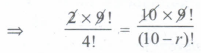
\(\Rightarrow\) (10-r)! = 5 \(\times\)4!
\(\Rightarrow\) (10-r)! = 5! [n(n-1)! = n!]
\(\Rightarrow\) 10-r = 5 \(\Rightarrow\) r = 5.

11th Standard Syllabus & Materials
11th Standard
TN 11th Tamil பீடு பெற நில் - செய்யுள் - காவடிச்சிந்து Important Questions And Answers Study Material - QB365 Set A
NEW11th Standard
TN 11th Tamil பீடு பெற நில் - உரைநடை - மலை இடப்பெயர்கள் : ஓர் ஆய்வு Important Questions And Answers Study Material - QB365 Set A
NEW11th Standard
TN 11th Tamil மாமழை போற்றுதும் - துணைப்பாடம் - யானை டாக்டர் Important Questions And Answers Study Material - QB365 Set A
NEW11th Standard
TN 11th Tamil மாமழை போற்றுதும் - செய்யுள் - ஐங்குறுநூறு Important Questions And Answers Study Material - QB365 Set A



Tamilnadu Stateboard 11th Standard Subjects
Maths

Commerce

Economics

Biology

Business Maths and Statistics

Accountancy

Computer Science

Physics

Chemistry
Maths
Biology
Economics
Physics
Chemistry

History
Business Maths and Statistics

Computer Science
Accountancy

Computer Applications
History
Computer Technology
Commerce
Computer Applications
Computer Technology

Tamil

English

French
Tamilnadu Stateboard Standards

