
 100% FREE ACCESS
11th Standard Syllabus & Materials
11th Standard
TN 11th Tamil இயற்கை வேளாண்மை,சுற்றுச்சூழல் -செய்யுள் - மனோன்மணீயம் Important Questions And Answers Study Material - QB365 Set A
NEW11th Standard
TN 11th Tamil என்னுயிர் என்பேன் -துணைப்பாடம் - இசைத்தமிழர் இருவர் Important Questions And Answers Study Material - QB365 Set A
NEW11th Standard
TN 11th Tamil மொழி கலை -செய்யுள் - ஒவ்வொரு புல்லையும் Important Questions And Answers Study Material - QB365 Set A
NEW11th Standard
TN 11th Tamil பீடு பெற நில் - இலக்கணம் - பகுபத உறுப்புகள் Important Questions And Answers Study Material - QB365 Set A
NEW11th Standard
TN 11th Tamil பீடு பெற நில் - துணைப்பாடம் - வாடிவாசல் Important Questions And Answers Study Material - QB365 Set A
NEW11th Standard
TN 11th Tamil பீடு பெற நில் - செய்யுள் - குறுந்தொகை Important Questions And Answers Study Material - QB365 Set A

Published on: 29/09/2018
Important questions -Differential Calculus
Download Tamil Nadu 11th Standard Maths question papers, model tests, one-mark questions, important questions, and public exam papers in PDF format. Free study materials and answer keys for TN State Board students.
Questions + Answers key
Take MCQ Maths Test1.
Find the derivatives of the following : y = xcosx
2.
Find \({dy\over dx}\) if x = at2 ; y = 2at, t\(\neq 0.\)
3.
Differentiate the following: y = cos (tan x)
4.
Differentiate 2x.
5.
Examine the differentiability of functions in R by drawing the diagrams |sin x|
6.
Determine whether the following function is differentiable at the indicated values. f(x) = |x| + |x - 1| at x = 0, 1
7.
Find the derivatives of the following functions using first principle. f(x) = - x2 + 2
8.
Find the derivatives of the following functions using first principle. f(x) = 6
9.
Show that the greatest integer function \(f(x)=\left\lfloor x \right\rfloor \) is not differentiable at any integer?
10.
Find the slope of the tangent line to the graph of f(x) = 7x + 5 at any point (x0, f(x0)).
11.
Find the derivatives of the following : \(\sqrt{x^2+y^2}=tan^{-1}({y\over x})\)
12.
Find f'(x) if f(x) = cos-1(4x3 - 3x).
13.
Differentiate y \(=x^{\sqrt{x}}\)
14.
Find the derivatives of the following functions with respect to corresponding independent variables: \(y=\frac{x}{\sin X+\cos X}\)
15.
Differentiate the following with respect to x : \(y={log x \ x \over e^x}\)
16.
Differentiate the following with respect to x : y = ex + sin x + 2
17.
Show that the following functions are not differentiable at the indicated value of x.

18.
The number of points in R in which the function \(f(x)=|x-1|+|x-3|+sin \ x\) is not differentiable, is
3
2
1
4
19.
\(\text { If } f(x)=\left\{\begin{array}{ll} a x^2-b, & -1<x<1 \\ \frac{1}{|x|}, & \text { elsewhere } \end{array} \ \text { is differentiable at } x=1\right. \text {, then }\)
\(a={1\over2},b={-3\over 2}\)
\(a={-1\over2},b={3\over 2}\)
\(a=-{1\over2},b=-{3\over 2}\)
\(a={1\over2},b={3\over 2}\)
20.
If f(x) = \(\left\{\begin{matrix} x+2& -1<x<3\\ 5,& x=3\\ 8-x,& x>3\\ \end{matrix}\right.\), then at x = 3, f'(x) is:
1
-1
0
does not exist
21.
If g(x) = (x2 + 2x + 3) f(x) and f(0) = 5 and \(lim_{x \rightarrow 0}{f(x)-5\over x}=4\), then g'(0) is
20
14
18
12
22.
0
2
3
4
23.
If f(x) = x + 2, then f '(f(x)) at x = 4 is
8
1
4
5
24.
If f(x) = x tan-1 x, then f '(1) is
\(1+{\pi\over 4}\)
\({1\over 2}+{\pi\over 4}\)
\({1\over 2}-{\pi\over 4}\)
2
25.
If y = mx + c and f(0) =\(f '(0)=1\), then f(2) is
1
2
3
-3
26.
If y = cos (sin x2), then \({dy\over dx}\) at x = \(\sqrt{\pi\over 2}\) is
-2
2
\(-2\sqrt{\pi\over 2}\)
0
27.
If y = \({1\over4}u^4,u={2\over 3}x^3+5,\) then \({dy\over dx}\) is
\({1\over 27}x^2(2 x^3+15)^3\)
\({2\over 27}x(2 x^3+5)^3\)
\({2\over 27}x^2(2 x^3+15)^3\)
\(-{2\over 27}x(2 x^3+5)^3\)
1.
\(y=x^{\cos x}\)
Take log on both sides.
\(\log y =\log \left(x^{\cos x}\right) \)
\(
\log y =\cos x \cdot \log x \)
\(
\frac{1}{y} \frac{d y}{d x} =\cos x \frac{d}{d x}(\log x)+\log x \frac{d}{d x}(\cos x) \)
\(
\frac{1}{y} \frac{d y}{d x} =\cos x \cdot \frac{1}{x}+\log x(-\sin x) \)
\(
\frac{d y}{d x} =y\left[\frac{\cos x}{x}-\log x(\sin x)\right] \)
\(=x^{\cos x}\left[\frac{\cos x}{x}-\log x(\sin x)\right]
\)
2.
We have x = at2 ; y = 2at
\({dy\over dx}={y'(t)\over x'(t)}={2a\over 2at}={1\over t}.\)
3.
y = cos(tan x)
Take \(u=\tan x \Rightarrow \frac{d u}{d x}=\sec ^2 x\)
\(y=\cos u\)
\(\frac{d y}{d x}=\frac{d y}{d u} \cdot \frac{d u}{d x}=-\sin u \cdot\left(\sec ^2 x\right)\)
\(=-\sin (\tan x) \sec ^2 x\)
4.
Let y = 2x = exlog2.
Take u = (log 2)x so that
y = eu
\({dy\over dx}={dy\over du}\times {du\over dx}=e^u \times log2=e^{xlog 2}\)
= (log2)2x.
5.
y = sinx
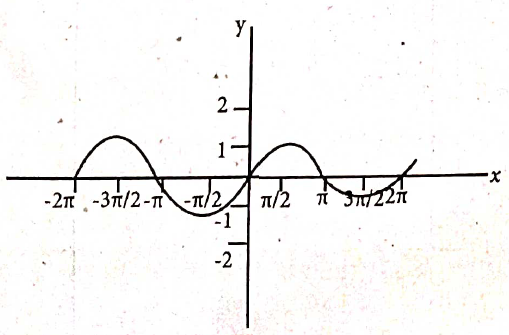
\(y=|\sin x|\)
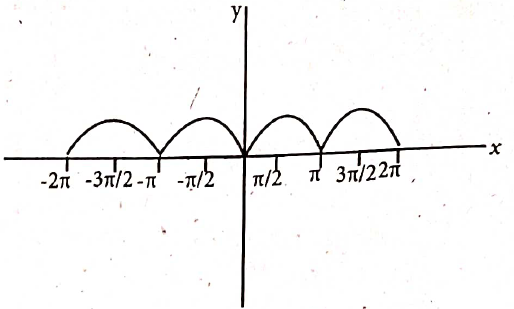
\(|\sin x|\) is not differentiable at \(x=n \pi, n \in Z\)
6.
\(f(x)=\left\{\begin{array}{ccc} 1-2 x & \text { if } & x<0 \\ 1 & \text { if } & 0 \leq x<1 \\ 2 x-1 & \text { if } & x \geq 1 \end{array}\right.\)
At x = 0
\(f^{\prime}\left(0^{+}\right)=\lim _{x \rightarrow 0^{+}} \frac{f(x)-f(0)}{x-0}\)
\(=\lim _{x \rightarrow 0^{+}} \frac{1-1}{x-0}=0\)
\(f^{\prime}\left(0^{-}\right)=\lim _{x \rightarrow 0^{-}} \frac{f(x)-f(0)}{x-0}\)
\(=\lim _{x \rightarrow 0^{-}} \frac{1-2 x-1}{x-0}=-\infty\)
\(\therefore\) It is not differentiable at x = 0
At x = 1
\(f^{\prime}\left(1^{+}\right)=\lim _{x \rightarrow 1^{+}} \frac{f(x)-f(1)}{x-1}=\lim _{x \rightarrow 1^{+}} \frac{2(x-1)}{(x-1)}=2\)
\(f^{\prime}\left(1^{-}\right)=\lim _{x \rightarrow 1^{-}} \frac{f(x)-f(1)}{x-1}=\lim _{x \rightarrow 1^{-}} \frac{1-1}{x-1}=0\)
\(\therefore f^{\prime}\left(1^{+}\right) \neq f^{\prime}\left(1^{-}\right)\)
\(\therefore f\) is not differentiable at x = 1.
Hence f(x) i not differentiable at x = 0, 1.
7.
\(f(x)=-x^2+2\)
\(f(x+h)=-(x+h)^2+2=-x^2-h^2-2 x h+2\)
\(f^{\prime}(x)=\lim _{h \rightarrow 0} \frac{f(x+h)-f(x)}{h}\)
\(=\lim _{h \rightarrow 0} \frac{-x^2-h^2-2 x h+2+x^2-2}{h}\)
\(=\lim _{h \rightarrow 0} \frac{+h(-h-2 x)}{h}\)
= -0 - 2x
\(f^{\prime}(x)=-2 x\)
8.
f'(x) = \(\lim _{h \rightarrow 2} \frac{f(x+h)-f(x)}{h}\)
Given f(x) = 6
⇒ f(x + hx) = 6
∴ f'(x) = \(\lim _{h \rightarrow 0} \frac{6-6}{h}=\lim _{t \rightarrow 0} \frac{0}{h}\) = 0
∴ f'(x) = 0
9.
The greatest integer function \(f(x)=\lfloor x\rfloor\) is not continuous at every integer point n, since \(\left.\lim _{x \rightarrow n^{-}} \mid x\right\rfloor=n-1\) and \(\lim _{x \rightarrow n^{+}}\lfloor x\rfloor=n .\) Thus f'(n) does not exist.
10.
Step (i) f(x0) = 7x0 + 5.
For any \(\triangle x\neq 0,\),
f(x0 +\(\triangle\)x) = 7(x0 + \(\triangle\)x) + 5
= 7x0 + 7\(\triangle\)x + 5
Step (ii) \(\triangle\)y = f(x0 + \(\triangle\)x) - f(x0)
= (7xo+7\(\triangle\)xo+5)
Step (iii)\({\triangle \ y\over \triangle x}=7\)
Thus, at any point on the graph of f(x) = 7x + 5, we have
Step (iv) mtan = \(lim_{\triangle x \rightarrow 0}{\triangle y\over \triangle x}\)
= \(lim_{\triangle x\rightarrow o}(7)\)
= 7.
11.
\(
\sqrt{x^2+y^2} =\tan ^{-1} \frac{y}{x}
\)
\(\left(x^2+y^2\right)^{1 / 2} =\tan ^{-1} \frac{y}{x}\)
\(
\frac{1}{2 \sqrt{x^2+y^2}}\left(2 x+2 y \frac{d y}{d x}\right)=\frac{1}{1+\left(\frac{y}{x}\right)^2}\left(\frac{x \frac{a y}{d x}-y}{x^2}\right)
\)
\(\frac{2\left(x+y \frac{d y}{d x}\right)}{2 \sqrt{x^2+y^2}}=\frac{1}{\left(\frac{x^2+y^2}{x^2}\right)}\left(\frac{x \frac{d y}{d x}-y}{x^2}\right)\)
\(
x+y \frac{d y}{d x}=\frac{\sqrt{x^2+y^2}}{\left(x^2+y^2\right)}\left(x \frac{d y}{d x}-y\right)
\)
\(x+y \frac{d y}{d x}=\frac{1}{\sqrt{x^2+y^2}}\left(x \frac{d y}{d x}-y\right) \)
\(x+y \frac{d y}{d x}=\frac{x}{\sqrt{x^2+y^2}} \frac{d y}{d x}-\frac{y}{\sqrt{x^2+y^2}}\)
\(
\frac{x}{\sqrt{x^2+y^2}} \frac{d y}{d x}-y \frac{d y}{d x} =x+\frac{y}{\sqrt{x^2+y^2}}\)
\(\frac{d y}{d x}\left(\frac{x}{\sqrt{x^2+y^2}}-y\right) =\frac{x \sqrt{x^2+y^2}+y}{\sqrt{x^2+y^2}}
\)
\(\frac{d y}{d x}\left(\frac{x-y \sqrt{x^2+y^2}}{\sqrt{x^2+y^2}}\right) =\frac{x \sqrt{x^2+y^2}+y}{\sqrt{x^2+y^2}} \)
\(\frac{d y}{d x} =\frac{x \sqrt{x^2+y^2}+y}{x-y \sqrt{x^2+y^2}}\)
12.
Let x = cos \(\theta\)
Then 4x3 − 3x = 4cos3 \(\theta\)- 3cos = cos3\(\theta\) and
f(x) = cos-1(cos3\(\theta\) ) = 3\(\theta\) = 3cos-1x
Therefore,f'(x) = 3\(({-1\over \sqrt{1-x^2}})={-3\over \sqrt{1-x^2}}.\)
13.
Take logarithm :
log y = \(\sqrt{x} \log x\)
Differentiating implicitly,
\({y'\over y}=\sqrt{x}.{1\over x}+{1\over 2\sqrt{x}}.log\ x\)
\(={log \ x+2\over 2\sqrt{x}}\)
Therefore, \({d\over dx}(x^{\sqrt{x}})=y'=x^{{\sqrt{x}}}({log \ x+2\over 2\sqrt{x}})\) .
14.
\(y=\frac{x}{\sin X+\cos X}\)
\(\frac{d y}{d x}=\frac{(\sin x+\cos x) \frac{d}{d x}(x)-x \frac{d}{d x}(\sin x+\cos x)}{(\sin x+\cos x)^2}\)
\(=\frac{(\sin x+\cos x)(1)-x(\cos x-\sin x)}{(\sin x+\cos x)^2}\)
\(=\frac{\sin x+\cos x-x \cos x+x \sin x}{(\sin x+\cos x)^2}\)
\(=\frac{\sin x(1+x)+\cos x(1-x)}{(\sin x+\cos x)^2}\)
15.
\(y={log \ x \over e^x }=e^{-x}.log \ x\)
\({dy\over dx}=e^{-x}({1\over x})+log \ x(e^{-x})(-1)\)
\(=e^{-x}[{1\over x}-log \ x]\).
16.
\(\frac{d y}{d x}=e^x+\cos x\)
17.
\(\therefore\) f'(x) = \(\underset { x\rightarrow 0^{ - } }{ lim } \frac { f(x)-f(0) }{ x-0 } =\underset { x\rightarrow 0^{ - } }{ lim } \frac { 3x-0 }{ x } =\underset { x\rightarrow 0^{ - } }{ lim } \frac { 3x }{ x } = 3\) [f(x) = 3x] .....(1)
\(\therefore\) f'(0+) = \(\underset { x\rightarrow 0^{ - } }{ lim } \frac { f(x)-f(0) }{ x-0 } =\underset { x\rightarrow 0^{ - } }{ lim } \frac { -4x-0 }{ x } \)
= \(\underset { x\rightarrow 0^{ - } }{ lim } \frac { -4x }{ x } \) = -4 .........(2)
by (1) & (2), f'(0-) ≠ f'(0+)
\(\therefore\) It is not differentiable.
18.
\(f(x)=|x-1|+|x-3|+\sin x\)
\(\text { Since } \sin x \text { is differentiable everywhere }\)
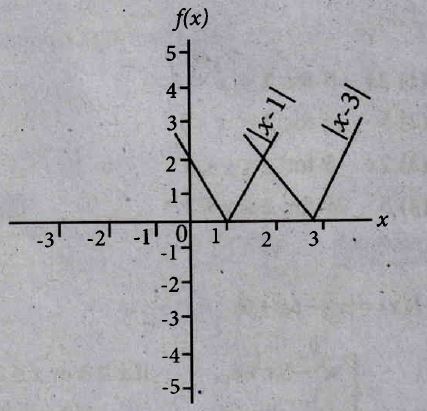
At x = 1 and x = 3. The graph admit cups.
\(\therefore\) The derivative is not exist.
\(\therefore\) The number of points in R is 2.
19.
Given f is differentiable
\(\therefore f^{\prime}\left(1^{-}\right)=f^{\prime}\left(1^{+}\right)=1 \)
\(f^{\prime}\left(1^{-}\right) =\lim _{x \rightarrow 1^{-}} \frac{f(x)-f(1)}{x+1}=\lim _{x \rightarrow 1^{-}} \frac{\left(a x^{2}-b\right)-(a-b)}{x+1} \)
\(=\lim _{x \rightarrow 1^{-}} \frac{a x^{2}-b-a+b}{x+1}=\lim _{x \rightarrow 1^{-}} \frac{a\left(x^{2}-1\right)}{x+1} \)
\(=\lim _{x \rightarrow 1^{-}}-a(x+1) \)
\(=a(1+1)=2 a \)
\(\therefore f^{\prime}\left(1^{+}\right) =\lim _{x \rightarrow 1^{+}} \frac{f(x)-f(1)}{x-1}=\lim _{x \rightarrow 1^{+}} \frac{\frac{1}{x}-1}{x-1} \)
\(=\lim _{x \rightarrow 1^{+}} \frac{1-x}{x(x-1)}=\lim _{x \rightarrow 1^{+}} \frac{-1}{x}=-1\)
\(\therefore 2 a =-1 \)
\(a =\frac{-1}{2} \)
\(\text { and } f(1)=1\)
\(a-b=1 \)
\(-1 / 2-1=b \)
\(b=-3 / 2 \)
20.
\(f^{\prime}\left(3^{-}\right)=\lim _{x \rightarrow 3^{-}} \frac{f(x)-f(3)}{x-3}=\lim _{x \rightarrow 3^{-}} \frac{x+2-5}{x-3}\)
\(=\lim _{x \rightarrow 3^{-}} \frac{x-3}{x-3}=1\)
\(f^{\prime}\left(3^{+}\right)=\lim _{x \rightarrow 3^{+}} \frac{f(x)-f(3)}{x-3}=\lim _{x \rightarrow 3^{+}} \frac{8-x-5}{x-3}\)
\(=\lim _{x \rightarrow 3^{+}} \frac{3-x}{x-3} \)
\(=\lim _{x \rightarrow 3^{+}} \frac{-(x-3)}{(x-3)}=-1 \)
\(\text { by }(1) \text { and }(2), f^{\prime}\left(3^{-}\right) \neq f^{\prime}\left(3^{+}\right)\)
\(\text { It is not differentiable }\)
\(\therefore f^{\prime}(x) \text { does not exist }\)
21.
\(\text { Given } f(0)=5\)
\(\lim _{x \rightarrow 0} \frac{f(x)-5}{x} =4 \)
\(\lim _{x \rightarrow 0} \frac{f(x)-f(0)}{x-0} =4 \)
\(f^{\prime}(0) =4 \)
\(g(x) =\left(x^{2}+2 x+1\right) f(x) \)
\(g^{\prime}(x) =\left(x^{2}+2 x+1\right) f^{\prime}(x)+(2 x+2) f(x) \)
\(g^{\prime}(0) =(1) f^{\prime}(0)+2 f(0) \)
\(=1(4)+2(5) \)
\(=4+10=14 \)
22.
\(\text { The right hand derivative of } f(x) \text { at } x=2 \text { is }\)
\(f^{\prime}\left(2^{+}\right) =\lim _{x \rightarrow 2^{+}} \frac{f(x)-f(2)}{x-2} \)
\(=\lim _{x \rightarrow 2^{+}} \frac{(3 x+4)-(3(2)+4)}{x-2} \)
\(=\lim _{x \rightarrow 2^{+}} \frac{3 x+4-6-4}{x-2} \)
\(=\lim _{x \rightarrow 2^{+}} \frac{3(x-2)}{(x-2)}=3 \)
23.
\(\text { Given } f(x)=x+2\)
\(f^{\prime}(x) =1 \)
\(f^{\prime}(f(x)) =f^{\prime}(x+2)=1 \)
24.
\(\text { Given } f(x)=x \tan ^{-1} x\)
\(f^{\prime}(x) =x \cdot \frac{1}{1+x^{2}}+\tan ^{-1} x \)
\(f^{\prime}(1) =\frac{1}{1+1^{2}}+\tan ^{-1}(1) \)
\(=\frac{1}{2}+\pi / 4 \)
\(\left(\because \tan 45^{\circ}=1\right)\)
25.
\(y =m x+c \)
\(f(x) =m x+c \Rightarrow f(0)=c=1 \)
\(\therefore c =1 \)
\(f^{\prime}(x) =m \)
\(f^{\prime}(0) =1=m \)
\(\therefore m =1 \)
\(\therefore f(x) =x+1 \)
\(f(2) =2+1=3 \)
26.
\(y =\cos \left(\sin x^{2}\right) \)
\(\frac{d y}{d x} =-\sin \left(\sin x^{2}\right) \cos \left(x^{2}\right)(2 x) \)
\(\text { At } x =\sqrt{\pi / 2}, \frac{d y}{d x}=-\sin \sin \left(\frac{\pi}{z}\right) \cos (\pi / 2) 2(\sqrt{\pi / 2}) \)
\(=(\sin 1)(0) 2\left(\frac{\sqrt{\pi}}{2}\right)=0 \quad[\because \cos \pi / 2=0] \)
27.
\(u =\frac{2}{3} x^{3}+5 \)
\(\frac{d u}{d x} =\frac{2}{3}\left(3 x^{2}\right)=2 x^{2} \)
\(y =\frac{1}{4} u^{4} \)
\(\frac{d y}{d x} =\frac{1}{4}\left(4 u^{3}\right) \frac{d u}{d x}=u^{3}\left(2 x^{2}\right) \)
\(=\left(\frac{2}{3} x^{3}+5\right)^{3}\left(2 x^{2}\right) \)
\(=\left(\frac{2 x^{3}+15}{3}\right)^{3} \times 2 x^{2}=\frac{\left(2 x^{3}+15\right)^{3}}{27}\left(2 x^{2}\right) \)

11th Standard Syllabus & Materials
11th Standard
TN 11th Tamil பீடு பெற நில் - செய்யுள் - காவடிச்சிந்து Important Questions And Answers Study Material - QB365 Set A
NEW11th Standard
TN 11th Tamil பீடு பெற நில் - உரைநடை - மலை இடப்பெயர்கள் : ஓர் ஆய்வு Important Questions And Answers Study Material - QB365 Set A
NEW11th Standard
TN 11th Tamil மாமழை போற்றுதும் - துணைப்பாடம் - யானை டாக்டர் Important Questions And Answers Study Material - QB365 Set A
NEW11th Standard
TN 11th Tamil மாமழை போற்றுதும் - செய்யுள் - ஐங்குறுநூறு Important Questions And Answers Study Material - QB365 Set A



Tamilnadu Stateboard 11th Standard Subjects
Maths

Commerce

Economics

Biology

Business Maths and Statistics

Accountancy

Computer Science

Physics

Chemistry
Maths
Biology
Economics
Physics
Chemistry

History
Business Maths and Statistics

Computer Science
Accountancy

Computer Applications
History
Computer Technology
Commerce
Computer Applications
Computer Technology

Tamil

English

French
Tamilnadu Stateboard Standards

