
 100% FREE ACCESS
11th Standard Syllabus & Materials
11th Standard
TN 11th Tamil இயற்கை வேளாண்மை,சுற்றுச்சூழல் -செய்யுள் - மனோன்மணீயம் Important Questions And Answers Study Material - QB365 Set A
NEW11th Standard
TN 11th Tamil என்னுயிர் என்பேன் -துணைப்பாடம் - இசைத்தமிழர் இருவர் Important Questions And Answers Study Material - QB365 Set A
NEW11th Standard
TN 11th Tamil மொழி கலை -செய்யுள் - ஒவ்வொரு புல்லையும் Important Questions And Answers Study Material - QB365 Set A
NEW11th Standard
TN 11th Tamil பீடு பெற நில் - இலக்கணம் - பகுபத உறுப்புகள் Important Questions And Answers Study Material - QB365 Set A
NEW11th Standard
TN 11th Tamil பீடு பெற நில் - துணைப்பாடம் - வாடிவாசல் Important Questions And Answers Study Material - QB365 Set A
NEW11th Standard
TN 11th Tamil பீடு பெற நில் - செய்யுள் - குறுந்தொகை Important Questions And Answers Study Material - QB365 Set A

Published on: 29/09/2018
Model Questions-Differential Calculus
Download Tamil Nadu 11th Standard Maths question papers, model tests, one-mark questions, important questions, and public exam papers in PDF format. Free study materials and answer keys for TN State Board students.
Questions + Answers key
Take MCQ Maths Test1.
Examine the continuity of the following: e2x + x2
2.
Determine if f defined by \(f(x)=\left\{\begin{array}{ll} x^{2} \sin \frac{1}{x}, & \text { if } x \neq 0 \\ 0, & \text { if } x=0 \end{array} \text { is continuous in } \mathbb{R}\right.\)
3.
Evaluate the following limits :\(lim_{x\rightarrow \infty}(1+{k\over x})^{m\over x} \)
4.
Find the left and right limits of \(f(x)={x^2-4\over (x^2+4x+4)(x+3)}at \ x=-2\) .
5.
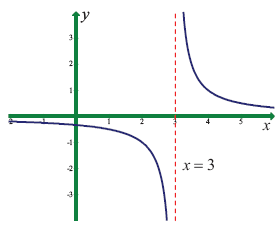
Use the graph to find the limits (if it exists). If the limit does not exist, explain why?
\(lim_{x\rightarrow3}{1\over x-3}\)
6.
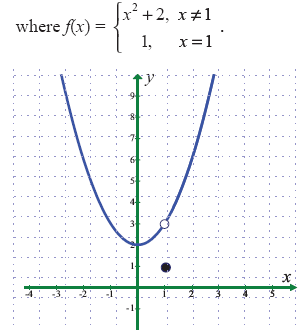
Use the graph to find the limits (if it exists). If the limit does not exist, explain why?
\(lim_{x\rightarrow1}f(x)\)
7.
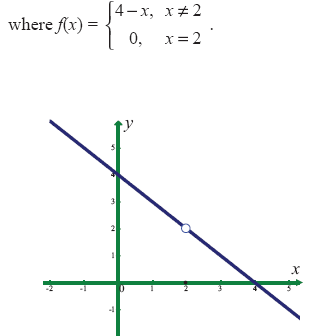
Use the graph to find the limits (if it exists). If the limit does not exist, explain why?
\(lim_{x\rightarrow2}f(x)\)
8.
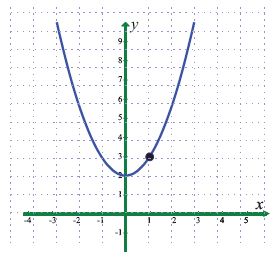
Use the graph to find the limits (if it exists). If the limit does not exist, explain why?
\(lim_{x\rightarrow1}(x^2+2)\)
9.
Use the graph to find the limits (if it exists). If the limit does not exist, explain why?
\(lim_{x\rightarrow3}(4-x)\).
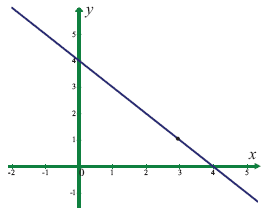
10.
In problem, using the table estimate the value of the limit
\(lim_{x\rightarrow0}{cos x-1\over x}\)
| x | -0.1 | -0.01 | -0.001 | 0.001 | 0.01 | 0.1 |
| f(x) | 0.04995 | 0.0049999 | 0.0004999 | –0.0004999 | –0.004999 | –0.04995 |
11.
In problem, using the table estimate the value of the limit
\(lim_{x\rightarrow{-3}}{\sqrt{1-x}-2\over x+3}\)
| x | -3.1 | -3.01 | -3.00 | -2.999 | -2.99 | -2.9 |
| f(x) | – 0.24845 | – 0.24984 | – 0.24998 | – 0.25001 | – 0.25015 | – 0.25158 |
12.
In problems 1-6, using the table estimate the value of the limit.
\(lim_{x\rightarrow 2}{x-2\over x^2-x-2}\)
| x | 1.9 | 1.99 | 1.999 | 2.001 | 2.01 | 2.1 |
| f(x) | 0.344820 | 0.33444 | 0.33344 | 0.333222 | 0.33222 | 0.332258 |
13.
Consider the function f(x) = \(\sqrt{x},x\ge0.\) Does\(lim_{x\rightarrow0}f(x)\) exist?
14.
Suppose that the diameter of an animal’s pupils is given by \(f(x)={160x^{-0.4}+90\over 4x^{-0.4}+15},\) where x is the intensity of light and f(x) is in mm. Find the diameter of the pupils with minimum light.
15.
\(f(x)= \begin{cases}\sin x, & x<0 \\ 1-\cos x, & 0 \leq x \leq \pi \\ \cos x, & x>\pi\end{cases}\)
16.
Sketch the graph of f, then identify the values of x0 for which \(lim_{x\rightarrow{x_o}}f(x)\) exists.
\(f(x)=\begin{cases} { x^ 2 } ,\quad x \le 2 \\ 8-{ 2x } ,\quad 2 < x < 4 \\ { 4 } ,\quad x\ge 4 \end{cases}\)
17.
Find the points of discontinuity of the function f, where f(x) = {\(\begin{matrix} { x }^{ 3 }-3, & if\quad x\le 2 \\ { x }^{ 2 }+1, & if\quad x>2 \end{matrix}\)
18.
Calculate \(lim_{x\rightarrow0}{1\over (x^2+x^3)}\)
19.
Let a function f be defined by \(f(x)={x-|x|\over x}\) for x \(\neq\) 0 and f(0) = 2. Then f is
continuous nowhere
continuous everywhere
continuous for all x except x = 1
continuous for all x except x = 0
20.
At x \(={3\over 2}\) the function \(f(x)={|2x-3|\over 2x-3}\) is
continuous
discontinuous
differentiable
non-zero
21.
The value of \(lim_{x\rightarrow k^-}x-\left\lfloor x \right\rfloor \) , where k is an integer is
-1
1
0
2
22.
The value of \(lim_{x \rightarrow 0}{sin x\over \sqrt{x^2}}\) is
1
-1
0
limit does not exist
23.
\(lim_{x \rightarrow 0}{e^{tan \ x}-e^x\over tan x-x}=\)
1
e
\({1\over2}\)
0
24.
\(lim_{n \rightarrow \infty}({1\over n^2}+{2\over n^2}+{3\over n^2}+..+{n\over n^2})\) is
\(1\over 2\)
0
1
\(\infty\)
25.
If f(x) = x(-1)\(\left\lfloor 1\over x \right\rfloor \), \(x\le0\), then the value of \(lim_{x\rightarrow 0}f(x)\) is equal to
-1
0
2
4
26.
\(lim_{x \rightarrow \infty}{\sqrt{x^2-1}\over 2x+1}=\)
1
0
-1
\(1\over 2\)
27.
\(lim_{x\rightarrow {\pi/2}}{2x-\pi\over cosx} \)
2
1
-2
0
28.
\(lim_{x\rightarrow\infty}{sin \ x \over x} \)
1
0
\(\infty\)
-\(\infty\)
1.
Let f(x)=e2x + x2
Since exponential function e2x and algebraic function (x2) is continuous for all \(x \in R\)
f(x)=e2x + x2 is continuous for all \(x \in R\).
2.
By Sandwitch theorem \(lim_{x\rightarrow 0}x^2sin{1\over x}=0\) and f(0) = 0 by the definition of f(x). Hence it is continuous at x = 0. For other values it is clearly continuous and hence continuous in R.
3.
\(lim_{x\rightarrow \infty}(1+{k\over x})^{m\over x} \)
put \({1\over x}=t\)
\(\therefore lim_{x\rightarrow \infty}(1+{k\over x})^{m\over x} =lim_{{1\over x}\rightarrow\infty}(1+kt)^{mt}\)\(=lim_{t\rightarrow 0}(1+0)^{m(0)}=lim_{t\rightarrow 0}(1)^{0}=1\)
4.
Given \(f(x)={x^2-4\over (x^2+4x+4)(x+3)}at \ x=-2\)
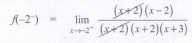
\(=lim_{x\rightarrow -2^-}{x-2\over (x+2)(x+3)}\)
\(={Negative \over 0(Negative)}=\infty\)
\(\therefore f(-2^-)\rightarrow \infty as \ x\rightarrow 2^-\)
\(f(-2)^+=lim_{x\rightarrow -2^+}{(x+2)(x-2)\over (x+2)(x+3)}\)
\(=lim_{x\rightarrow -2^+}{x-2\over (x+2)(x+3)}\)
\(={Negative \over 0(Positive)}\rightarrow-\infty\)
\(\therefore f(-2^+)\rightarrow -\infty as \ x\rightarrow 2^+\).
5.
\(\frac{1}{x-3}\) can be made arbitrarily large by choosing x suficiently close to 1 on the right side but not equal to 1.
\(\therefore \frac{1}{x-3}\) does not approach any value when x approaches 3 from the right.
\(\therefore \lim _{x \rightarrow 3^{+}} \frac{1}{x-3}=x\) and hence the limit does not exist.
6.
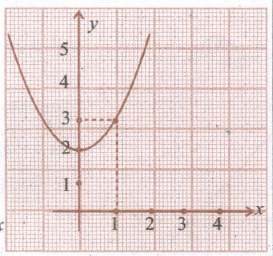
At x = 1, the value of the curve on the y-axis is 3.
\(\therefore lim_{x\rightarrow1}f(x)=3\)
7.
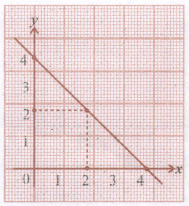
At x = 2, the value of the curve on y-axis is 2.
\(\therefore lim_{x\rightarrow2}f(x)=2\)
8.
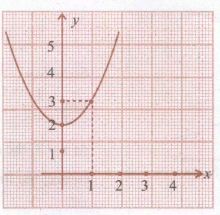
\(lim_{x\rightarrow1}(x^2+2)\)
Atx = 1, the value of the curve on y-axis is 3.
\(\therefore lim_{x\rightarrow1}(x^2+2)=3\)
9.
\(lim_{x\rightarrow3}(4-x)\)
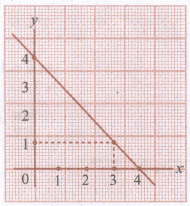
At x = 3, the value of the curve on y-axis is 1.
\(\therefore lim_{x\rightarrow3}(4-x)=1\)
10.
Let \( f(x)=\frac{\cos x-1}{x}
\)
\(\therefore \lim _{x \rightarrow 0} \frac{\cos x-1}{x}=0\)
11.
Let \( f(x)=\frac{\sqrt{1-x}-2}{x+3}
\)
\(\therefore \lim _{x \rightarrow-3} \frac{\sqrt{1-x}-2}{x+3}=-0.250
\)
12.
Let \(
f(x)=\frac{x-2}{x^2-x-2}=\frac{x-2}{(x-2)(x+1)}=\frac{1}{x+1}
\)
\( \therefore \lim _{x \rightarrow 2} \frac{x-2}{\dot{x}^2-x-2}=\lim _{x \rightarrow 2} \frac{1}{x+1}=\frac{1}{3}=0 . \overline{3}
\)
13.
No. f(x) = \(\sqrt{x}\) is not even defined for x < 0.
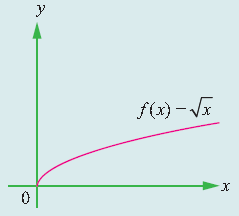
Therefore as x \(\rightarrow 0^-,lim_{x\rightarrow0^-}\sqrt{x}\) does not exist.
However, \(lim_{x\rightarrow0^+}\sqrt{x}=0.\) Therefore \(lim_{x\rightarrow0}\sqrt{x}\) does not exist.
14.
For minimum light it is enough to find the limit of the function when x\(\rightarrow\)0+.
\(lim_{x\rightarrow 0^+}f(x)=lim_{x\rightarrow 0^+}{160x^{-0.4}+90\over 4x^{-0.4}+15}=lim_{x\rightarrow0^+}{160+90x^{0.4}\over 4+15x^{0.4}}\)
\(={160\over 4}=40mm\).
15.
\(f(x)= \begin{cases}\sin x, & x<0 \\ 1-\cos x, & 0 \leq x \leq \pi \\ \cos x, & x>\pi\end{cases}\)
To sketch the graph of y = f(x)
(i) Draw y = sin x where x < 0
(ii) To draw y = \(1-\cos x, 0 \leq x \leq \pi\)
Draw \(y=\cos x, 0 \leq x \leq \pi\)and reflect it on x-axis and then lift up by 1 unit.
(OR)
Putting x = 0, y = 1 - cos 0 = 1 -1 = 0
Putting \(x=\pi / 2, y=1-\cos \pi / 2=1-0=1\)
Putting \(x=\pi, y=1-\cos \pi=1+1=2\)
\(\therefore y=1-\cos x\) passes through \((0,0),\left(\frac{\pi}{2}, 1\right)\), \((\pi, 2)\)
(iii) Draw y = cos X where x >\(\pi\)
when \(x=\pi, y=\cos \pi=-1\)
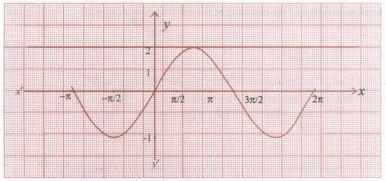
\(
\lim _{x \rightarrow \pi^{-}} f(x)=2
\)
\( \lim _{x \rightarrow \pi^{+}} f(x)=-1
\)
\( \therefore \lim _{x \rightarrow \pi} f(x)
\) dose not exist.
\(\therefore \lim _{x \rightarrow x_0} f(x) \text { exists for } x \in R-\{\pi\}
\)
16.
\(f(x)=\begin{cases} { x^ 2 } ,\quad x \le 2 \\ 8-{ 2x } ,\quad 2 < x < 4 \\ { 4 } ,\quad x\ge 4 \end{cases}\)
To sketch the graph of y = f(x)
(i) y = x2 is an upward parabola with vertex at origin
when x = 2, y = (2)2 = 4
Draw the graph y = x2 where \(x \leq 2\)
(ii) y = 8 - 2x is a straight line.
when x = 2, y = 8 - 4 = 4
when x = 4, y = 8 - 8 = 0
Join (2, 4) and (4, 0) by a line segment and delete the points (2, 4) and (4, 0)
(iii) y = 4 is a horizontal line with y intercept 4.
when x = 4, y = 4
Draw y = 4 where \(k \geq 4\)
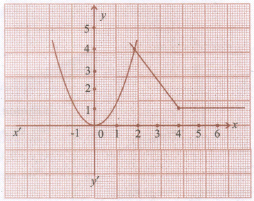
\( \lim _{x \rightarrow 4^{-}} f(x)=0 \ and\ \lim _{x \rightarrow \mathbb{4}^{+}} f(x)=4 \)
\( \therefore \lim _{x \rightarrow 4} f(x) \) does not exist.
\( \therefore \lim _{x \rightarrow x_0} f(x) exists\ for\ x_0 \in R-\{4\} \)
17.
Let f(x) = {\(\begin{matrix} { x }^{ 3 }-3, & if\quad x\le 2 \\ { x }^{ 2 }+1, & if\quad x>2 \end{matrix}\)
\(lim_{x \rightarrow 2^-}f(x)=lim_{x\rightarrow2^-}(x^3-3)=8-3=5\)
\(lim_{x \rightarrow 2^+}f(x)=lim_{x\rightarrow2^+}x^2+1=4+1=5\)
Also,f(2) = x3-3 = 23-3 = 8-3 = 5
\(\therefore f(x)\) is continuous in R.
18.
One can tabulate values of x near 0 (from either side) and conclude \(f(x)={1\over x^2+x^3}\) grows without bound and hence \(f(x)\rightarrow \infty as \ x\rightarrow 0.\)
To calculate this limit without making a table, we first divide the numerator and denominator by x2. This division can be done, since in the calculation of the limit x ≠ 0 and hence x2 ≠ 0. We can have
\(lim_{x\rightarrow 0}{1\over x^2+x^3}=lim_{x\rightarrow 0}{{1\over x^2}\over{x^2+x^3\over x^2}}={lim_{x\rightarrow}({1\over x^2})\over lim_{x\rightarrow0}(1+x)}\)
Now \({1\over 8}\rightarrow \infty as \ x\rightarrow 0\) and \(lim_{x\rightarrow0}(1+x)=1\) .
Thus the numerator grows without bound while the denominator approaches 1, implying that \({1\over (x^2+x^3)}\) does tend to infinity.
19.
\(f(x) =\frac{x-|x|}{x}, x \neq 0 \)
\(=1-\frac{|x|}{x} \)
\(= \begin{cases}1-\frac{(-x)}{x}, & x<0 \\ 1-\frac{x}{x}, & x>0\end{cases} \)
\(= \begin{cases}1+1, & x<0 \\ 1-1, & x>0\end{cases} \)
\(= \begin{cases}2, & x<0 \\ 0, & x>0\end{cases} \)
\(\text { Given: } f(0)=2 \text {. }\)
\(\therefore f(x)= \begin{cases}2, & x \leq 0 \\ 0, & x>0\end{cases}\)
\(\text { Obviously } f\left(0^{-}\right)=2 \text { and } f\left(0^{+}\right)=0\)
\(\therefore f(x) \text { is not continuous at } x=0 \text {. }\)
\(\text { It is continuous elsewhere }\)
20.
\(f(x)=\frac{|2 x-3|}{2 x-3} \text { is not defined at } x= \frac{3}{2}\)
\(\therefore f(x) \text { is not continuous at } x=\frac{3}{2}\)
21.
\(\text { WKT }\left\lfloor k^{-}\right\rfloor=k-1 \text { and }\left\lfloor k^{+}\right\rfloor=k \text { where } k \text { is an integer }\)
\(\therefore \lim _{x \rightarrow k^{-}} x-\lfloor x\rfloor=k-(k-1)=1\)
22.
\(\lim _{x \rightarrow 0^{-}} \frac{\sin x}{\sqrt{x^{2}}} =\lim _{x \rightarrow 0^{-}} \frac{\sin x}{|x|} \)
\(=\lim _{x \rightarrow 0^{-}} \frac{\sin x}{-x}(\because x<0) \)
= -1
23.
\(\lim _{x \rightarrow 0} \frac{e^{\tan x}-e^{x}}{\tan x-x}=\lim _{x \rightarrow 0} e^{x}\left(\frac{e^{\tan x-x}-1}{\tan x-x}\right)\)
\(=e^{0}(1) \quad(\because \tan x-x \rightarrow 0)\)
=1
24.
\(\lim _{n \rightarrow \infty}[\left.\frac{1}{n^{2}}+\frac{2}{n^{2}}+\frac{3}{n^{2}}+\cdots+\frac{n}{n^{2}}\right] \)
\(=\lim _{n \rightarrow \infty}\left[\frac{(1+2+3+\cdots+\dot{n})}{n^{2}}\right] \)
\(=\lim _{n \rightarrow \infty}\left[\frac{n(n+1)}{2 n^{2}}\right] \)
\(=\frac{1}{2} \lim _{n \rightarrow \infty}\left(\frac{n+1}{n}\right) \)
\(=\frac{1}{2} \lim _{n \rightarrow \infty}\left(1+\frac{1}{n}\right)=1 / 2(1+0)=1 / 2
\)
25.
\(f(x)=x(-1)^{\left\lfloor\frac{1}{x}\right\rfloor}\)
\(=x(\pm 1) \left(\because\left[\frac{1}{x}\right\rfloor \text { is an integer }\right) \)
\(=\pm x \)
\(\therefore \lim _{x \rightarrow 0} f(x)=\lim _{x \rightarrow 0}(\pm x)=0\)
26.
\(\lim _{x \rightarrow \infty} \frac{\sqrt{x^{2}-1}}{2 x+1}=\lim _{x \rightarrow \infty} \frac{\sqrt{1-\frac{1}{x^{2}}}}{2+\frac{1}{x}}=\frac{\sqrt{1-0}}{2+0}=\frac{1}{2}\)
27.
\(\lim _{x \rightarrow \pi / 2} \frac{2 x-\pi}{\cos x} =\lim _{x \rightarrow \pi / 2} \frac{2 x-\pi}{\sin \left(\frac{\pi}{2}-x\right)} \)
\(=\lim _{\left(\frac{\pi}{2}-x\right) \rightarrow 0} \frac{-2\left(\frac{\pi}{2}-x\right)}{\sin \left(\frac{\pi}{2}-x\right)}=-2
\)
28.
(b)
0

11th Standard Syllabus & Materials
11th Standard
TN 11th Tamil பீடு பெற நில் - செய்யுள் - காவடிச்சிந்து Important Questions And Answers Study Material - QB365 Set A
NEW11th Standard
TN 11th Tamil பீடு பெற நில் - உரைநடை - மலை இடப்பெயர்கள் : ஓர் ஆய்வு Important Questions And Answers Study Material - QB365 Set A
NEW11th Standard
TN 11th Tamil மாமழை போற்றுதும் - துணைப்பாடம் - யானை டாக்டர் Important Questions And Answers Study Material - QB365 Set A
NEW11th Standard
TN 11th Tamil மாமழை போற்றுதும் - செய்யுள் - ஐங்குறுநூறு Important Questions And Answers Study Material - QB365 Set A



Tamilnadu Stateboard 11th Standard Subjects
Maths

Commerce

Economics

Biology

Business Maths and Statistics

Accountancy

Computer Science

Physics

Chemistry
Maths
Biology
Economics
Physics
Chemistry

History
Business Maths and Statistics

Computer Science
Accountancy

Computer Applications
History
Computer Technology
Commerce
Computer Applications
Computer Technology

Tamil

English

French
Tamilnadu Stateboard Standards

