
11th Standard Syllabus & Materials
11th Standard
Tamilnadu 11th Standard Tamil மொழி கலை -செய்யுள் - ஒவ்வொரு புல்லையும் Important Questions And Answers Study Material - QB365
NEW11th Standard
Tamilnadu 11th Standard Tamil கேடில் விழுச்செல்வம் - உரைநடை - தமிழகக் கல்வி வரலாறு Important Questions And Answers Study Material - QB365
NEW11th Standard
Tamilnadu 11th Standard Tamil பீடு பெற நில் - இலக்கணம் - பகுபத உறுப்புகள் Important Questions And Answers Study Material - QB365
NEW11th Standard
Tamilnadu 11th Standard Tamil பீடு பெற நில் - செய்யுள் - குறுந்தொகை Important Questions And Answers Study Material - QB365 Set B
NEW11th Standard
Tamilnadu 11th Standard Tamil பீடு பெற நில் - செய்யுள் - குறுந்தொகை Important Questions And Answers Study Material - QB365 Set A
NEW11th Standard
Tamilnadu 11th Standard Tamil பீடு பெற நில் - செய்யுள் - காவடிச்சிந்து Important Questions And Answers Study Material - QB365 Set B

Published on: 03/08/2018
In this question paper, the questions are prepared from the Term I syllabus.The chapter that covers the syllabus is
1. Matrices And Determinants
2. Algebra
3.Analytical Geometry
Download Tamil Nadu 11th Standard Business Maths and Statistics question papers, model tests, one-mark questions, important questions, and public exam papers in PDF format. Free study materials and answer keys for TN State Board students.
Questions + Answers key
Take MCQ Business Maths and Statistics Test
Part C
Answer All Questions
1.
Expand the following by using binomial theorem.\(\left( x+\frac { 1 }{ y } \right) ^{ 7 }\)
2.
Using matrix method, solve x + 2y + z = 7, x + 3z = 11 and 2x - 3y =1.
3.
How many chords can be drawn through 21 points on a circle?
4.
How many triangles can be formed by joining the vertices of a hexagon?
5.
Find the centre and radius of the circle x2 + y2 = 16
6.
Find the center and radius of the circle 5x2 + 5y2 + 4x - 8y - 16 = 0
7.
Find the center and radius of the circle (x + 2) ( x - 5) + (y - 2 ) ( y - 1) = 0
8.
Using co-factors of elements of second column evaluate \(\left| \begin{matrix} 6 & -1 & 5 \\ 3 & 0 & 4 \\ -2 & 7 & -3 \end{matrix} \right| \)
9.
If the letters of the word are arranged as in dictionary, find the rank of the word "AGAIN".
10.
In how many ways can n prizes be given to n boys, when a boy may receive any number of prizes?
11.
For what value of \(\lambda \) are the three lines 2x-5y+3 = 0, 5x-9y+\(\lambda \)=0 and x-2y+1=0 are concurrent?
12.
Find the value of k if the straight line 2x + 3y + 4 + k(6x - y + 12) = 0 is perpendicular to the line 7x + 5y - 4 = 0
13.
Find the locus of a point which moves in such a way that the square of its distance from the point (3, -2) is numerically equal to its distance from the line 5x - 12y = 13
14.
Find the locus of a point such that the sum of its distances from the points (0, 2) and (0, -2) is 6.
15.
Find the slope of the lines which make an angle of 45° with the line 3x - y + 5 = 0.
Part A
Multiple Choice Question
16.
The co-factor of -7 in the determinant \(\begin{vmatrix} 2 & -3 & 5 \\ 6 & 0 & 4 \\ 1 & 5 & -7 \end{vmatrix}\) is________.
-18
18
-7
7
17.
If \(\triangle=\begin{vmatrix} 1 & 2 & 3 \\ 3 & 1 & 2 \\ 2 & 3 & 1 \end{vmatrix}\) then \(\begin{vmatrix} 3 & 1 & 2 \\ 1 & 2 & 3 \\ 2 & 3 & 1 \end{vmatrix}\) is ________.
\(\triangle\)
-\(\triangle\)
3\(\triangle\)
-3\(\triangle\)
18.
The value of the determinant \({\begin{vmatrix} a & 0 & 0 \\ 0 & a & 0 \\ 0 & 0 & c \end{vmatrix}}^{2}\)is ________.
abc
0
a2b2c2
-abc
19.
If \(\triangle=\begin{vmatrix} {a}_{11} & {a}_{12} & {a}_{13} \\ {a}_{21} & {a}_{22} & {a}_{23} \\ {a}_{31} & {a}_{32} & {a}_{33} \end{vmatrix}\) and Aij is cofactor of aij, then value of \(\triangle\) is given by ________.
a11 A31 + a12 A32 + a13 A33
a11 A11 + a12 A21 + a13 A31
a21 A11 + a22 A12 + a23 A13
a11 A11 + a21 A21 + a31 A31
20.
If nC3 = nC2, then the value of nC4 is _______.
2
3
4
5
21.
The value of n, when nP2 = 20 is _______.
3
6
5
4
22.
Number of words with or without meaning that can be formed using letters of the word "EQUATION" , with no repetition of letters is _____.
7!
3!
8!
5!
23.
24.
If the lines 2x - 3y - 5 = 0 and 3x - 4y - 7 = 0 are the diameters of a circle, then its centre is _______.
(-1, 1)
(1,1)
(1, -1 )
(-1, -1)
25.
The eccentricity of the parabola is _______.
3
2
0
1
Part D
Answer All Questions
26.
If A = \(\begin{bmatrix}1 & 1 & 1 \\ 3 & 4 & 7\\1 & -1 & 1 \end{bmatrix}\) verify that A ( adj A ) = ( adj A ) A = |A| I3.
27.
If A = \(\begin{bmatrix}3 & -1 & 1 \\ -15 & 6 & -5\\5 & -2 & 2 \end{bmatrix}\) then, find the Inverse of A.
28.
Show that the equation 12x2 - 10xy + 2y2 + 14x - 5y + 2 = 0 represents a pair of straight lines and also find the separate equations of the straight lines.
29.
Decompose into Partial Fractions:\(\frac { 5{ x }^{ 2 }-8x+5 }{ (x-2)({ x }^{ 2 }-x+1) } \)
30.
If A =\(\left[ \begin{matrix} -1 & 2 & -2 \\ 4 & -3 & 4 \\ 4 & -4 & 5 \end{matrix} \right] \)then, show that the inverse of A is A itself.
31.
Determine the values of x for which the matrix A =\(\left[ \begin{matrix} x+1 & -3 & 4 \\ -5 & x+2 & 2 \\ 4 & 1 & x-6 \end{matrix} \right] \)is singular.
32.
Solve by matrix inversion method: 3x - y + 2z = 13 ; 2x + Y - z = 3 ; x + 3y - 5z = - 8.
33.
Find the axis, vertex, focus, equation of directrix and the length of latus rectum of the parabola (y - 2)2 = 4(x - 1).
Part B
Answer All Questions
34.
Find the adjoint of the matrix \(A=\begin{bmatrix}2&3\\1&4 \end{bmatrix}\)
35.
Evaluate \(\begin{vmatrix} 2 &-1 &-2 \\0 & 2 & -1\\3 & -5& 0 \end{vmatrix}.\)
36.
Find the values of x if \(\begin{vmatrix} 2 & 4 \\5 & 1 \end{vmatrix}=\begin{vmatrix} 2x & 4\\6 & x \end{vmatrix}.\)
37.
Using the property of determinant, evaluate \(\begin{vmatrix} 6 &5 &12 \\ 2 & 4 &4 \\2 & 1 & 4 \end{vmatrix}.\)
38.
Verify that 8C4 + 8C3 = 9C4
39.
Evaluate the following : \(\frac { 7! }{ 6! } \)
40.
Show that 10P3 = 9 P3 + 3. 9P2
41.
Find n if 25 Cn+5 = 25 C2n-1.
Part C
Answer All Questions
1.
\(\left(x+\frac{1}{y}\right)^7 =7 C_0 x^7+7 C_1 x^6\left(\frac{1}{y}\right)+7 C_2 x^5\left(\frac{1}{y}\right)^2 +7 C_4 x^3\left(\frac{1}{y}\right)^4+7 C_5 x^2\left(\frac{1}{y}\right)^5 +7 C_6 x\left(\frac{1}{y}\right)^6+7 C_7\left(\frac{1}{y}\right)^7\)
\(=x^7+\frac{7 x^6}{y}+\frac{21 x^5}{y^2}+\frac{35 x^4}{y^3} +\frac{35 x^3}{y^4}+\frac{21 x^2}{y^5}+\frac{7 x}{y^6}+\frac{1}{y^7}\)
2.
The system of equations can be written in the form AX = B where,
\(A=\left[ \begin{matrix} 1 & 2 & 1 \\ 1 & 0 & 3 \\ 2 & -3 & 0 \end{matrix} \right] ,X=\left[ \begin{matrix} x \\ y \\ z \end{matrix} \right] ,B=\left[ \begin{matrix} 7 \\ 11 \\ 1 \end{matrix} \right] \)
Now, |A| = \(\left| \begin{matrix} 1 & 2 & 1 \\ 1 & 0 & 3 \\ 2 & -3 & 0 \end{matrix} \right| =1\left| \begin{matrix} 0 & 3 \\ -3 & 0 \end{matrix} \right| -2\left| \begin{matrix} 1 & 3 \\ 2 & 0 \end{matrix} \right| +1 \left| \begin{matrix} 1 & 0 \\ 2 & -3 \end{matrix} \right| \)
= 1(0 + 9) - 2(0 - 6) + 1(-3 - 0) = 9 + 12 - 3 = 18 \(\neq \) 0
\(\Rightarrow\) A-1 exists.
A11 = 0 + 9 = 9, A12 = -(0 - 6) = 6, A13 = -3 - 0 = -3
A21 = -(0 + 3) = -3, A22 = 0 - 2 = -2, A23 = -(-3 - 4) = 7
A31 = 6 - 0 = 6, A32 = -(3 - 1) = -2, A33 = 0 - 2 = -2
\(\therefore adj\quad A={ \left[ \begin{matrix} 9 & 6 & -3 \\ -3 & -2 & 7 \\ 6 & -2 & -2 \end{matrix} \right] }^{ T }=\left[ \begin{matrix} 9 & -3 & 6 \\ 6 & -2 & -2 \\ -3 & 7 & -2 \end{matrix} \right] \)
\({ A }^{ -1 }=\frac { 1 }{ |A| } adj\quad A=\frac { 1 }{ 18 } \left[ \begin{matrix} 9 & -3 & 6 \\ 6 & -2 & -2 \\ -3 & 7 & -2 \end{matrix} \right] \)
\(\therefore \ X={ A }^{ -1 }B=\frac { 1 }{ 18 } \left[ \begin{matrix} 9 & -3 & 6 \\ 6 & -2 & -2 \\ -3 & 7 & -2 \end{matrix} \right] \left[ \begin{matrix} 7 \\ 11 \\ 1 \end{matrix} \right] \)
\(=\frac { 1 }{ 18 } \left[ \begin{matrix} 63 & -33 & +6 \\ 42 & -22 & -2 \\ -21 & +77 & -2 \end{matrix} \right] =\frac { 1 }{ 18 } \left[ \begin{matrix} 36 \\ 18 \\ 54 \end{matrix} \right] =\left[ \begin{matrix} 2 \\ 1 \\ 3 \end{matrix} \right] \)
\(\therefore\) x = 2, y = 1, and z = 3.
3.
To draw a line we need two points
No. of chords \(=21 C_2=\frac{21 \times 20}{2 \times 1}=210\)
4.
A hexagon has 6 vertices and to draw a triangle we need 3 points
Number of triangles \(=6 C_3=\frac{6 \times 5 \times 4}{3 \times 2 \times 1}=20\)
5.
x2 + y2 = 16
\(\therefore\) Centre is (0,0), r2 = 16
r = 4 units
6.
5x2 + 5y2 +4x - 8y - 16 = 0
[Divide by 5]
x2 + y2 + \(\frac { 4 }{ 5 } x-\frac { 8 }{ 5 } y-\frac { 16 }{ 5 } =0\)
Here 2g = \(\frac { 4 }{ 5 } \) \(\Rightarrow\) \(g=+\frac { 2 }{ 5 } \)
2f = \(-\frac { 8 }{ 5 } \) \(\Rightarrow\) \(f=-\frac { 4 }{ 5 } \)
and c = \(-\frac { 16 }{ 5 } \)
Center of the circle is (-g, -f) \(\Rightarrow \) \(\left( -\frac { 2 }{ 5 } ,\frac { 4 }{ 5 } \right) \)
Radius of the circle is \(\sqrt { { g }^{ 2 }+{ f }^{ 2 }-c } \)
\(\Rightarrow\) r = \(\sqrt { \frac { 4 }{ 25 } +\frac { 16 }{ 25 } +\frac { 16 }{ 5 } } =\sqrt { \frac { 20 }{ 25 }+ { \frac { 16 }{ 5 }} } \)
\(\Rightarrow\) \(r=\sqrt { \frac { 20 }{ 5 } } \) = \(\sqrt { 4 } \) = 2 units
7.
(x + 2) ( x - 5) + (y -2 ) ( y -1) = 0
\(\Rightarrow\) x2 -5x + 2x - 10 + y2 - y - 2y + 2 = 0
\(\Rightarrow\) x2 + y2 - 3x - 3y - 8 = 0
here 2g = -3 \(\Rightarrow\) \(g=-\frac { 3 }{ 2 }\)
2f = -3 \(\Rightarrow\) \(f=-\frac { 3 }{ 2 } \)
and C = -8
Center of the circle (-g, -f) = \(\left( \frac { 3 }{ 2 } ,\frac { 3 }{ 2 } \right) \)
A radius of the circle is \(\sqrt { { g }^{ 2 }+{ f }^{ 2 }-c } \)
Radius of the circle is \(= \sqrt { \frac { 9 }{ 4 } +\frac { 9 }{ 4 } +8 }\)
\(=\sqrt{\frac{18}{4}+8}=\sqrt{\frac{9}{2}+8}\)
\(r=\sqrt{\frac{25}{2}}=\frac{5}{\sqrt{2}} \text { units }\)
8.
Let \(\triangle=\begin{vmatrix} 6&-1&5\\3&0&4\\-2&7&-3 \end{vmatrix}\)
Now M12 = \(\begin{vmatrix} 3&4\\-2&-3 \end{vmatrix}=-9-(-8)=-1\)
M22 = \(\begin{vmatrix} 6&5\\-2&-3 \end{vmatrix}=-18-(-10)=-8\)
M32 = \(\begin{vmatrix} 6&5\\3&4 \end{vmatrix}=24-15=9\)
Now expansion of |A| using co-factors of elements of second column we get,
|A| = a12 A12 + a21 A21 + a31A31
A12 = (-1)1 + 2 M12 (-1) (-1) = 1
A22 = (-1)2 + 2 M22 = 1(-8) = -8
A32 = (-1)3 + 2 M32 = -(9) = -9
\(\therefore\) |A| = -1(1) + 0(-8) + 7(-9) = -1 - 63 = -64.
9.
In "AGAIN" the letters in ascending order are A, A, G, I, N
∴ The first word is AAGIN
Number of words beginning with A A
= No of ways of arranging G, 1, N = 3! = 6
The next word begin with AG and it is AGAIN
∴ No. of words before AGAIN = 6.
∴ Rank of word AGAIN = 7
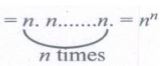
10.
No. of ways of giving I prize = n
No. of ways of giving II prize = n
.............................................
Similarly no. of ways of giving nth prize = n
Therefore By fundamental principle of counting, the required number of ways
11.
The given lines are
2x - 5y + 3 = 0
5x - 9y + \(\lambda \) = 0
x - 2y + 1 = 0
The condition for the lines to be concurrent is
\(\left| \begin{matrix} 2 & -5 & 3 \\ 6 & -9 & \lambda \\ 1 & -2 & 1 \end{matrix} \right| =0\quad \)
Expanding along R1 , we get
\(2\left| \begin{matrix} -9 & \lambda \\ -2 & 1 \end{matrix} \right| +5\left| \begin{matrix} 5 & \lambda \\ 1 & 1 \end{matrix} \right| +3\left| \begin{matrix} 5 & -9 \\ 1 & -2 \end{matrix} \right| =0\)
\(\Rightarrow 2(-9+2\lambda )+5(5-\lambda )+3(-10+9)=0\)
\(\Rightarrow -18+4\lambda +25-5\lambda -30+27=0\)
\(\Rightarrow -\lambda +4=0\Rightarrow \lambda =+4\)
12.
The two lines are x (2 + 6k) + y(3 - k) + 4 + 12k = 0
7x + 5y - 4 = 0
Let m1 and m2 be the slopes of the given lines.
Then m1=\(-\frac { { \text {Co-efficient of y} } }{ \text {Co-efficient of y }} =\frac { -(2+6k) }{ 3-k } \)
\(\\ and\ { m }_{ 2 }=\frac { -7 }{ 5 } \)
Since the given lines are perpendicular,
\(-\left( \frac { 2+6k }{ 3-k } \right) \left( \frac { -7 }{ 5 } \right) =-1\)
\(\Rightarrow 7(2+6k)=-5(3-k)\)
\(\Rightarrow 14+42k=-15+5k\)
\(\Rightarrow 37k=-29\)
\(\Rightarrow k=\frac { -29 }{ 37 } \)
13.
Solution: Let p (x1,y1) be any point on the locus, such that the square of its distance from A (3, -2) is equal to its distance from 5x - 12y = 13.
\(\therefore\) (x1 - 3)2 + (y1 + 2)2 = \(\frac { \left| { 5x }_{ 1 }-12{ y }_{ 1 }+13 \right| }{ \sqrt { { 5 }^{ 2 }+{ \left( -12 \right) }^{ 2 } } } \)
⇒ 13[(x1 - 3)2 + (y1 + 2)2] = 土(5x1 - 12y1 + 13)
⇒ 13(x12 - 6x1 + 9 + y12 + 4 + 4y1) = 士(5x1 - 12y1 + 13)
Case (i)
⇒ 13(x12 + y12 - 6x1 + 4y1 + 13) = 5x1 - 12y1 + 13
⇒ 13x12 + 13y12 - 83x1 + 64y1 + 182 = 0
Case (ii)
13(x12 + y12 - 6x1 + 4y1 + 13) = -(5x1 - 12y1 + 13)
13x12 + 13y12 - 73x1 + 40y1 + 156 = 0
\(\therefore\) Locus of (x1, y1) is 13x2 + 13y2 - 83x + 64y + 182 = 0 (or) 13x2 + 13y2 - 73x + 40y + 156 = 0
14.
Let P(x1, y1) be any point on the locus and let A(0, 2) B(0, -2) be the fixed points.
By the given condition, PA + PB =6
\(\Rightarrow \sqrt { { \left( { x }_{ 1 }-0 \right) }^{ 2 }+{ \left( { y }_{ 1 }-2 \right) }^{ 2 } } +\sqrt { { ({ x }_{ 1 }-0 })^{ 2 }+{ ({ y }_{ 1 }+2) }^{ 2 } } =6\)
\(\Rightarrow \sqrt { { x }_{ 1 }^{ 2 }+{ ({ y }_{ 1 }-2) }^{ 2 } } =6-\sqrt { { x }_{ 1 }^{ 2 }+{ ({ y }_{ 1 }+2) }^{ 2 } } \)
Squaring both sides we get,
\({ x }_{ 1 }^{ 2 }+{ ({ y }_{ 1 }-2) }^{ 2 }=36-12\sqrt { { x }_{ 1 }^{ 2 }+({ y }_{ 1 }+2)^{ 2 } } +{ x }_{ 1 }^{ 2 }+{ ({ y }_{ 1 }+2) }^{ 2 }\)
\(\Rightarrow \quad { x }_{ 1 }^{ 2 }+{ y }_{ 1 }^{ 2 }+4-4{ y }_{ 1 }=36-12\sqrt { { x }_{ 1 }^{ 2 }+{ ({ y }_{ 1 }+2) }^{ 2 } } +{ x }_{ 1 }^{ 2 }+{ y }_{ 1 }^{ 2 }+4+4{ y }_{ 1 }\)
\(\Rightarrow \quad { x }_{ 1 }^{ 2 }+{ y }_{ 1 }^{ 2 }+4-4{ y }_{ 1 }-36-{ x }_{ 1 }^{ 2 }-{ y }_{ 1 }^{ 2 }-4-4{ y }_{ 1 }=-12\sqrt { { x }_{ 1 }^{ 2 }+{ ({ y }_{ 1 }+2) }^{ 2 } } \)
= -8y1 - 36 = -12 \(\sqrt { { x }_{ 1 }^{ 2 }+{ ({ y }_{ 1 }+2) }^{ 2 } } \)
= 2y1 + 9 = 3\(\sqrt { { x }_{ 1 }^{ 2 }+{ ({ y }_{ 1 }+2) }^{ 2 } } \)
Squaring again we get,
(2y1+9)2 = 9[\({ x }_{ 1 }^{ 2 }+({ y }_{ 1 }+2)^{ 2 }]\)
\(\Rightarrow 4{ y }_{ 1 }^{ 2 }+81+36{ y }_{ 1 }=9[{ x }_{ 1 }^{ 2 }+{ y }_{ 1 }^{ 2 }+4+4{ y }_{ 1 }]\)
\(\Rightarrow 4{ y }_{ 1 }^{ 2 }+81+36{ y }_{ 1 }-9{ x }_{ 1 }^{ 2 }-9{ y }_{ 1 }^{ 2 }-36-36{ y }_{ 1 }=0\)
\(\Rightarrow -9{ x }_{ 1 }^{ 2 }-5{ y }_{ 1 }^{ 2 }+45=0\)
\(\Rightarrow 9{ x }_{ 1 }^{ 2 }+5{ y }_{ 1 }^{ 2 }=45\)
\(\therefore \) Locus of (x1 , y1) is 9x2 + 5y2 = 45
15.
Slope of the line 3x-y+5=0 is
\(\Rightarrow \quad { m }_{ 2 }=-\frac { co-efficient\quad of\quad x }{ co-efficient\quad of\quad y } =\frac { -3 }{ -1 } =3\)
Let m1 = m and \(\theta =45\)
\(\therefore \quad tan\theta =\left| \frac { { m }_{ 1 }-{ m }_{ 2 } }{ 1+{ m }_{ 1 }{ m }_{ 2 } } \right| \)
\(\Rightarrow \quad tan\quad 45=\left| \frac { m-3 }{ 1+3m } \right| \)
\(\Rightarrow \quad 1=\left| \frac { m-3 }{ 1+3m } \right| \)
\(\Rightarrow \quad 1|1+3m|=|m-3|\)
\(\Rightarrow \quad 1+3m=\pm (m-3)\)
\(\Rightarrow \quad 1+3m=m-3\quad or\quad 1+3m=-m+3\)
\(\Rightarrow\) 2m = - 4 or 4m = 2
\(\Rightarrow \) m = - 2 or \(m=\frac { 2 }{ 4 } =\frac { 1 }{ 2 }\)
\(\therefore \) m = - 2 or \(\frac { 1 }{ 2 } \)
Part A
Multiple Choice Question
16.
\(\text {Co-factor of }-7=\left|\begin{array}{cc} 2 & -3 \\ 6 & 0 \end{array}\right|=0+18=18\)
17.
(b)
-\(\triangle\)
18.
(c)
a2b2c2
19.
(Corresponding co-factor)
20.
x + y = n
3 + 2 = 5 = n
nC4 = 5C4 = 5C1 = 5
21.
nP2 = 20
n(n - 1) = 5 x 4
n = 5
22.
(c)
8!
23.
(c)
24.
(c)
(1, -1 )
25.
(d)
1
Part D
Answer All Questions
26.
Given A \(=\begin{bmatrix} 1&1&1\\3&4&7\\1&-1&1 \end{bmatrix}\)
\(=(4+7)-1(3-7)+1(-3-4)\)
\(=11+4-7=8\)
\(\text {Co-factor matrix }=\left(\begin{array}{ccc} 11 & 4 & -7 \\ -2 & 0 & +2 \\ 3 & -4 & 1 \end{array}\right)\)
\(\operatorname{adj} A=\left(\begin{array}{ccc} 11 & -2 & 3 \\ 4 & 0 & -4 \\ -7 & 2 & 1 \end{array}\right)\)
\(\mathrm{A}(\operatorname{adj} A)=\left(\begin{array}{ccc} 1 & 1 & 1 \\ 3 & 4 & 7 \\ 1 & -1 & 1 \end{array}\right)\left(\begin{array}{ccc} 11 & -2 & 3 \\ 4 & 0 & -4 \\ -7 & 2 & 1 \end{array}\right)\)
\(=\left(\begin{array}{ccc} 11+4-7 & -2+0+2 & 3-4+1 \\ 33+16-49 & -6+0+14 & 9-16+7 \\ 11-4-7 & -2+0+2 & 3+4+1 \end{array}\right)\)
\(=\left(\begin{array}{lll} 8 & 0 & 0 \\ 0 & 8 & 0 \\ 0 & 0 & 8 \end{array}\right)=8\left(\begin{array}{lll} 1 & 0 & 0 \\ 0 & 1 & 0 \\ 0 & 0 & 1 \end{array}\right)=|A| I_3\)
\((adj\ A)\ A=\begin{bmatrix}11&-2&3\\4&0&-4\\-7&2&1\end{bmatrix}\begin{bmatrix} 1&1&1\\3&4&7\\1&-1&1 \end{bmatrix}\)
\(=\begin{bmatrix} 11-6+3&11-8-3&11-14+3\\4+0-4&4+0+4&4+0-4\\-7+6+1&-7+8-1&-7+14+1 \end{bmatrix}=\begin{bmatrix} 8&0&0\\0&8&0\\0&0&8 \end{bmatrix}\) ...(2)
\(|A|.{I}_{3}=8\begin{bmatrix}1&0&0\\0&1&0\\0&0&1 \end{bmatrix}=\begin{bmatrix} 8&0&0\\0&8&0\\0&0&8\end{bmatrix}\) ...(3)
From (1), (2) and (3)
A (adj A) = (adj A) A = |A|I3.
27.
\(A=\left(\begin{array}{ccc} 3 & -1 & 1 \\ -15 & 6 & -5 \\ 5 & -2 & 2 \end{array}\right)\)
\(|A|=3(12-10)+1(-30+25)+1(30-30)\)
\(=6-5=1 \neq 0\)
\(\therefore A^{-1} \text { exists }\)
\(\text {Co-factor matrix }=\left(\begin{array}{ccc} 2 & 5 & 0 \\ 0 & 1 & 1 \\ -1 & 0 & 3 \end{array}\right)\)
\(A^{-1}=\frac{1}{|A|} \operatorname{adj} A=\left(\begin{array}{ccc} 2 & 0 & -1 \\ 5 & 1 & 0 \\ 0 & 1 & 3 \end{array}\right)\)
28.
Compare the equation
12x2 - 10xy + 2y2 + 14x - 5y + 2 = 0 with
ax2 + 2hxy + by2 + 2gx + 2fy + c = 0
We get a = 12, 2h = -10, b = 2, 2g = 14, 2f = -5
\(h=-5\quad g=7\quad f=-\frac { 5 }{ 2 } ,c=2\)
\(\left|\begin{array}{lll} a & h & g \\ h & b & f \\ g & f & c \end{array}\right|=\left|\begin{array}{ccc} 12 & -5 & 7 \\ -5 & 2 & \frac{-5}{2} \\ 7 & \frac{-5}{2} & 2 \end{array}\right|\)
\(=12\left(4-\frac{25}{4}\right)+5\left(-10+\frac{35}{2}\right)+7\left(\frac{25}{2}-14\right)\)
\(=48-75-50+\frac{175}{2}+\frac{175}{2}-98\)
= -175 + 175 = 0
Hence the given equations represent a pair of straight lines.
To find separate equation
\(12 x^2-10 x y+2 y^2 =12 x^2-6 x y-4 x y+2 y^2 \)
\(=6 x(2 x-y)-2 y(2 x-y) \)
\(=(6 x-2 y)(2 x-y)\)
\(12 x^2-10 x y+2 y^2+ 14 x-5 y+2 =(6 x-2 y+l)(2 x-y+\mathrm{m})\)
Comparing the coefficient of x and y
14 = 6m + 2l
divided by 2
7 = 3m + l .........(1)
-5 = -2m - l .......(2)
Solving (1) and (2) we get m = 2, 1 = 1
The separate equations are
6x - 2y + 1 = 0
2x - y + 2 = 0
29.
\(\frac{5 x^2-8 x+5}{(x-2)\left(x^2-x+1\right)}=\frac{A}{x-2}+\frac{B x+C}{x^2-x+1}\)
\(\frac{5 x^2-8 x+5}{(x-2)\left(x^2-x+1\right)} =\frac{A\left(x^2-x+1\right)+(B x+C)(x-2)}{(x-2)\left(x^2-x+1\right)}\)
\(\Rightarrow\) 5x2 - 8x + 5 = A (x2 - x + 1) + (Bx + C) (x - 2) ...(1)
Substituting x = 2 in (1) we get,
20 - 16 + 5 = A (4 - 2 + 1)
\(\Rightarrow\) 9 = A ( 3 )\(\Rightarrow\) \(A={{9}\over3{}}\) \(\Rightarrow\) \({A=3}\)
Equating the co-efficient of x2 in (1) we get,
5 = A + B
\(5=3+B \Rightarrow B=2\)
\(\text {If } x=0\)
\(5=A-2 C\)
\(\Rightarrow\) 5 = 3 - 2C
\(\Rightarrow\) 2 = - 2C
\(\Rightarrow\) c = -1
\(\therefore\) \({{5x^2-8x+5}\over{(x-2)(x^2-x+1)}}={{3}\over{x-2}}+{{2x-1}\over{x^2-x+1}}\)
30.
To show that A is inverse of A itself it is enough if, we prove that
\(A . A=I \left(\because \mathrm{AA}^{-1}=\mathrm{I}\right. and \left.\mathrm{A}^{-1}=\mathrm{A}\right)\)
\(A \cdot A=\left(\begin{array}{ccc} -1 & 2 & -2 \\ 4 & -3 & 4 \\ 4 & -4 & 5 \end{array}\right)\left(\begin{array}{ccc} -1 & 2 & -2 \\ 4 & -3 & 4 \\ 4 & -4 & 5 \end{array}\right)\)
\(=\left(\begin{array}{ccc} 1+8-8 & -2-6+8 & 2+8-10 \\ -4-12+16 & 8+9-16 & -8-12+20 \\ -4-16+20 & 8+12-20 & -8-16+25 \end{array}\right)\)
\(=\left(\begin{array}{lll} 1 & 0 & 0 \\ 0 & 1 & 0 \\ 0 & 0 & 1 \end{array}\right)=I\)
\(\therefore \mathrm{A} \text { is inverse of } \mathrm{A}\)
31.
Given matrix A is singular, if |A| = 0
\(|A|=\begin{vmatrix} x+1&-3&4\\-5&x+2&2\\4&1&x-6 \end{vmatrix}=0\)
Expanding along R1 we get,
\(|A|=x+1\begin{vmatrix}x+2 & 2 \\ 1 & x-6 \end{vmatrix}+3\begin{vmatrix} -5 & 2 \\ 4 & x-6 \end{vmatrix}+4\begin{vmatrix}-5 & x+2 \\ 4 & 1\end{vmatrix}=0\)
\(\Rightarrow\) (x + 1)[(x + 2)(x - 6) - 2] + 3[-5 (x - 6) - 8] + 4 [-5 - 4 (x + 2)] = 0
\(\Rightarrow\) (x + 1) [x2 - 4x - 12 - 2] + 3[-5x + 30 - 8] + 4 [-5 - 4x - 8] = -0
\(\Rightarrow\) (x + 1)(x2 - 4x - 14) + 3(-5x + 22) + 4(-4x - 13) = 0
\(\Rightarrow\) x3 - 4xl - 14x + xl - 4x - 14 - 15x + 66 - 16x - 52 = 0
\(\Rightarrow\) x3 - 3x2 - 49x = 0
\(\Rightarrow\) x(x2 - 3x - 49) = 0
\(\Rightarrow\) \(x=0\ or\ x={{3\pm\sqrt{{(-3)}^{2}}-4(1)(-49)}\over{2a}}\)
\(\begin{bmatrix} \because\ x = {-b \pm \sqrt{b^2-4ac} \over 2a},a = 1, b = -3, c=-49 \end{bmatrix}\)
\(\Rightarrow\) \(x=0\ or\ x={{3\pm\sqrt{9+196}}\over{2}}\)
\(\Rightarrow\) \(x=0\ or\ x={{3\pm\sqrt{205}}\over{2}}\)
32.
\(3 x-y+2 z=13 ; 2 x+y-z=3\)
\(x+3 y-5 z=-8\)
The given system can be written as
\(\left(\begin{array}{ccc} 3 & -1 & 2 \\ 2 & 1 & -1 \\ 1 & 3 & -5 \end{array}\right)\left(\begin{array}{l} x \\ y \\ z \end{array}\right)=\left(\begin{array}{c} 13 \\ 3 \\ -8 \end{array}\right)\)
\(A X=B \Rightarrow X=A^{-1} B\)
\(\text {Where } A=\left(\begin{array}{ccc} 3 & -1 & 2 \\ 2 & 1 & -1 \\ 1 & 3 & -5 \end{array}\right), X=\left(\begin{array}{l} x \\ y \\ z \end{array}\right)\)
\(B=\left(\begin{array}{c} 13 \\ 3 \\ -8 \end{array}\right)\)
\(|A|=3(-5+3)+1(-10+1)+2(6-1)\)
\(=-6-9+10=-5 \neq 0\)
\(\therefore A^{-1} exists\)
\(\mathrm{A}_{11}=\text {Co-factor of } 3=(-5+3)=-2 \)
\(\mathrm{A}_{12}=\text {Co-factor of }-1=-(-10+1)=9 \)
\(\mathrm{A}_{13}=\text {Co-factor of } 2=(6-1)=5\)
\(\mathrm{A}_{21}=\text { Co-factor of } 2=-(5-6)=1\)
\(\mathrm{A}_{22}=\text { Co-factor of } 1=-15-2=-17 \)
\(\mathrm{A}_{23}=\text { Co-factor of }-1=-(9+1)=-10\)
\(\mathrm{A}_{31}=\text {Co-factor of } 1=1-2=-1\)
\(\mathrm{A}_{32}=\text {Co-factor of } 3=-(-3-4)=7 \)
\(\mathrm{A}_{33}=\text {Co-factor of }-5=3+2=5\)
\(\text {Co-factor matrix }=\left(\begin{array}{ccc} -2 & 9 & 5 \\ 1 & -17 & -10 \\ -1 & 7 & 5 \end{array}\right)\)
\(A^{-1}=\frac{1}{|A|} \operatorname{adj} A=\frac{1}{-5}\left(\begin{array}{ccc} -2 & 1 & -1 \\ 9 & -17 & 7 \\ 5 & -10 & 5 \end{array}\right)\)
\(X=A^{-1} B=\frac{-1}{5}\left(\begin{array}{ccc} -2 & 1 & -1 \\ 9 & -17 & 7 \\ 5 & -10 & 5 \end{array}\right)\left(\begin{array}{c} 13 \\ 3 \\ -8 \end{array}\right)\)
\(=\frac{-1}{5}\left(\begin{array}{ccc} -26 & 3 & 8 \\ 117 & -51 & -56 \\ 65 & -30 & -40 \end{array}\right)\)
\(=\frac{-1}{5}\left(\begin{array}{c} -15 \\ 10 \\ -5 \end{array}\right)\)
\(\left(\begin{array}{l} x \\ y \\ z \end{array}\right)=\left(\begin{array}{c} 3 \\ -2 \\ 1 \end{array}\right)\)
\(x=3, \mathrm{y}=-2, \mathrm{z}=1\)
33.
(y - 2)2 = 4(x - 1).
\(\Rightarrow\) y2 = 4x where X = x - 1 and Y = y - 2. \(\Rightarrow\) 4a = 4 \(\Rightarrow\) a = 1
| Referred to (x, y) | Referred to (x,y) x = x + 1, y = y + 2 | ||
| (i) | Axis | X-axis \(\Rightarrow\) y = 0 | y - 2 = 0 \(\Rightarrow\) y = 2 |
| (ii) | Vertex | (0,0) | (1,2) |
| (iii) | Focus(0,0) | (A, 0)(1,0) | (2,2) |
| (iv) | Equation of directrix | X = -a X = -1 |
x-1 = -1 \(\Rightarrow\) x = 0 |
| (v) | Length of latus rectum | 4a = 4 | 4 |
Part B
Answer All Questions
34.
Given \(A=\begin{bmatrix}2&3\\1&4 \end{bmatrix}\)
\(Adj\ A=\begin{bmatrix}4&-3\\-1&2 \end{bmatrix}\)
35.
Let \(|A|=\begin{vmatrix} 2&-1&-2 \\ 0 &2&-1\\3&-5&0 \end{vmatrix}\)
Expanding along R1 we get,
\(|A|=2\begin{vmatrix} 2 & -1\\ -5 & 0\end{vmatrix}+1\begin{vmatrix} 0 & -1 \\ 3 & 0 \end{vmatrix}-2\begin{vmatrix} 0 & 2 \\ 3 & -5 \end{vmatrix}\)
= 2 ( 0 - 5 ) + 1 ( 0 + 3 ) - 2 ( 0 - 6 )
= - 10 + 3 + 12 = 5
\(\therefore\) |A| = 5.
36.
Given \(\begin{vmatrix}2 & 4 \\5 & 1 \end{vmatrix}=\begin{vmatrix} 2x & 4 \\ 6 & x \end{vmatrix}\)
\(\Rightarrow\) 2 - 20 = 2x2 - 24
\(\Rightarrow\) -18 = 2x2 - 24
\(\Rightarrow\) -18 + 24 = 2x2
\(\Rightarrow\) 6 = 2x2
\(\Rightarrow\) x2 = 3
\(\Rightarrow\) x = \(\pm\sqrt{3}\)
37.
Let |A| = \(\begin{vmatrix} 6 &5 &12 \\ 2 & 4 &4 \\2 & 1 & 4 \end{vmatrix}\)
Taking 2 common from C1 and 4 common from C3, we get,
\(|A|=2\times4\begin{vmatrix} 3 & 5&3 \\ 1 & 4 & 1\\1 &1 &1\end{vmatrix}=8\times 0\ [\because C_1\equiv C_3]=0\)
38.
LHS = 8C4+8C3
\(=\frac{8 \times 7 \times 6 \times 5}{4 \times 3 \times 2 \times 1}+\frac{8 \times 7 \times 6}{3 \times 2 \times 1}\)
\(=70+56=126\)
\(\mathrm{RHS}=9 C_4=\frac{9 \times 8 \times 7 \times 6}{4 \times 3 \times 2 \times 1}\)
\(=126\)
Hence verified
39.
\(\frac { 7! }{ 6! } =\frac { 7\times 6! }{ 6! } =7\)
40.
LHS 10P3 = 10 x 9 x 8 = 720
RHS 9P3 + 3. 9P2 = 9 x 8 x 7 + 3 x 9 x 8
= 9 x 8 (7 + 3) = 72 (10) = 720
LHS= RHS Hence proved.
41.
nCx = nCy \(\Rightarrow\)x= y or x + y = n
\(\Rightarrow\) \(\therefore\) 25 Cn+5 = 25 C2n-1
\(\Rightarrow\) n + 5 = 2n-1
\(\Rightarrow\) n =5 (or) n + 5 + 2n - 1 = 25
\(\Rightarrow\) 6 = 2n - n or 3n + 4 = 25
\(\Rightarrow\) n= 6 or 3n = 21\(\Rightarrow\) n=7
∴ n = 6 or n = 7

11th Standard Syllabus & Materials
11th Standard
Tamilnadu 11th Standard Tamil பீடு பெற நில் - செய்யுள் - காவடிச்சிந்து Important Questions And Answers Study Material - QB365 Set A
NEW11th Standard
Tamilnadu 11th Standard Tamil பீடு பெற நில் - உரைநடை - மலை இடப்பெயர்கள் : ஓர் ஆய்வு Important Questions And Answers Study Material - QB365 Set B
NEW11th Standard
Tamilnadu 11th Standard Tamil பீடு பெற நில் - உரைநடை - மலை இடப்பெயர்கள் : ஓர் ஆய்வு Important Questions And Answers Study Material - QB365 Set A
NEW11th Standard
Tamilnadu 11th Standard Tamil மாமழை போற்றுதும் - செய்யுள் - ஐங்குறுநூறு Important Questions And Answers Study Material - QB365 Set B



Tamilnadu Stateboard 11th Standard Subjects

Maths

Commerce

Economics

Biology
Business Maths and Statistics

Accountancy

Computer Science

Physics

Chemistry
Maths
Biology
Economics
Physics
Chemistry

History
Business Maths and Statistics

Computer Science
Accountancy

Computer Applications
History
Computer Technology
Commerce
Computer Applications
Computer Technology

Tamil

English

French
Tamilnadu Stateboard Standards
